How do you find Polaris and true north in the night sky?
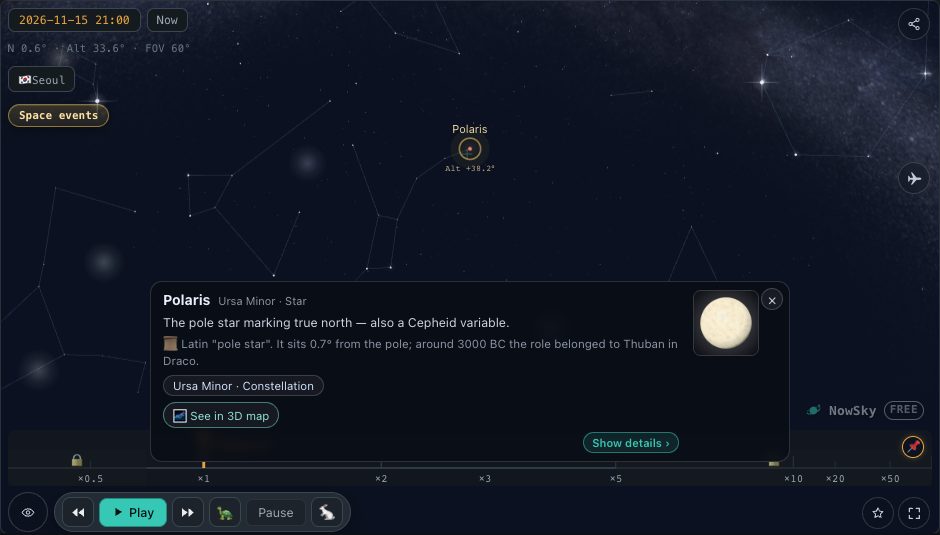
In the Northern Hemisphere, Polaris sits within about a degree of the north celestial pole, so the point on the horizon directly below it marks true north. Extend the line through the two end stars of the Big Dipper's bowl about five times their separation and you reach it; when the Dipper is low, the W of Cassiopeia does the same job. South of the equator Polaris is out of sight, and the Southern Cross is used instead.
Why Polaris marks north
As Earth spins on its axis, every star appears to circle around the point where that axis, extended, meets the sky. This point is the north celestial pole. Polaris lay about 0.66 degrees from it in 2018, close enough that it seems to stay put all night while everything else turns.
Polaris is often assumed to be the brightest star in the sky, but it shines at about magnitude 2 and ranks only around 47th in brightness. It is easy to see even from a city, yet nothing about it stands out at first glance, because no other bright star sits nearby. For that reason observers locate it by following well-known patterns rather than by searching for it directly.
Polaris has not always been the pole star. Earth's axis slowly traces a circle over about 26,000 years, a motion called precession, and the celestial pole moves with it. Polaris will come closest to the pole, about 0.45 degrees, soon after the year 2100. In roughly 12,000 years the bright star Vega will take over the role.
Following the Big Dipper's pointer stars
The Big Dipper is a group of seven bright stars within the constellation Ursa Major; in Britain it is often called the Plough. The two stars at the outer end of its bowl, Merak and Dubhe, are known as the Pointers. Draw a line from Merak through Dubhe and extend it about five times the gap between them, and you arrive at Polaris.
The method works whatever the Dipper's orientation. Because the whole pattern circles the pole once a day, the bowl can appear upright, upside down or on its side depending on the hour and the season. The Pointers, however, always point toward Polaris.
For observers in the mid-northern latitudes, such as New York at about 40.7 degrees north or London at 51.5 degrees north, the Dipper rides high on spring evenings and sits low over the northern horizon on autumn evenings. Following the curve of its handle onward leads to Arcturus, the bright star of Boötes, a useful starting point for the spring sky.
 ▶ Open in the simulator
 When the Dipper is low: using Cassiopeia
The five brightest stars of Cassiopeia form a W, or an M, depending on how it is turned. Cassiopeia lies on roughly the opposite side of Polaris from the Big Dipper, so on autumn and early-winter evenings, when the Dipper skims the northern horizon, Cassiopeia stands high. Polaris sits roughly halfway between the two patterns.
A common technique is to extend the two outer strokes of the W until they meet, then draw a line from that meeting point through the middle star of the W and carry it onward. The line leads to a lone star of similar brightness with no bright neighbours: Polaris.
From latitudes above about 34 degrees north, Cassiopeia never sets. For observers across most of Europe, Canada and the northern United States, this means that on any clear night either the Dipper or Cassiopeia, and often both, will be somewhere in the northern sky to guide you.
Polaris's altitude equals your latitude
The altitude of Polaris, its angle above the horizon, is almost exactly equal to the observer's latitude. Stand at the North Pole and Polaris is overhead at 90 degrees; stand on the equator and it lies on the horizon at 0 degrees. Everywhere in between, it sits as high as your latitude.
From New York, at about 40.7 degrees north, Polaris stands roughly 41 degrees above the northern horizon; from London, at 51.5 degrees north, it stands about 51 degrees up. Travel south and it sinks; travel north and it climbs. Navigators used this relationship for centuries to estimate their latitude at sea simply by measuring how high the pole star stood.
In the Sky view, selecting Polaris shows its current altitude. Change the observing location to another city and the pole star's height changes with latitude; move to a Southern Hemisphere city and Polaris drops below the horizon altogether.
The nightly circling of the stars
Because Earth rotates from west to east, stars rise in the east and set in the west. Watch the northern sky for a while and the stars turn slowly anticlockwise around Polaris. Earth completes one rotation relative to the stars in about 23 hours 56 minutes 4 seconds, so the sky turns by about 15 degrees each hour.
Stars close to Polaris trace small circles and never dip below the horizon. These are circumpolar stars, and the rule is simple: any star whose angular distance from the visible pole is less than your latitude never sets. The farther from the equator you are, the more circumpolar stars you have; on the equator there are none.
Because that rotation is about four minutes shorter than the 24-hour solar day, each star rises roughly four minutes earlier every night. Over a month this adds up to about two hours, and over a year it is why different constellations fill the evening sky in different seasons. Speeding up time in the Sky view shows the whole northern sky wheeling around the pole.
In the Southern Hemisphere: the Southern Cross
From the Southern Hemisphere, Polaris is below the horizon. The star nearest the south celestial pole, Sigma Octantis, is only about magnitude 5.4, barely visible to the naked eye even from a dark site, and it lies a little more than a degree from the pole, so it is of little practical use.
Instead, observers use Crux, the Southern Cross. It is the smallest of the 88 constellations, but its bright stars form a compact, easily recognised cross. Draw a line along the long axis of the cross, from Gamma Crucis through Alpha Crucis, and extend it about four and a half times its length; this brings you close to the south celestial pole. The two bright stars Alpha and Beta Centauri nearby act as pointers that lead the eye to the Cross.
Crux is visible from latitudes south of about 20 degrees north. South of about 34 degrees south it never sets, so from Cape Town it is always up, and from Sydney it stays above the horizon for most of the night. As in the north, the altitude of the south celestial pole equals the observer's latitude, so from Sydney the pole lies about 34 degrees above the southern horizon.
Try it in the simulator
- See Polaris tonight →Shows Polaris from your location, with its direction and altitude.
- Check the Big Dipper →Shows where Ursa Major stands around the pole tonight.
- Find Cassiopeia's W →Shows Cassiopeia on the far side of Polaris from the Dipper.
FAQ
- Is compass north the same as the direction of Polaris?
- No. A compass points to magnetic north, while Polaris marks true north, the direction of Earth's rotation axis. The difference varies from place to place, and where it matters, Polaris gives the closer approximation to true north.
- Does Polaris move at all during the night?
- Yes, slightly. Because it lies about 0.66 degrees from the pole, Polaris traces a tiny circle each day. The circle is too small to notice by eye, but it shows up as a short arc in long-exposure star-trail photographs.
- How do you find direction near the equator?
- Near the equator Polaris hangs very low over the northern horizon, while the Southern Cross is visible in the south. With a clear horizon, both guides can be used.
Related reading
- Object Polaris
- Object Ursa Major
- Object Cassiopeia
- Object Ursa Minor
- Guide How do you start stargazing with just your eyes?