BepiColombo enters Mercury orbit
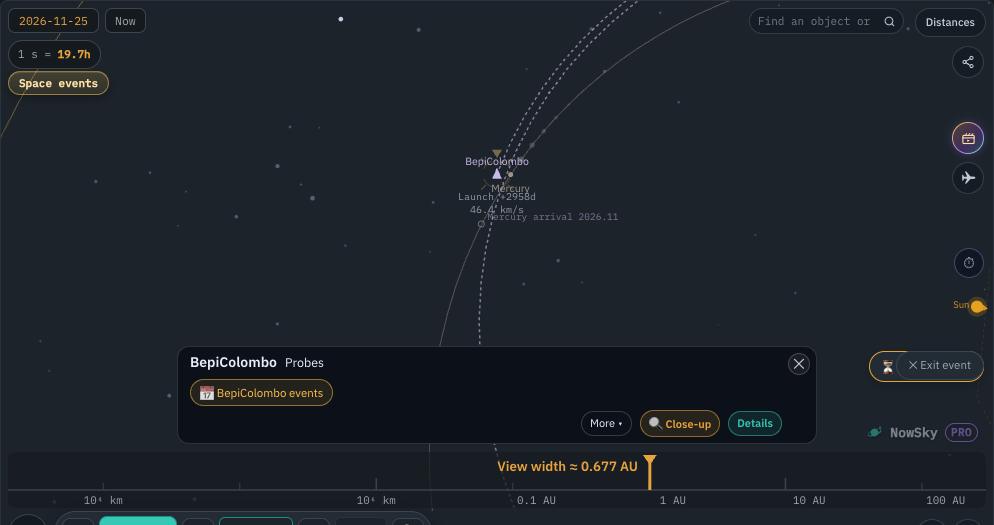
After eight years and nine flybys, the European–Japanese spacecraft BepiColombo begins entering orbit around Mercury on 21 November 2026, with a series of burns shaping the orbit until March 2027. The orbit view recreates the whole inward, spiral-like route to Mercury.
📍 Visible from where you are right now — computed in your browser

 ▶ Open this scene in the simulator
 Available views: Orbit ✓ · Sky — (not visible in the sky)
The story
BepiColombo is a Mercury mission built jointly by the European Space Agency (ESA) and the Japan Aerospace Exploration Agency (JAXA). It left Earth in October 2018 and has been flying for nearly eight years, making nine flybys along the way: one of Earth, two of Venus and six of Mercury. The trip takes so long for a simple reason. Anything heading toward the Sun speeds up on its own, so to be captured by Mercury a spacecraft must get rid of that extra speed.
Getting rid of speed is the heart of the mission's design. During the cruise, ion engines powered by solar panels push gently against the direction of travel for months at a time, working like a soft brake. The bigger slowdowns come from flybys of planets. Each flyby tightens the orbit a little further toward the Sun, and the place where that tightening finally ends is an orbit around Mercury. Moving the orbit view to the time of orbit insertion draws the entire eight-year path winding in toward Mercury on a single screen.
Once it is in orbit around Mercury, the spacecraft that flew out as one stack splits in two. ESA's Mercury Planetary Orbiter (MPO) studies the surface and interior from a low orbit, while JAXA's Mio studies the magnetic field and the charged particles around the planet from a longer, stretched-out orbit. With two orbiters watching the same planet from different heights at the same time, scientists can compare what happens on the ground with what happens in the space around it.
The schedule has not been smooth. In May 2024 the ion engines could not deliver their full power, and arrival slipped about 11 months from December 2025. On 3 September 2026 the Mercury Transfer Module (MTM), which had pushed the spacecraft with its ion engines for eight years, separated. MPO's own thrusters, which now move the spacecraft, were test-fired for the first time on 24 September. Orbit insertion begins on 21 November and takes a series of burns through March 2027; along the way, on 9–10 December, MPO and Mio separate. Full science observations are planned to start in April 2027.
Mission goals
Mercury is the hardest of the inner planets to explain. It is far too heavy for its size, and a metal core takes up most of the planet. Where its outer rocky layers went is still unknown. Some scientists think a giant impact stripped them away; others think the planet formed that way from the start, in the hot region close to the Sun. Which idea is right changes our understanding of how planets form.
Mercury also has a magnetic field, which is surprising for a small, old planet. The space this field carves out of the stream of particles blowing from the Sun looks like a small version of Earth's, but it changes much faster. Mercury has almost no air, so particles from the Sun hit the ground directly, and the particles knocked loose form a very thin cloud around the planet. The core idea of the mission is for Mio to watch this process from space while MPO photographs the same surface at the same moment.
Another puzzle is ice. Mercury is the closest planet to the Sun, yet the floors of some craters near its poles never receive sunlight. Radar has picked up signals of what looks like water ice in those places. So a planet with daytime temperatures above 400 °C also seems to hold ice. BepiColombo will collect the data needed to find out what this material is and where it came from.
Mission chronology and background
Only two spacecraft have visited Mercury before. In the 1970s Mariner 10 flew past it three times and took the first pictures of nearly half its surface. Then no spacecraft visited for more than 30 years. In 2011 NASA's MESSENGER entered orbit around Mercury after a series of flybys and made the first map of the whole planet, and the evidence for ice at the poles grew much stronger from its data.
The mission is named after the Italian scientist Giuseppe 'Bepi' Colombo. He explained Mercury's unusual pattern of turning exactly three times on its axis for every two trips around the Sun. He also suggested planning Mariner 10's path so that it would meet Mercury again and again instead of passing it only once. The very method of designing paths for Mercury spacecraft is part of his legacy.
Once orbit insertion is complete, the main science work begins in April 2027. The two orbiters carry out a basic mission of about one year, which may be extended by another year if they stay healthy. Near the Sun, heat and radiation are intense, so how long they actually keep working depends on how well the spacecraft cope. The next big Mercury event visible from the ground is in November 2032, when Mercury passes across the face of the Sun.
Other milestones of this mission
Where to see it — sky and simulator
Orbit insertion is not something that can be seen in the sky. The spacecraft slows down quietly next to Mercury, and on Earth the event is confirmed only by radio signals. Instead, rewinding the orbit replay to autumn 2018 and running it forward quickly shows the orbit tightening step by step as the spacecraft passes Earth, Venus and Mercury in turn. Comparing the shape of the orbit just before and just after a flyby makes it clear what a gravity assist does.
Mercury itself can be seen with the naked eye. But it always stays close to the Sun in the sky, so it is visible only when it sits low in the east just before sunrise or low in the west just after sunset. From a place with an open horizon, it appears as a fairly bright yellowish point in the twilight. Pointing binoculars or a telescope in that direction while the Sun is above the horizon can seriously damage the eyes and must never be done.
News of the real mission comes from ESA and JAXA. The two agencies have issued status reports around major manoeuvres and have released close-up pictures from each Mercury flyby. Orbit insertion runs from 21 November to March 2027 in a series of burns, with the two orbiters separating on 9–10 December along the way. Following announcements over several months therefore matches the real sequence better than a single day of live coverage.
See this for yourself — replay the moment in the orbit view
FAQ
Can the orbit insertion be seen in the sky?
No. The spacecraft moves beside Mercury and the event is confirmed on Earth only by radio. The orbit replay recreates the eight-year cruise and its flybys step by step, while the agencies report on the real manoeuvre.
Why does it take so long to reach Mercury?
Anything heading toward the Sun speeds up on its own, so a spacecraft must shed that speed before Mercury can capture it. The mission spreads the work over many flybys and long periods of ion-engine thrust. The hard part of a trip to Mercury is not the distance but getting rid of speed.
What does it mean that the spacecraft splits in two?
BepiColombo flew as two orbiters joined in one stack. After reaching Mercury orbit they separate into ESA's MPO and JAXA's Mio and settle into different orbits. MPO studies the surface and interior, and Mio the magnetic field and surrounding particles, so the same planet is watched from two places at once.
How can Mercury be found with the naked eye?
It can be found low in the east just before sunrise or low in the west just after sunset. An open horizon is needed, and Mercury looks like a fairly bright yellowish point in the twilight. Turning binoculars toward it while the Sun is still up is dangerous.
Related
- BepiColombo launch (2018)
- The 2032 transit of Mercury
- JUICE arrives at Jupiter
- Mercury — object index
- BepiColombo — object index
- The Sun — object index
Times and figures are approximate — verify with official sources when planning travel. Simulation uses J2000 mean elements.