Sun
What is Sun?
Stars· Diameter 1,392,700 km · mass 333,000× Earth. The star at the centre of the solar system, holding 99.86% of its mass. Its light takes 8 minutes 19 seconds to reach Earth.
📍 Visible from where you are right now — computed in your browser
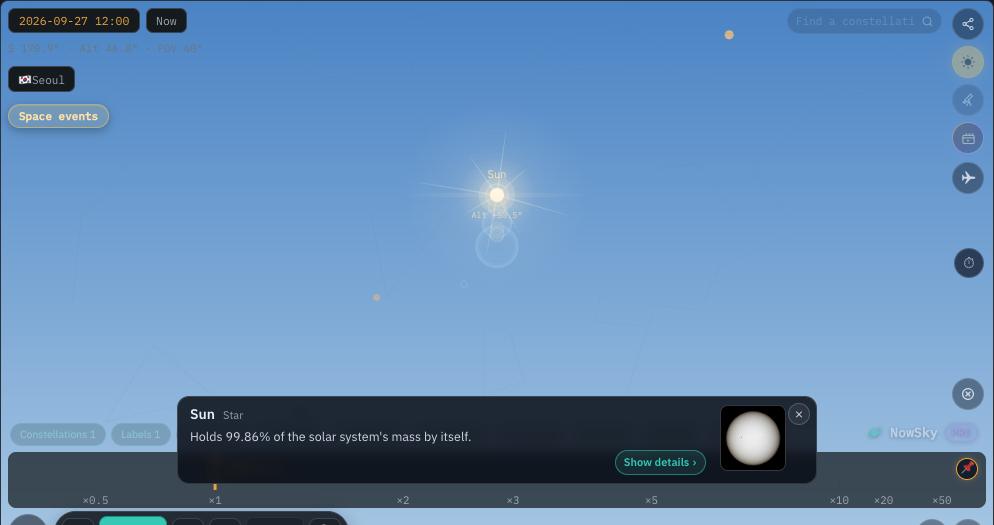 ▶ Open this view in the simulator
Stellar figures
| Diameter | 1,392,700 km |
|---|---|
| Mass | 333,000× Earth |
| Surface temp | 5,500 °C |
| Age | 4.6 Gyr |
Figures are representative approximations. Source: compiled from NASA and IAU public data.
Related events
1,361 watts per square metre — the solar constant
One square metre facing the Sun at Earth's distance receives 1,361 watts. This value is called the solar constant, and satellites above the atmosphere have measured it continuously since 1978. Over the Sun's 11-year activity cycle it changes by only about 0.1 percent. These measurements are one reason scientists conclude that recent global warming is not caused by the Sun getting brighter.
The Sun sends out more than light. A stream of electrically charged particles, the solar wind, flows from it constantly at 400 to 800 km/s. Sometimes magnetic fields near sunspots snap and hurl out huge clouds of particles that reach Earth a day or two later. They cause aurorae and, when strong, can damage power grids and satellites. During the Carrington event of 1859, aurorae were seen as far south as the Caribbean.
Light made at the Sun's centre takes a very long time to reach the surface. In the dense interior it is absorbed and given off again countless times, zigzagging its way out. The journey is calculated to take tens of thousands to hundreds of thousands of years. Neutrinos made by the same fusion hardly interact with matter at all, and escape the Sun in about two seconds.
The star in depth
The Sun holds 99.86% of all the mass in the solar system. The eight planets and all the asteroids and comets put together make up only the remaining 0.14%. The Sun is about 1.39 million km across, 109 times Earth's diameter, and about 1.3 million Earths would fit inside it. Every planet in the solar system is held by its enormous gravity.
The Sun's power comes from nuclear fusion at its centre. The core is hotter than 15 million degrees, hot enough for hydrogen nuclei to collide and fuse into helium. Each second about 600 million tonnes of hydrogen become helium, and about 4 million tonnes of mass turn into light and heat. Earth catches only one 2.2-billionth of that energy, yet it drives our weather and all life.
The visible surface is about 5,500 °C. The thin outer atmosphere around it, the corona, is over a million degrees. It is as if the air got hotter the farther you moved from a fire, and scientists still do not fully understand why. Sunspots, the dark patches on the surface, are places where strong magnetic fields block the flow of heat, leaving them about 1,500 °C cooler than their surroundings. Their number rises and falls over a cycle of about 11 years.
At about 4.6 billion years old, the Sun is roughly halfway through the long, steady stage in which it burns hydrogen. In about five billion years, when the hydrogen in its core runs out, it is expected to swell into a red giant and swallow Mercury and Venus. It will then shed its outer layers and remain as an Earth-sized white dwarf, slowly cooling.
Frequently asked
- How big is Sun?
- The diameter of Sun is 1,392,700 km.
- What is the mass of Sun?
- The mass of Sun is 333,000× Earth.
- In one line, what is Sun?
- Stars — The star at the centre of the solar system, holding 99.86% of its mass.
Related
Figures are representative approximations. Simulated positions use J2000 mean elements.