MMX launch — Martian moon sample return
JAXA's Martian Moons eXploration (MMX) is scheduled to launch on an H3 rocket on 19 October 2026 (UTC). It is the first attempt to land on the Martian moon Phobos and bring a sample back to Earth.
📍 Visible from where you are right now — computed in your browser

 ▶ Open this scene in the simulator
 Available views: Orbit ✓ · Sky — (not visible in the sky)
The story
MMX, short for Martian Moons eXploration, is a plan by the Japan Aerospace Exploration Agency (JAXA) to land on Phobos, a moon of Mars, scoop up material from its surface, and bring it back to Earth. The spacecraft is scheduled to launch on the tenth H3 rocket from the Yoshinobu launch complex at the Tanegashima Space Center in Japan, at 19:41:03 UTC on 19 October 2026. If it succeeds, it will return the first sample ever collected in the neighbourhood of Mars, with the capsule planned to land in Australia around 2031.
Phobos is small and unusual. It is about 22 km across on average and shaped like a battered potato. It orbits closer to the surface of its planet than any other moon in the solar system and goes around Mars in only about seven and a half hours, less than one Martian day. Its orbit is also slowly shrinking, and scientists expect that in the far future it will break apart, either falling onto Mars or forming a ring.
The spacecraft has three parts: a propulsion module that carries it to Mars, an exploration module that holds the instruments and makes the landing, and a return module that brings the sample capsule back to Earth. The plan is to spend a few years in orbit around Mars, study Phobos and the other moon, Deimos, land on Phobos to collect a sample, and then wait for the right time to head home. A small rover called IDEFIX, built by the French and German space agencies, rides along and will be placed on the surface before the main landing.
The launch date has already slipped once. MMX was first aimed at a 2024 launch, but problems with the H3 rocket pushed it back two years to 2026. Earth and Mars line up well for travel only about once every 26 months, so missing a chance means waiting about two years. The launch time is now set, and if weather or other problems cause a delay, a new attempt can be made within a backup period that runs to 7 November.
Mission goals
The biggest question is where Phobos came from. One idea is that Phobos and Deimos were asteroids passing near Mars that got captured. Another is that they formed from pieces thrown up when a large object struck Mars and then clumped back together. The two ideas describe completely different histories, and decades of telescope and spacecraft observations have not settled which is right.
A sample could bring the answer much closer. Tiny differences in the proportions of elements inside the grains act like a fingerprint showing where in the solar system the material formed. Laboratory instruments on Earth can measure these proportions far more precisely than any instrument that fits on a spacecraft. That is why the mission takes on the complicated job of bringing a sample home.
There may also be a bonus. Phobos is so close to Mars that material blasted off the planet by impacts is likely to have landed on it. If so, the MMX sample may contain a little Martian material along with the rock of Phobos itself.
Mission chronology and background
Exploring Phobos has a history of failure. The Soviet Phobos 1 and Phobos 2 probes of the late 1980s both failed to complete their missions: the first was lost because of a wrong command, and contact with the second was lost just before it moved in close to Phobos. Russia's Phobos-Grunt, launched in 2011 to return a sample, never left Earth orbit. No spacecraft has yet landed on Phobos.
Japan has experience bringing back samples from asteroids. Hayabusa returned grains from the asteroid Itokawa despite many breakdowns, and Hayabusa2 collected both surface and underground material from the asteroid Ryugu and delivered it to Australia as planned in 2020. MMX builds on that capsule design and experience to take on a harder target, a moon of Mars.
Japan is not the only country aiming to bring back samples from around Mars. China is preparing Tianwen-3 to return material from the surface of Mars, and the NASA–ESA Mars Sample Return plan is being reconsidered because of its cost. If the MMX capsule comes home, laboratory study will likely go on for years, as it has for the asteroid samples.
Where to see it — sky and simulator
Phobos cannot be seen with the naked eye, and even large telescopes struggle to pick it out from the glare of bright Mars. What can be watched is the launch. JAXA streams its launches live, usually with Japanese commentary and often with an English broadcast as well. Liftoff is set for 19:41 UTC on 19 October, but launches can be delayed by weather or technical issues, so the actual time is best taken from the announcements the day before and on launch day.
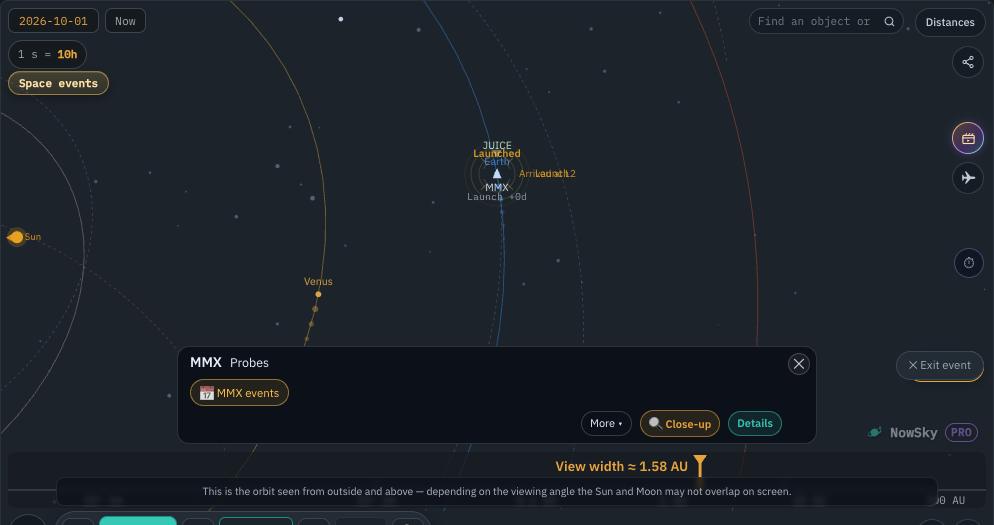
The orbit view shows the shape of the mission most clearly. Setting the date to launch reveals a long curve linking Earth and Mars. The trip is planned so that the spacecraft meets Mars on the day it arrives, not where Mars is on the day it leaves, so running the clock forward shows Mars catching up with the spacecraft.
After launch, the key moments are spread over several years: arrival and entry into orbit around Mars, a survey flying alongside Phobos to map it, the landing to collect the sample, and the engine burn that starts the trip home. The long quiet periods in between are normal for flights between planets.
See this for yourself — replay the moment in the orbit view
FAQ
Why land on a moon instead of Mars itself?
Because it takes far less fuel. Phobos's gravity is less than a thousandth of Earth's, so landing and taking off again need very little thrust, and with no atmosphere there is no need for entry equipment. Its soil may also contain material thrown off Mars by impacts.
Exactly when does it launch?
It is set for 19:41:03 UTC on 19 October 2026, which is 04:41 on 20 October in Japan. The rocket is the tenth H3, flying from the Yoshinobu launch complex at the Tanegashima Space Center. If weather or other problems force a delay, a new attempt can be made within a backup period that runs to 7 November. Chances to fly to Mars come only about every 26 months, so missing this period would mean waiting nearly two years.
Can I see Phobos through a telescope?
Not with the naked eye, and it is very hard even with a telescope, because Phobos orbits right next to the much brighter planet and is lost in its glare. It can only be attempted when Mars is close to Earth, with a large telescope and a way of blocking the planet's light.
When would the sample reach Earth?
If it launches in 2026 as planned, the sample is due to land in Australia around 2031. A later launch would delay the return by about the same amount.
Related
- Tianwen-3 — China's Mars sample return
- The Mars transfer window — a 26-month rhythm
- Perseverance — the rover that caches samples
- Phobos — object index
- Deimos — object index
- Mars — object index
Times and figures are approximate — verify with official sources when planning travel. Simulation uses J2000 mean elements.