Mars
What is Mars?
Planets· Diameter 6,779 km. A red desert world with the tallest known volcano in the solar system, Olympus Mons, and a canyon 4,000 km long. Rovers explore its surface today, and Japan's MMX is set to launch in October 2026 for the Martian moon Phobos.
📍 Visible from where you are right now — computed in your browser
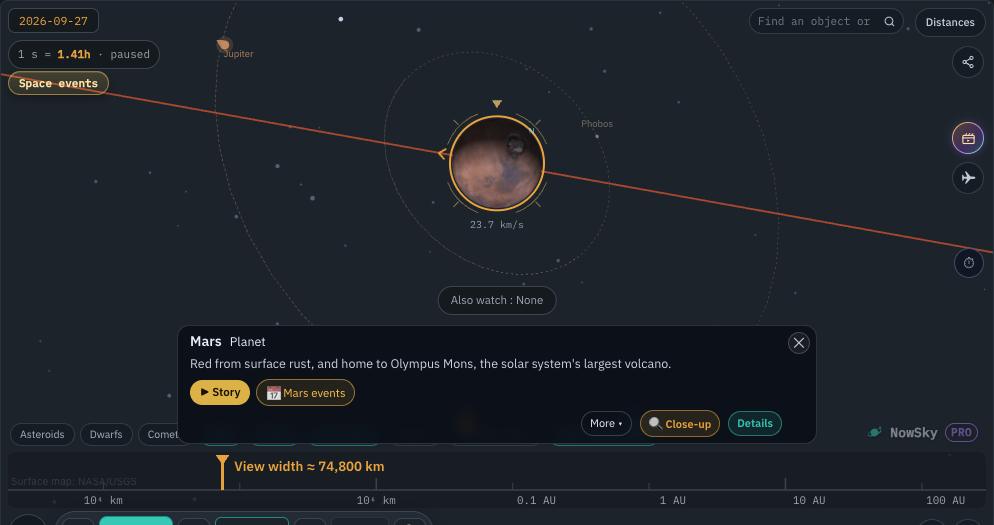 ▶ Open this view in the simulator
Orbit and size
| Diameter | 6,779 km |
|---|---|
| Distance | 1.52 AU |
| Year | 687 d |
| Day | 24h 37m |
Figures are representative approximations. Source: compiled from NASA and IAU public data.
Moons of Mars
Related events
- Mariner 4 — first close-ups of Mars
- Viking 1 — to the surface of Mars
- Curiosity launch — Mars rover
- MMX launch — Martian moon sample return(planned)
- Tianwen-3 — Mars sample return bid(planned)
- Mars transfer window — next departure(planned)
Why Mars's northern and southern seasons differ
Mars's axis is tilted 25.2 degrees, close to Earth's 23.4, so Mars has spring, summer, autumn and winter too. The difference lies in its orbit. Mars follows an oval about six times more stretched than Earth's, so its distance from the Sun changes a lot through the year. As a result, southern summer comes when Mars is near the Sun and is short and hot, while northern summer comes when it is far away and is long and cool.
That is also why the great Martian dust storms gather in southern summer. As Mars nears the Sun the ground warms and dust lifts into the air. Every few years a storm spreads over the whole planet and hides the sky for weeks. The storm of 2018 blocked the sunlight that powered the Opportunity rover, and it never recovered.
Mars's tilt is not steady like Earth's either. Earth's large Moon holds its axis in place, but Mars has no such moon. Calculations by scientists suggest that over millions of years the Martian tilt has swung between about 15 and 35 degrees. Each swing appears to have brought ice ages, moving polar ice toward the equator.
The planet in depth
Signs of flowing water are found all over Mars: dry riverbeds, deltas built where rivers ran into lakes, and layers of sediment laid down on lake floors. They show that more than three billion years ago Mars had rivers and lakes on its surface. Whether it also had a large ocean is still debated. Some of that water survives today as polar ice caps and ice buried underground.
Mars has landforms far larger than Earth's. The volcano Olympus Mons stands about 22 km high, two and a half times the height of Mount Everest. The canyon Valles Marineris runs 4,000 km, about the width of the United States. Yet the air is thin, less than 1 percent of Earth's pressure. With so little air pressing down, water quickly escapes, so liquid water cannot last long on the surface today.
The colours of the Martian sky are the reverse of ours. By day, fine dust floating in the air turns the sky pinkish, and at sunset only the area around the Sun looks blue. It is as if Earth's blue daytime sky and red sunset had traded places. The reason is that the fine Martian dust scatters blue light mostly close to the direction of the Sun.
The Perseverance rover is still exploring the surface. It has sealed rock samples that might hold signs of ancient life in small tubes. Plans to bring those samples back to Earth, however, have not been settled because of their cost. The orbit view shows Earth and Mars drawing close every 26 months, and missions to Mars are launched to match those windows.
Frequently asked
- How big is Mars?
- The diameter of Mars is 6,779 km.
- How far is Mars from Earth?
- The distance of Mars is 1.52 AU.
- How long is a day on Mars?
- The day of Mars is 24h 37m.
- What are the main moons of Mars?
- The main moons of Mars are Phobos, Deimos.
Related
Figures are representative approximations. Simulated positions use J2000 mean elements.