Jupiter
What is Jupiter?
Planets· Diameter 139,820 km. The largest planet, 2.5 times as massive as all the other planets combined. It hosts the Great Red Spot, a storm wider than Earth, and four large moons that circle it like a small solar system.
📍 Visible from where you are right now — computed in your browser
 ▶ Open this view in the simulator
Orbit and size
| Diameter | 139,820 km |
|---|---|
| Distance | 5.2 AU |
| Year | 11.9 yr |
| Moons | 95+ |
Figures are representative approximations. Source: compiled from NASA and IAU public data.
Moons of Jupiter
Related events
- Shoemaker–Levy 9 hits Jupiter
- The Great Conjunction of 2020
- JUICE launch — to the icy moons
- Europa Clipper reaches Jupiter(planned)
- JUICE arrives at Jupiter(planned)
Ten hours per spin: why Jupiter is squashed
Jupiter spins faster than any other planet, turning once in just 9 hours 56 minutes. Because the planet is eleven times wider than Earth, clouds at its equator travel at more than 40,000 km/h. The fast spin has flattened Jupiter like a squeezed ball: its equator is 6.5 percent wider than its pole-to-pole diameter, and even a small telescope shows the disk spread sideways.
The fast spin also makes the stripes. On a quickly turning planet the air is dragged into east-west flows, so the clouds line up in bands along lines of latitude. And with no solid surface, different latitudes turn at rates that differ by several minutes. Scientists therefore use the rotation of Jupiter's magnetic field as its official day.
Juno, which went into orbit around Jupiter in 2016, was the first spacecraft to look straight down on the planet's poles. Around the north pole it found eight storms, each about 4,000 km across, circling one central storm and holding their pattern for years. Later Juno also flew close to Ganymede, Europa and Io and sent back pictures of these moons.
The planet in depth
Jupiter is 2.5 times as massive as the other seven planets put together. Even so, it is far too small to shine as a star; it would need about 80 times more mass. Its strong gravity has still shaped the solar system. The asteroids between Mars and Jupiter never gathered into a planet, and the usual explanation is that Jupiter's pull kept stirring them up.
The stripes on Jupiter are clouds. It is a gas planet with no solid ground, so what we see are the tops of ammonia clouds. Winds faster than 500 km/h flow east and west between them, drawing out the bands. The Great Red Spot is a storm big enough to swallow Earth. Telescopes have followed it for more than 190 years, but since the twentieth century it has been shrinking.
In 1994 comet Shoemaker-Levy 9 struck Jupiter. The comet had passed close to the planet and been torn by its gravity into more than twenty pieces, which fell into Jupiter one after another over several days. It was the first time people watched two bodies in the solar system collide. The dark scars were large enough to see in small telescopes on Earth and lingered in Jupiter's clouds for weeks.
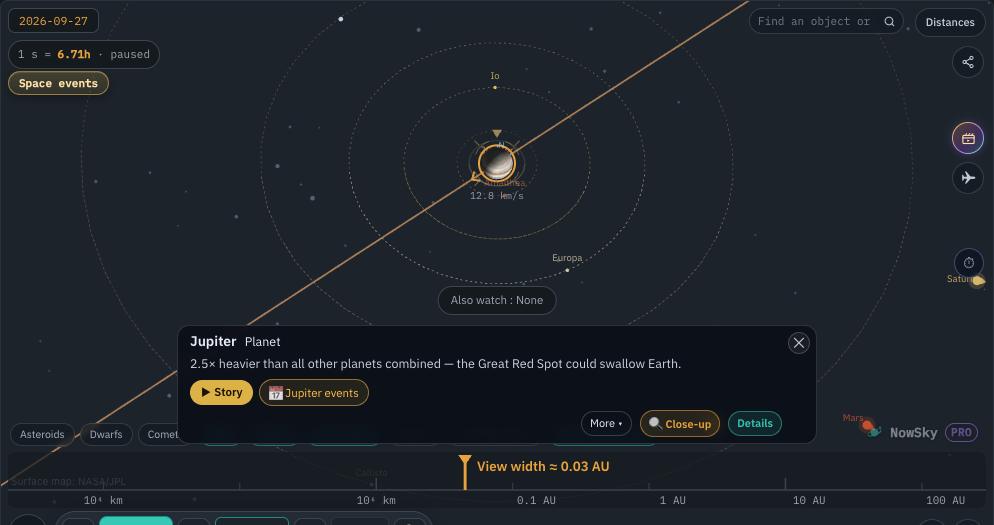
In 1610 Galileo used a telescope to discover four moons circling Jupiter: Io, Europa, Ganymede and Callisto. At a time when people believed everything went around Earth, it was the first proof that some bodies orbit something else. Zooming in on Jupiter in the orbit view shows the four moons moving with their true relative periods.
Frequently asked
- How big is Jupiter?
- The diameter of Jupiter is 139,820 km.
- How far is Jupiter from Earth?
- The distance of Jupiter is 5.2 AU.
- What are the main moons of Jupiter?
- The main moons of Jupiter are Europa, Ganymede, Io, Callisto.
Related
Figures are representative approximations. Simulated positions use J2000 mean elements.