Shoemaker–Levy 9 hits Jupiter
From 16 to 22 July 1994, 21 fragments of the broken comet Shoemaker–Levy 9 struck Jupiter one after another. It was the first collision with a planet that people predicted and watched, and it left dark scars as large as Earth.

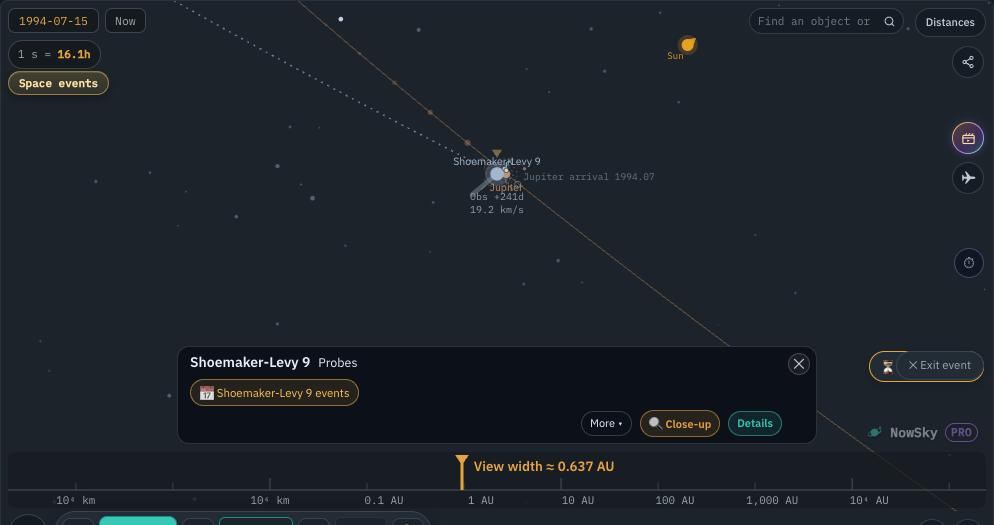 ▶ Open this scene in the simulator
 Available views: Orbit ✓ · Sky — (not visible in the sky)
The story
In March 1993 Carolyn and Eugene Shoemaker and David Levy discovered a strange comet at Palomar Observatory. It was not a single comet but many pieces lined up in a row, which people compared to a string of pearls. And this comet was orbiting Jupiter, not the Sun.
The comet had broken apart in July 1992. It passed about 40,000 km above Jupiter's cloud tops, so close that Jupiter's gravity pulled much harder on the near side of the comet than on the far side. That difference tore it to pieces. By calculating the orbit, scientists announced in advance that the pieces would strike Jupiter in July 1994.
As predicted, from 16 to 22 July 1994, 21 fragments slammed one after another into Jupiter's southern hemisphere at about 60 km per second. The biggest, fragment G, is calculated to have released energy equal to 6 million megatons of TNT, about 600 times all the world's nuclear weapons put together. It left a dark scar more than 12,000 km across, almost the width of Earth.
The impacts happened just beyond the edge of Jupiter's far side as seen from Earth. But Jupiter spins so fast, once in about ten hours, that the impact sites came into view within minutes. The Galileo spacecraft, on its way to Jupiter, saw the flashes directly. Move the orbit view to July 1994 to reproduce the positions of Jupiter and Earth at the time of the impacts.
When and where to see it
The scars were spread out by Jupiter's strong winds and faded within months; none remain today. They formed at about 44° south latitude on Jupiter. Through a small telescope today Jupiter shows a few cloud belts and the Great Red Spot, and the impact scars lay well to the south of those bands.
Select Jupiter in the sky view to see its height, direction and rising time from where you are. At about magnitude −2 it is one of the brightest planets in the night sky, and even binoculars show its four Galilean moons as small points. Move the orbit view to 16 July 1994 to reproduce the arrangement of Jupiter, Earth and the Sun at the time. The comet fragments are not in the orbit data, so they are not drawn.
See this for yourself — replay the moment in the orbit view
Past returns and history
Scientists think the comet was captured by Jupiter some 20 to 30 years before it was discovered, and had been circling the planet ever since. Before it broke up, its nucleus is estimated to have been about 1.8 km across. An object the size of a small mountain left these enormous scars.
Before the impacts, some predicted that the fragments were too small and would simply be swallowed by Jupiter's atmosphere without leaving much of a mark. But soon after the first fragment hit, a clear dark spot appeared, and those doubts disappeared. The scars turned out to be much larger and easier to see than expected.
Because Jupiter is so big and massive, it is struck by comets far more often than Earth. Scientists estimate that comets hit Jupiter 2,000 to 8,000 times more often than they hit Earth. For a while it was widely believed that Jupiter acts as a shield, pulling comets away from Earth. But more recent studies suggest that Jupiter can also send some objects toward Earth, so its role is still being debated.
Why it matters
The Shoemaker–Levy 9 impacts showed, in front of everyone, that collisions between worlds are not just something from the distant past. Craters on the Moon and the impact that wiped out the dinosaurs were already known, but watching Earth-sized scars appear was a shock. Afterwards, at the urging of the US Congress, NASA set a goal in 1998 of finding 90 percent of near-Earth objects larger than 1 km across.
The impacts also offered a look inside Jupiter's atmosphere. The fragments plunged deep and stirred up material in which sulphur, ammonia and hydrogen sulphide were detected. By watching the waves spreading out after each impact, scientists could also study the structure of Jupiter's atmosphere. It was valuable data obtained without sending a probe into the atmosphere.
The event also showed that amateur astronomers can contribute to science. The scars could be seen with small telescopes, and records made by amateurs around the world were used to piece together how the scars changed. In July 2009 a new impact scar on Jupiter was likewise first spotted by an amateur, Anthony Wesley in Australia.
FAQ
How many fragments were there?
Twenty-one, striking Jupiter one after another from 16 to 22 July 1994. The largest was fragment G.
Were the impacts seen from Earth?
The impacts happened just out of sight, but Jupiter's fast spin brought the sites into view within minutes. The Galileo spacecraft saw the flashes directly.
How big were the scars?
The scar from fragment G was more than 12,000 km across, about the width of Earth. The scars were spread out by the winds over the following months.
What does it have to do with protecting Earth?
It showed that impacts still happen, which spurred serious searches for near-Earth objects. That effort led on to experiments such as DART, which changed an asteroid's orbit.
Related
- DART — humanity moves an asteroid
- Hera arrives at Dimorphos
- Hubble Space Telescope launch
- Jupiter — object index
Times and figures are approximate — verify with official sources when planning travel. Simulation uses J2000 mean elements.