Saturn
What is Saturn?
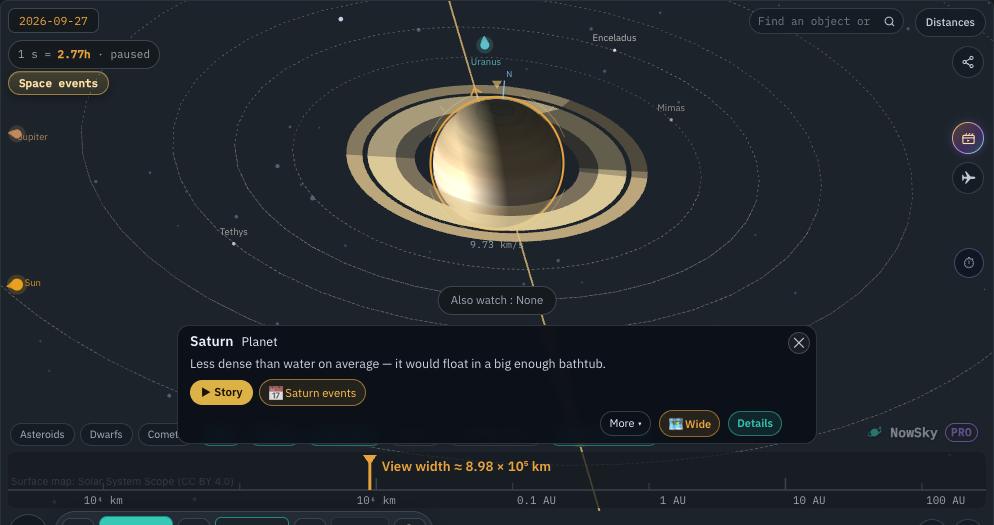
Planets· Diameter 116,460 km. The ringed planet, circled by countless pieces of ice. It is the only planet less dense than water, and its moons Titan and Enceladus are major targets in the search for life.
📍 Visible from where you are right now — computed in your browser
 ▶ Open this view in the simulator
Orbit and size
| Diameter | 116,460 km |
|---|---|
| Distance | 9.5 AU |
| Year | 29.5 yr |
| Rings | ~280,000 km |
Figures are representative approximations. Source: compiled from NASA and IAU public data.
Moons of Saturn
Related events
The six-sided cloud at Saturn's north pole
At Saturn's north pole there is a cloud pattern shaped like a hexagon. Each side is longer than Earth is wide. The Voyager probes first photographed it in the early 1980s, and when Cassini arrived in 2004 it was still in the same place with the same shape. Winds of 320 km/h flow along its edges. The south pole has nothing like it.
Why the cloud forms a hexagon was explained with laboratory experiments. When a tank of water is spun so that the inner and outer parts turn at different speeds, under the right conditions the flow settles into a shape with straight sides. Saturn's fast jet stream appears to form its hexagon in the same way.
Cassini also saw the hexagon change colour. A year on Saturn lasts 29.5 Earth years, so each season runs for more than seven years. During Cassini's 13 years there, the north pole moved from winter darkness into summer sunlight, and the inside of the hexagon turned from blue to gold. From Earth the pattern can be seen only when Saturn tips its north pole toward us.
The planet in depth
Saturn's rings are about 280,000 km wide, more than two-thirds of the distance from Earth to the Moon. Yet most of them are only 10 m to 1 km thick, which for their width is thinner than a sheet of paper. They are made almost entirely of pieces of water ice, from pebbles to chunks the size of a house, each circling Saturn on its own path.
When and how the rings formed is still debated. Measurements by the Cassini spacecraft suggested they could be young, perhaps around 100 million years old, which would mean they formed during the age of the dinosaurs. Other studies argue they could be much older. Cassini also saw ice falling from the rings into Saturn, a 'ring rain'. At that rate, calculations suggest the rings could disappear within a few hundred million years.
Saturn's average density is only 0.69 times that of water. That is why people say it would float in a bathtub big enough to hold it. Saturn also has a huge family of moons, more than 270 confirmed as of 2025. Titan has a thick atmosphere and methane lakes, and Enceladus sprays water from a hidden ocean into space. Both are major targets in the search for life.
About every 15 years the rings line up edge-on to Earth. They are so thin that they almost vanish from view. The most recent time was March 2025, and since then the rings have been opening a little wider each year. Moving time back and forth in the orbit view shows the tilt of the rings changing.
Frequently asked
- How big is Saturn?
- The diameter of Saturn is 116,460 km.
- How far is Saturn from Earth?
- The distance of Saturn is 9.5 AU.
- What are the main moons of Saturn?
- The main moons of Saturn are Titan, Enceladus, Rhea, Iapetus, Dione, Tethys, Mimas.
Related
Figures are representative approximations. Simulated positions use J2000 mean elements.