Artemis II — crewed lunar flyby
The first crewed trip to the Moon since Apollo 17 in 1972. Four astronauts flew Orion around the far side, reached a record 406,771 km from Earth, beating Apollo 13, and splashed down in the Pacific on 11 April (UTC).

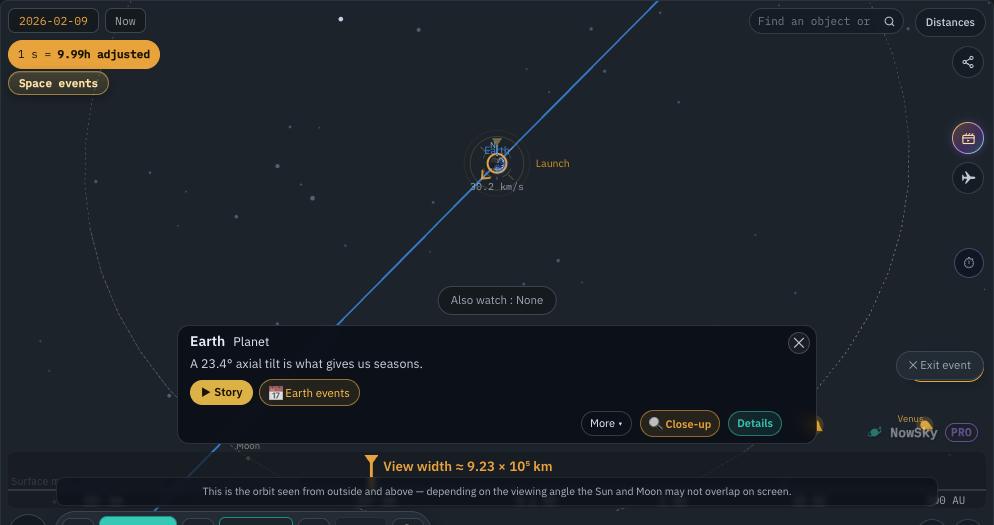 ▶ Open this scene in the simulator
 Available views: Orbit ✓ · Sky — (not visible in the sky)
The story
At 22:35 UTC on 1 April 2026, an SLS rocket carried the Orion spacecraft off pad 39B at NASA's Kennedy Space Center. It was the first time people had left the region close to Earth since Apollo 17 in 1972. Four astronauts were aboard: commander Reid Wiseman, pilot Victor Glover, Christina Koch, and Jeremy Hansen of the Canadian Space Agency.
Landing on the Moon was never part of this flight. Orion first checked its systems in orbit around Earth and then sped up toward the Moon. It flew a free-return trajectory, a path on which swinging around the far side lets the Moon's gravity send the spacecraft back toward Earth on its own. The closest approach came at about 23:00 UTC on 6 April, roughly 6,545 km above the far side, before the ship headed home.
Around that time the crew reached 406,771 km from Earth. That beat the 400,171 km set by Apollo 13 in 1970, so the record for the farthest humans have ever travelled was broken for the first time in more than fifty years. Koch also became the first woman, Glover the first person of colour and Hansen the first Canadian to fly around the Moon.
Orion splashed down in the Pacific Ocean south-west of San Diego at 00:07 UTC on 11 April, after about nine days and an hour and a half in space. During the flight, the toilet's vent line froze. The crew fixed it by warming the line and turning the spacecraft, and no problem threatened the mission. The orbit replay draws the round trip in time order: out from Earth, around the far side of the Moon, and back again.
Mission goals
The main purpose of the flight was to prove, from the beginning, a spacecraft that carries people into deep space and back. Apollo's designs and records survive, but the people, companies and parts of that era are all gone. Life support, which manages air and water, long-distance communication, manual flying, and re-entry at the high speed of a return from the Moon can only be properly tested with a crew aboard. This was the first time Orion passed those tests with people inside.
The heat shield drew the most attention. It is the protective layer on the bottom of the capsule that blocks the intense heat of re-entry. On the uncrewed Artemis I flight in 2022, parts of the shield's surface came off in ways nobody had expected. NASA chose to change the path the capsule takes into the atmosphere rather than build a new shield. Artemis II was the first test of that choice with a crew aboard, and every later Artemis flight builds on the result.
The flight also turned an international plan into a real mission. The service module that pushes Orion was built by the European Space Agency, and a Canadian astronaut held one of the four seats. For the countries that signed the Artemis Accords, a set of shared rules for exploring the Moon, it was the first clear sign that the programme had moved from paper into space.
Mission chronology and background
Artemis I flew the same kind of Moon mission without a crew, sending Orion alone for about 25 days in November and December 2022. The heat shield came back worn away in unexpected ways, which delayed Artemis II. After a long investigation, NASA decided to adjust the path of re-entry instead of designing a new shield.
The crew was announced in April 2023. Koch holds the record for the longest single spaceflight by a woman, 328 days. Glover was the pilot on the first regular mission of the Crew Dragon spacecraft. Wiseman had led NASA's astronaut office, and Hansen is a former fighter pilot in the Royal Canadian Air Force.
The flight was first planned for 2024 and slipped to 2026 because of heat-shield and life-support reviews; the rocket finally flew on 1 April. Shortly before launch, on 27 February 2026, NASA changed Artemis III into a crewed test flight in orbit close to Earth, docking with test versions of the lunar landers, planned for no earlier than June 2027. The first crewed landing since Apollo 17 now falls to Artemis IV, planned for early 2028.
Other milestones of this mission
Where to see it — sky and simulator
The flight is over, but its record is public. NASA broadcast the launch, the pass around the Moon, re-entry and splashdown live. That video, along with the photographs of Earth and the Moon that the crew took through Orion's windows, is available in NASA's public archives. They include scenes such as Earth rising beyond the Moon's far side, photographed by people for the first time in more than half a century.
During the flight, Orion could not be seen with the naked eye. It was a small spacecraft hundreds of thousands of kilometres away. While it passed behind the Moon, the Moon itself blocked the radio signal and contact with Earth was lost for a while. That gap cannot be avoided on any flight that goes around the far side.
The orbit replay draws the path from Earth, around the far side of the Moon, and back down into the Pacific. With the view locked on the Moon, the free-return shape stands out clearly as the ship swings behind the Moon and comes back out toward Earth. The replay follows the real flight dates: launch on 1 April, closest approach on 6 April and splashdown on 11 April.
See this for yourself — replay the moment in the orbit view
FAQ
Did it land on the Moon?
No. It passed about 6,545 km above the far side and came home on a free-return trajectory. The next crewed landing is planned for Artemis IV in early 2028.
How long was the flight?
About nine days and an hour and a half, from launch at 22:35 UTC on 1 April 2026 to splashdown in the Pacific at 00:07 UTC on 11 April.
What records did it set?
The crew reached 406,771 km from Earth, passing Apollo 13's 400,171 km. Koch is the first woman, Glover the first person of colour and Hansen the first Canadian to travel around the Moon.
What is a free-return trajectory?
It is a path on which the Moon's gravity swings the spacecraft back toward Earth without another major engine burn. Apollo 13 used the same principle to get home after its accident in 1970.
Related
- Artemis III — docking test in Earth orbit
- Apollo 11 landing
- Starship — the road to a lunar lander
- The Moon — object index
- Earth — object index
Times and figures are approximate — verify with official sources when planning travel. Simulation uses J2000 mean elements.