Moon
What is Moon?
Moons· Diameter 3,475 km. Earth's only natural satellite and the only other world people have walked on. It always turns the same face toward us, changes phase over the month and makes eclipses possible.
📍 Visible from where you are right now — computed in your browser
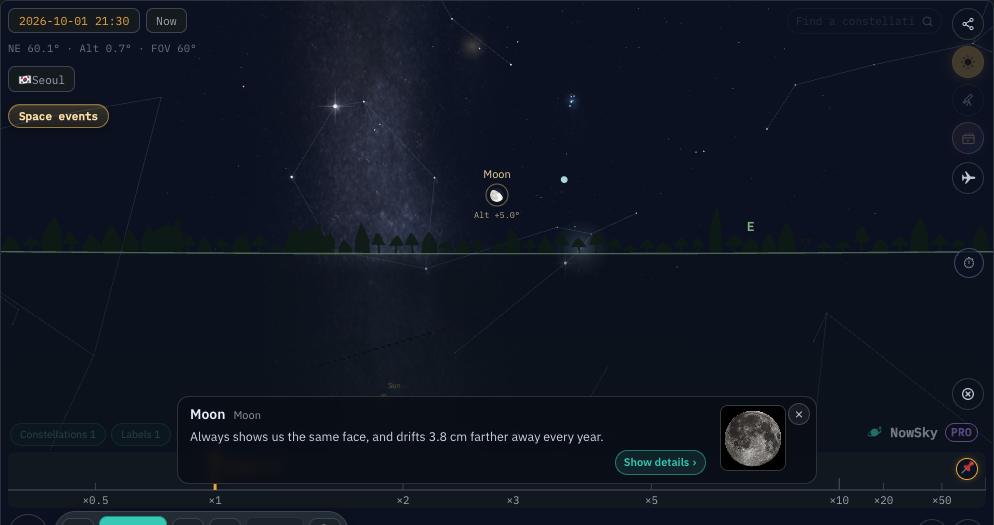 ▶ Open this view in the simulator
Orbit and size
| Diameter | 3,475 km |
|---|---|
| Distance | 384,400 km |
| Orbit | 27.3 d |
| Note | receding 3.8 cm/yr |
Figures are representative approximations. Source: compiled from NASA and IAU public data.
Parent planet and sibling moons
Related events
- Apollo 11 — first footsteps on the Moon
- Danuri — Korea's first lunar orbiter
- Artemis II — crewed lunar flyby
- MMX launch — Martian moon sample return(planned)
- Total lunar eclipse — New Year blood moon(planned)
Why the Moon looks bigger on the horizon
A Moon that has just risen looks much bigger than one high overhead. Yet measured in a photograph, the two are the same size. In fact the horizon Moon is about 1.5 percent smaller, because it is farther from the observer by roughly one Earth radius. The larger look is an illusion made by the brain, not the eye, which is why a camera never records it.
People have argued about the cause for more than two thousand years. The explanation most widely accepted today is this: the brain judges things near the horizon to be far away. So when two images are the same size, the one it believes is farther away is interpreted as larger. With an arm held straight out, a little fingernail covers the Moon at any height.
A 'supermoon', by contrast, is a real difference in size. The Moon's orbit is a slightly stretched oval, so its distance from Earth varies between about 360,000 and 400,000 km. A full Moon at the closest point looks 14 percent wider and 30 percent brighter than one at the farthest. Without the two side by side, though, the eye can hardly tell. Selecting the Moon in the sky view shows today's distance and apparent size.
The moon in depth
The Moon is 3,475 km across, more than a quarter of Earth's diameter. No other planet has a moon this large compared with itself. The most widely accepted explanation of its origin is the giant-impact idea: about 4.5 billion years ago a body the size of Mars struck the young Earth a glancing blow, and debris thrown out by the crash gathered into the Moon. A key piece of evidence is that rocks brought back by the Apollo astronauts are very similar in makeup to rocks on Earth.
The Moon turns exactly once on its axis for every trip around Earth, so the same side always faces us. The dark patches spread across the near side are plains of ancient hardened lava, called 'seas' (maria). The far side has almost none of them and is crowded with craters instead. No one had seen the far side until the Soviet Luna 3 sent back pictures in 1959. Following the Moon in the orbit view and turning the camera brings the far side into view.
The Moon moves 3.8 cm farther from Earth every year. Today the Moon and Sun look almost the same size in our sky, which is why the Moon can cover the Sun completely in a total solar eclipse. As the Moon keeps drifting away, it will eventually be too small to cover the whole Sun. In a few hundred million years total eclipses are expected to end, leaving only annular eclipses, where a bright ring of Sun remains.
Frequently asked
- How big is Moon?
- The diameter of Moon is 3,475 km.
- How far is Moon from Earth?
- The distance of Moon is 384,400 km.
- What is notable about Moon?
- The note of Moon is receding 3.8 cm/yr.
- Which planet does Moon orbit?
- Moon orbits Earth.
Related
Figures are representative approximations. Simulated positions use J2000 mean elements.