Total lunar eclipse — New Year blood moon
On the last night of 2028 the full Moon is due to slip into Earth's shadow and turn red. Totality lasts about 71 minutes from 16:16 UTC, when it is already 1 January 2029 in East Asia and Australia, so the first sky of their new year holds a red Moon.
📍 Visible from where you are right now — computed in your browser

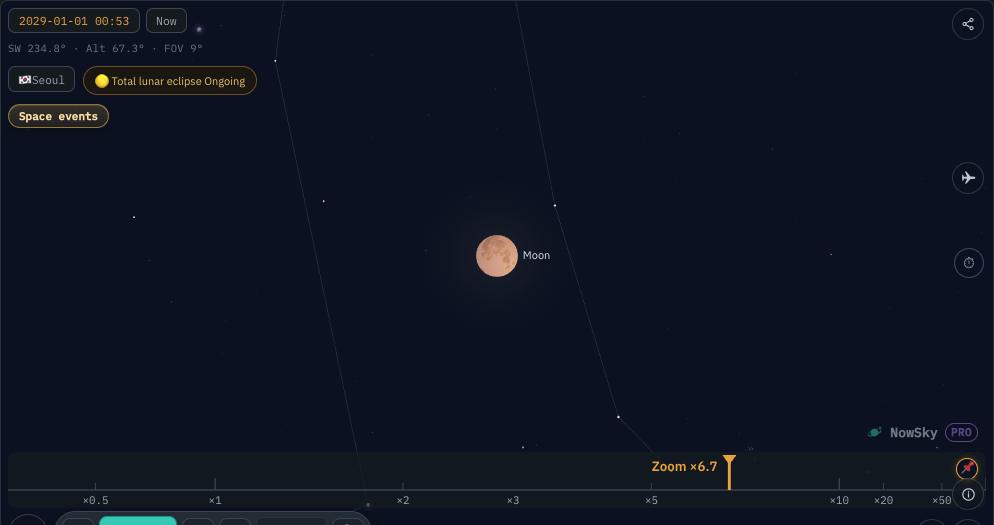 ▶ Open this scene in the simulator
 Available views: Orbit ✓ · Sky ✓
The story
On the night of 31 December 2028 the full Moon is due to pass into Earth's shadow in a total lunar eclipse. A total lunar eclipse happens when the Sun, Earth and Moon line up almost exactly, in that order. This one can be seen from start to finish across Asia, Australia and eastern Europe, while in western Europe and Africa the Moon will rise with the eclipse already under way.
A Moon fully inside the shadow does not vanish; it turns red. Sunlight passing through Earth's layer of air is bent slightly into the shadow, and along the way the blue part of the light is scattered out while mostly red light gets through. If you could stand on the Moon at that moment, you would see the dark Earth surrounded by a thin red ring made of the light of every sunrise and sunset on the planet.
In universal time the Moon begins to enter the pale outer shadow at about 14:00 UTC on 31 December, and from about 15:07 UTC a dark bite starts to show. Totality lasts from 16:16 to about 17:28 UTC. In East Asia and Australia this falls after local midnight, so the eclipse spans the change of year; in East Asia the Moon then stands high in the sky, well clear of buildings and hills.
Totality lasts about 71 minutes, which is generous. Because the Moon passes a little north of the shadow's centre, one edge of the disk stays brighter than the other during totality, and that difference shifts slowly, so there is time to watch it without hurrying. Set the sky view to a city such as Sydney or Perth and move the clock to that night, and the Moon's passage into the shadow is reproduced step by step.
Viewing guide — timing and direction
A lunar eclipse is completely safe to watch with the naked eye. Unlike a solar eclipse, it needs no filters or protective glasses at all, because what you are looking at is moonlight, a faint reflection of a tiny part of the Sun's light. You simply look up. Binoculars bring out the lighter and darker shades of red and the soft edge of the shadow, and a camera on a tripod can photograph it without difficulty.
A lunar eclipse looks the same from everywhere the Moon is above the horizon at the time, so there is no need to travel to a narrow path as with a solar eclipse. The shadow phases run from about 15:07 to 18:37 UTC, and across Asia and Australia the Moon is above the horizon throughout, so it can be seen well from almost anywhere there. City lights barely get in the way.
What really matters on the night is the weather and the cold. You will be outside for over an hour in the small hours of midwinter, so warm clothes, gloves and a hot drink are worth preparing. Replay the night in the orbit view and the Sun, Earth and Moon are reproduced lining up, with the Moon moving into the shadow behind Earth and out again.
See this for yourself — open that sky at that moment · replay the moment in the orbit view
Why this lunar eclipse is worth it
A lunar eclipse works like an experiment that looks at Earth's air from space. All the light reaching the Moon during totality has passed through Earth's atmosphere, so the Moon's colour and brightness carry a record of the state of that air. After a major volcanic eruption, tiny particles spread high in the sky block some of the light, and eclipses become noticeably darker. Observers have long recorded this brightness on the Danjon scale, which runs from 0 to 4.
The same idea links to the study of planets around other stars. When such a planet passes in front of its star, splitting the starlight that has passed through its atmosphere into colours reveals which gases that atmosphere contains. Moonlight during a lunar eclipse is the same situation, seen from Earth. Scientists have analysed eclipsed moonlight and found the traces of oxygen and ozone in our own atmosphere, which helps guide the search for signs of life on distant worlds.
Lunar eclipses are also old evidence that Earth is round. The ancient Greek thinker Aristotle argued that Earth must be a ball because the edge of its shadow on the Moon is always curved. Only a sphere casts a round shadow whichever direction the light comes from. It was a conclusion reached by watching the sky carefully, long before telescopes existed.
Background
Because lunar eclipses can be calculated in advance, they have played a part in history more than once. In a well-known story, Christopher Columbus, stranded in Jamaica in 1504, learned from an astronomical almanac that an eclipse was coming and announced that the Moon would lose its light. When the Moon did darken, he is said to have obtained food from the local people. The story shows that eclipses could already be predicted quite accurately at that time.
Ancient astronomers found the saros cycle by collecting eclipse records. The idea that the Sun, Earth and Moon return to nearly the same arrangement every 18 years, 11 days and about 8 hours first became known from Babylonian records, and it is still used to sort solar and lunar eclipses into families. This eclipse belongs to the family called Saros 125.
The next total lunar eclipses are not far off. On 26 June 2029 there is one well placed for the Americas, and on 20 December 2029 one well placed for Europe, Africa and western Asia. Any one area sees a total lunar eclipse every few years on average, so it is a major sky event that most people can see many times in their lives.
FAQ
Is it safe to look at with the naked eye?
Completely safe. You are looking at moonlight, so no protective equipment is needed; eclipse glasses or solar filters would simply block the view. Binoculars and telescopes are safe too, and they show the changing shades of red more clearly.
When does it happen?
In UTC, the Moon starts to enter the pale outer shadow at about 14:00 on 31 December and a dark bite appears from about 15:07. Totality runs from 16:16 to about 17:28 UTC, with the deepest point at 16:52 UTC.
Why does the Moon turn red?
Earth's air bends sunlight into the shadow, and on the way blue light is scattered out while mostly red light gets through. It is the same effect that makes sunsets red.
How long does this eclipse last?
Totality lasts about 71 minutes, and the Moon takes about three and a half hours to pass into the dark shadow and out again. Unlike a solar eclipse, where totality lasts only minutes, there is time to watch at leisure.
Related
- The 2029 total lunar eclipse over the Americas
- The 2026 total lunar eclipse over the Pacific
- The 2028 total eclipse over Sydney
- The Moon — object index
- Earth — object index
Times and figures are approximate — verify with official sources when planning travel. Simulation uses J2000 mean elements.