Total solar eclipse — across Sydney
On 22 July 2028 the shadow of a total solar eclipse is due to cross Australia and pass over central Sydney. A city of more than five million people will sit in the Moon's shadow for 3 minutes 49 seconds, its first total eclipse since 1857.
📍 Visible from where you are right now — computed in your browser

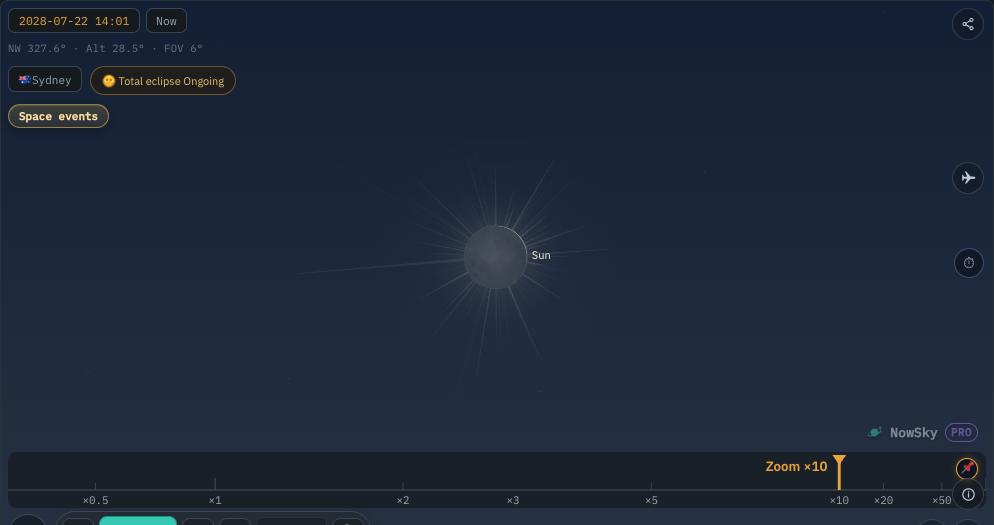 ▶ Open this scene in the simulator
 Available views: Orbit ✓ · Sky ✓
The story
On 22 July 2028 the Moon's shadow is due to reach the Kimberley coast of northern Western Australia and cross the continent diagonally from north-west to south-east. The shadow of a total eclipse often falls on ocean, desert or ice. This time it passes over Sydney, a city of more than five million people. Central Sydney will sit inside the Moon's dark shadow for 3 minutes 49 seconds at around 2 p.m local time (about 04:00 UTC).
From Western Australia the shadow crosses the Northern Territory, south-western Queensland and New South Wales before reaching Sydney. July is winter in the southern hemisphere and the dry season in northern inland Australia, when rain is rare. The early part of the path therefore spends a long time over land with a good chance of clear skies. After Sydney the shadow crosses the Tasman Sea and passes over Queenstown and Dunedin on New Zealand's South Island.
The last time a total eclipse was seen from Sydney was 26 March 1857. After 171 years the corona will return above the Harbour Bridge and the Opera House. When a whole city falls inside the shadow, the event changes character. Instead of travelling to a remote spot, people will watch totality from harbours, parks and office windows close to home.
Sydney's weather in July cannot be known in advance. A coastal city in winter carries a higher chance of cloud than the dry interior, and the Sun does not climb very high even at midday. Many observers will weigh the better odds of a clear sky inland against the views of the city. Set the sky view to Sydney and the Sun's height and the timing of totality that afternoon are reproduced.
Viewing guide — where, when, how
Totality can only be seen inside a strip that starts in the Kimberley in Western Australia, crosses the Northern Territory, south-western Queensland and New South Wales to reach Sydney, and continues over the Tasman Sea to New Zealand's South Island. In Sydney it lasts 3 minutes 49 seconds at around 2 p.m local time (about 04:00 UTC). Cities outside the strip, such as Melbourne and Brisbane, see only a partial eclipse with most of the Sun covered, and no corona appears. Seeing totality means getting inside the strip.
Safety comes first. As long as any part of the Sun is showing, you must wear eclipse glasses certified to ISO 12312-2. Sunglasses, stacked film, smoked glass and camera viewfinders are all unsafe. The only time to look with bare eyes is during totality, while the Sun is completely covered, and the glasses must go back on as soon as sunlight returns. Binoculars and telescopes need a solar filter fitted over the front.
Preparing on the ground is simple but best done early. During totality the Sun over Sydney will sit in the northern to north-western sky, not very high, so you need a spot where that part of the sky is not blocked by buildings. Harbourside areas and parks with good views are expected to be crowded, so allow plenty of travel time. Replay the day in the orbit view and the Moon's shadow is reproduced crossing the Australian continent.
See this for yourself — open that sky at that moment · replay the moment in the orbit view
Why this eclipse is special
A total eclipse is the only time the corona, the outermost layer of the Sun's atmosphere, can be seen with the naked eye. The corona is far fainter than the Sun's bright surface, so it is usually lost in the glare; only for the few minutes when the Moon exactly covers the Sun do its pearly streamers appear. Why the corona is so much hotter than the surface is still unsolved, so scientists still travel to eclipses to observe it.
This eclipse stands out for the sheer number of people under the shadow. When a large city lies on the path, the moment is recorded not only by professional instruments but also by huge numbers of cameras and amateur telescopes. That is ideal for collecting things that need many observers, such as changes in the shape of the corona or shadow bands, the faint wavy stripes that can flicker across the ground just before totality.
Australia has had several total eclipses in recent years, but most crossed thinly populated land. It is rare for any one city to fall inside a path of totality, and rarer still for a city as large as Sydney. Sydney's next total eclipse will not come until 2858. That is what makes this eclipse special in the city's history.
Background and earlier eclipses
When Sydney last saw totality in 1857, it was a far smaller port town than it is today; it has since become one of the largest cities in the southern hemisphere. The 171-year wait shows how narrow the path of a total eclipse is compared with the whole Earth. Most cities fall inside such a path only once every few hundred years.
Australia has met total eclipses fairly often lately. Totality reached the Cairns area of far north Queensland in November 2012 and the Exmouth Peninsula in Western Australia in April 2023. Both times the path was narrow or crossed thinly populated land, so observers had to travel a long way. 2028 is the opposite: the observing site is a place where people already live.
Looking ahead makes this eclipse's value clearer. Another total eclipse crosses southern Australia in November 2030, but central Sydney will not lie inside a path of totality again until 2858.
FAQ
How long does totality last in Sydney?
About 3 minutes 49 seconds in central Sydney, at around 2 p.m. local time (about 04:00 UTC). It gets shorter away from the middle of the strip, drops to a few seconds at its edge, and does not happen at all outside the strip.
Is it ever safe to look without a filter?
Only during totality, while the Sun is fully covered. Every partial phase needs eclipse glasses certified to ISO 12312-2, and they must go back on as soon as sunlight returns. Sunglasses and smoked glass are never safe substitutes.
What about the weather — where should I go?
July is winter on the New South Wales coast, so Sydney has a higher chance of cloud than the interior. On clear-sky odds alone, the dry-season inland stretch across northern and central Australia is better; for views and easy access, Sydney is more convenient. It helps to plan so you can move along the path and follow the forecast in the last few days.
Where can it be seen?
Totality crosses Australia from the Kimberley to Sydney and continues to New Zealand's South Island, with greatest eclipse at 02:56 UTC. A partial eclipse is seen across the rest of Australia and New Zealand, South-East Asia and the south-west Pacific; Europe, Africa, the Americas and East Asia are outside it. Setting the sky view to Sydney reproduces the sky of that afternoon.
Related
- The great eclipse of 2027 over Egypt
- The 2028 annular eclipse at Spanish sunset
- The 2028 New Year blood moon
- The Sun — object index
- The Moon — object index
Times and figures are approximate — verify with official sources when planning travel. Simulation uses J2000 mean elements.