[Space facts]
Types of black holes, explained — from stellar-mass to supermassive
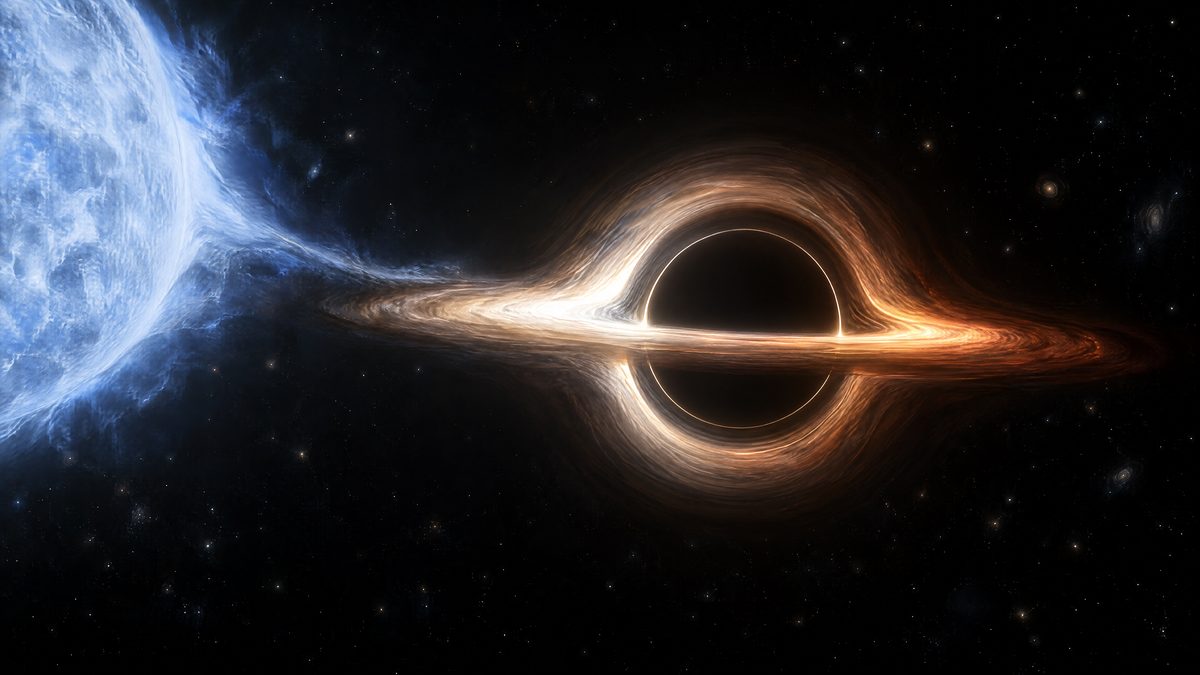
The types of black holes explained — stellar-mass, intermediate, supermassive — with Cygnus X-1 and Sagittarius A*, how we find them, and neutron stars.
One headline says a black hole weighs about fifteen Suns; another says six and a half billion. Both are called black holes. The difference comes down to classification: astronomers sort the types of black holes mainly by mass, and each class has a different origin story and a different way of being caught.
This guide walks through the three established classes plus one that is still only an idea, explains how astronomers find something that gives off no light at all, and clears up the difference between a black hole and its close cousin, the neutron star. With that framework, names like Cygnus X-1 and Sagittarius A* fall into clear categories.
The main types of black holes, sorted by mass
A black hole is a region where gravity is so strong that not even light can climb back out. The boundary of no return is called the event horizon. The physics is the same for all of them, but the masses span an enormous range, so mass is the natural way to classify them. Following NASA's grouping:
| Type | Mass (Sun = 1) | Examples |
|---|---|---|
| Stellar-mass | a few to tens | Cygnus X-1, Gaia BH1 |
| Intermediate | ~100 to 100,000s | Omega Centauri candidate |
| Supermassive | 100,000s to billions | Sagittarius A, M87 |
| Primordial | unknown | none found (hypothetical) |
Stellar-mass black holes are what is left when a very massive star runs out of fuel and its core collapses. NASA estimates there may be as many as 100 million of them in the Milky Way, yet only around 50 have been identified, almost all because a companion star gave them away. A lone black hole drifting through space is close to invisible. Few objects have been found between the heaviest neutron stars and the lightest black holes, roughly 2 to 5 solar masses, a stretch known as the lower mass gap.
Intermediate-mass black holes are the missing link. Theory says they should exist, but firm detections are rare. The gravitational-wave event GW190521, recorded in 2019, left behind a black hole of about 142 solar masses after two smaller ones merged. In 2024, fast-moving stars at the heart of the globular cluster Omega Centauri pointed to a black hole of at least 8,200 solar masses.
Supermassive black holes sit at the centres of almost all large galaxies. Ours, Sagittarius A, weighs about 4.3 million Suns. M87, in a giant elliptical galaxy roughly 53 million light-years away in Virgo, comes in at about 6.5 billion. How such giants got so big so early is still an open question.
How are black holes found if they emit no light?
The method is to observe not the black hole itself but its effect on its surroundings. There are three classic routes.
- X-ray binaries. When a black hole strips gas from a companion star, the gas spirals into a hot accretion disc and glows in X-rays. Cygnus X-1 was found this way in 1964, by X-ray detectors carried on a sounding rocket.
- Stellar orbits. If a star whips around something unseen, the size and period of its orbit reveal the unseen mass. The star S2 circles Sagittarius A* every 16 years or so, and that work earned Reinhard Genzel and Andrea Ghez a share of the 2020 Nobel Prize in Physics. Gaia BH1, announced in 2022, was found the same way: a Sun-like star orbiting an invisible partner every 185 days.
- Shadows. The Event Horizon Telescope links radio dishes across the planet into one Earth-sized instrument. It released the first image of M87* in April 2019 and of Sagittarius A* in May 2022. Both show a dark shadow ringed by light bent around the black hole by its gravity.
Since 2015 there has also been a fourth route: gravitational waves, the ripples in spacetime sent out when two black holes spiral together.
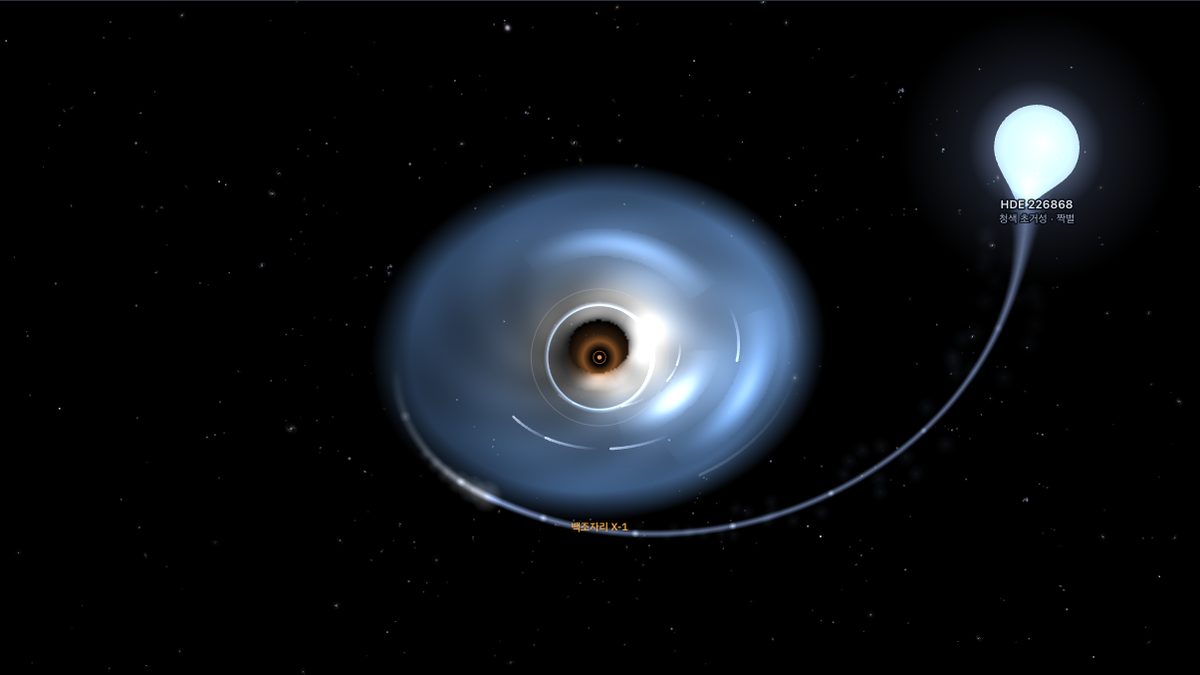
Three famous black holes worth knowing
Cygnus X-1 was the first object widely accepted as a black hole. It lies about 7,200 light-years away and orbits a blue supergiant, HDE 226868, of roughly 29 solar masses once every 5.6 days. Estimates of the black hole's own mass vary between studies, from the mid-teens to about 20 Suns. In 1974 Stephen Hawking bet Kip Thorne that it was not a black hole, calling the wager an insurance policy for his own theories, and he conceded in 1990. In the sky it sits in Cygnus, the Swan, which rides high on autumn evenings from mid-northern latitudes such as Europe and the northern United States. The black hole itself cannot be seen, but its direction in the sky can be located.
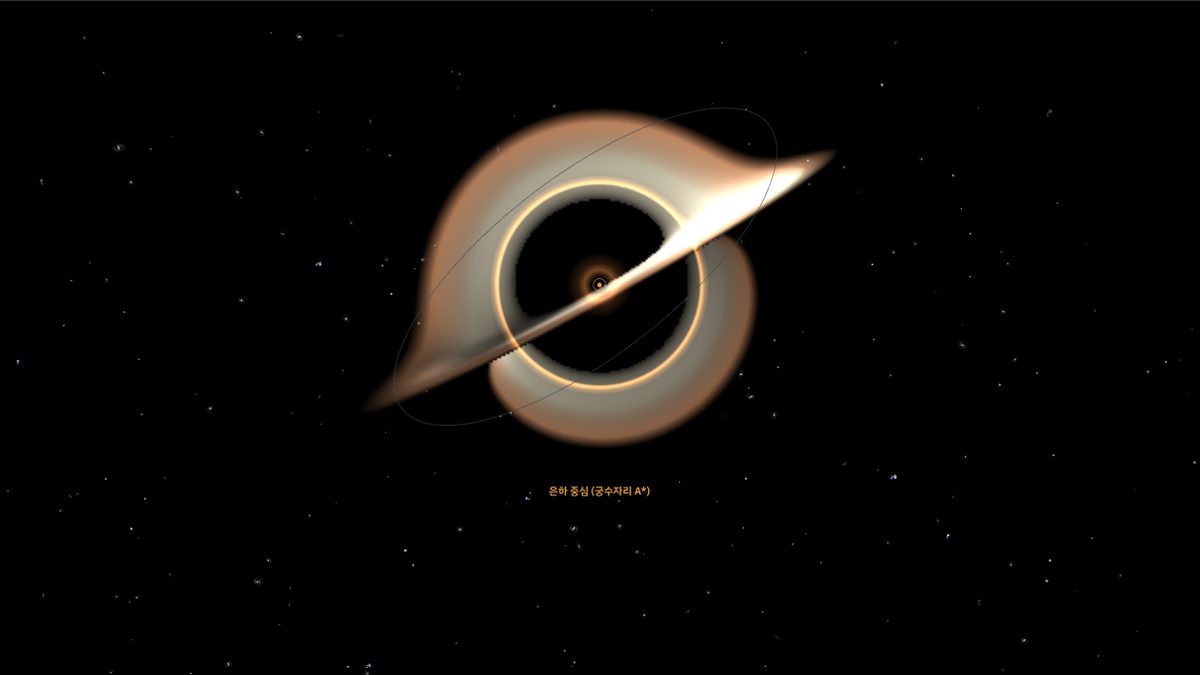
Sagittarius A* marks the centre of our galaxy, about 27,000 light-years away, near the border of Sagittarius and Scorpius. Thick dust blocks it from view in ordinary telescopes. From mid-northern latitudes that part of the sky stays low in the south on summer evenings; from places like Sydney, Cape Town or Santiago it climbs almost overhead in the southern winter, which is why the Milky Way's core appears especially bright and high from the southern hemisphere.
M87* was the first black hole ever imaged. It is more than a thousand times more massive than Sagittarius A*, yet in the EHT images the two look remarkably alike, a strong hint that the same physics rules near every event horizon.
Black hole or neutron star? Mass decides
Black holes and neutron stars share a birthplace: both are the collapsed cores left after a massive star dies, usually in a supernova. What separates them is how much mass the core ends up with.
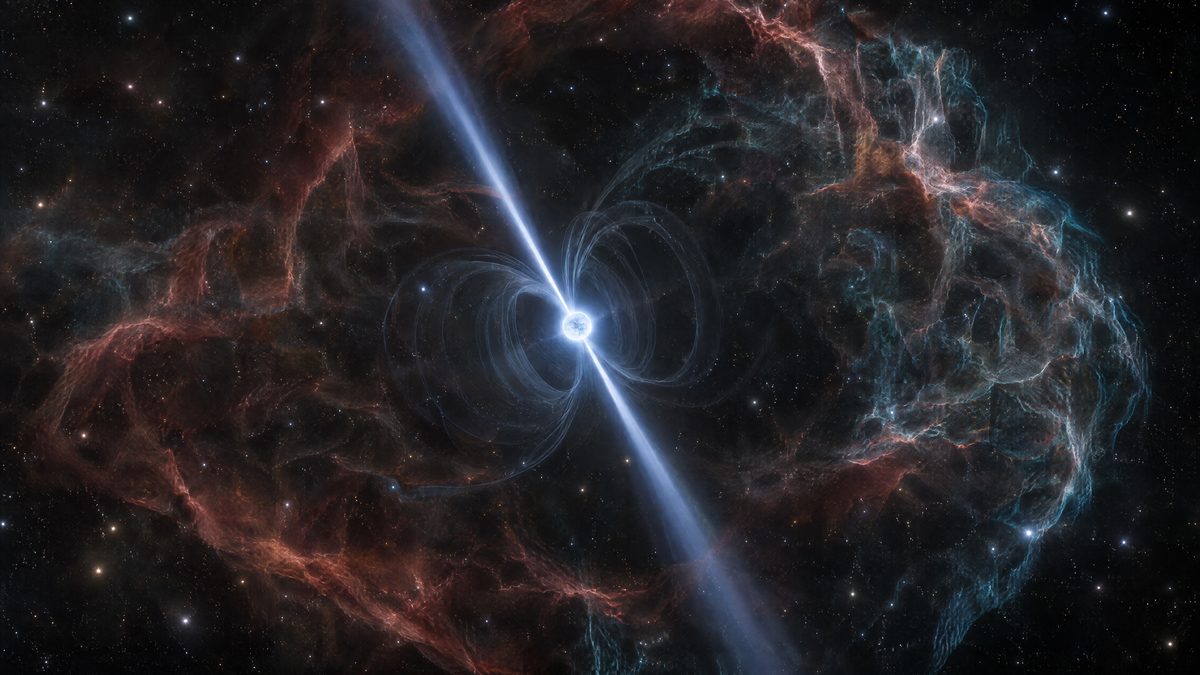
- Stars that start out at roughly 10 to 25 solar masses typically leave a neutron star: about 1.4 solar masses packed into a ball some 20 km across. A single teaspoon of it would weigh about 900 times as much as the Great Pyramid of Giza.
- Neutron stars have a maximum mass, somewhere around 2.2 to 2.9 Suns. If the leftover core is heavier, nothing can halt the collapse and it becomes a black hole.
A rapidly spinning neutron star that sweeps beams of radio waves across space like a lighthouse is a pulsar. The Vela pulsar, about 960 light-years away, spins more than 11 times a second. Its discovery in 1968 at the heart of a supernova remnant gave direct proof that supernovae make neutron stars.
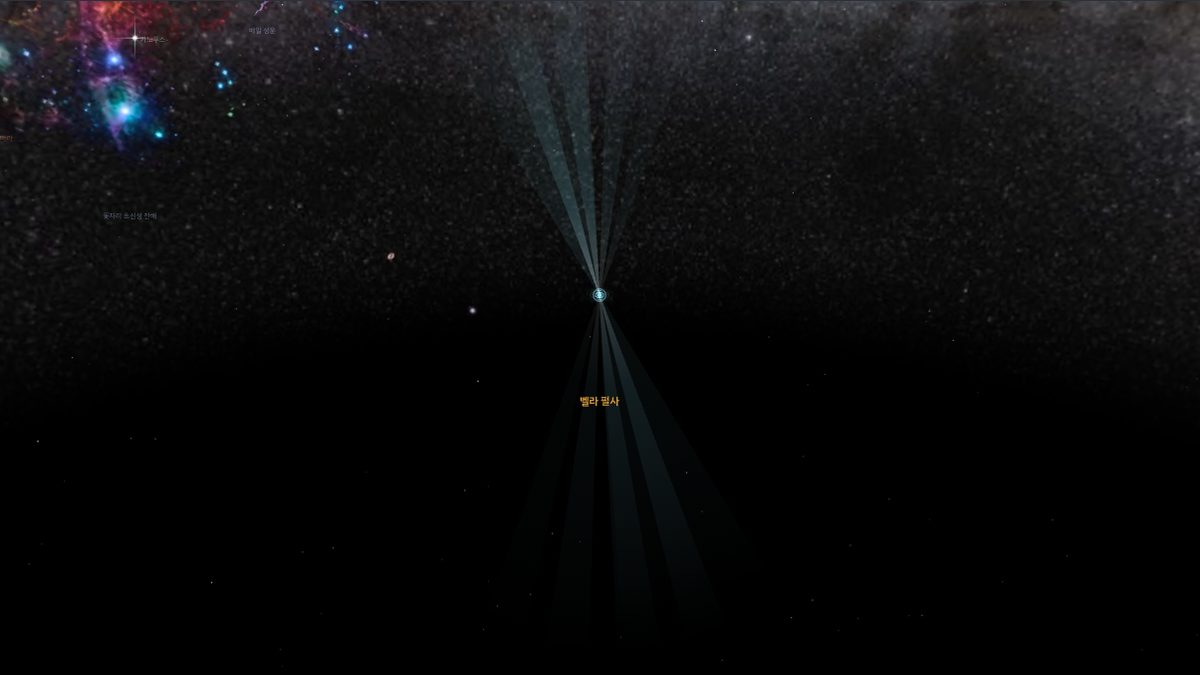
Seeing them on a 3D black hole map
Distances like 7,200 or 27,000 light-years are hard to grasp on paper. A 3D space map that places objects at their true direction and distance makes them easier to compare. NowSky's Space 3D view centres on the Sun and places stars, nebulae and compact objects where they really are; type a name into the search box and the camera flies there.
- Set side by side on one map, the Vela pulsar at 960 light-years, Gaia BH1 at about 1,560 light-years (the nearest black hole known with confidence), Cygnus X-1 at 7,200 and Sagittarius A* at 27,000 show how widely the compact objects we know are scattered around the Sun.
- Pick an object and its card offers a distance readout and a link showing where it sits in the local night sky.
Frequently asked questions
What is the nearest known black hole?
As of 2026 it is Gaia BH1, in the direction of Ophiuchus, about 1,560 light-years away. At roughly nine solar masses it poses no threat to Earth whatsoever.
Can a black hole be seen through a telescope?
Not the black hole itself, since it gives off no light. What we detect is hot gas around it, stars orbiting it, or the shadow outlined by bent light.
Wrapping up
The types of black holes are set by mass, running from single dead stars of a few solar masses to galactic giants billions of times heavier. A dying star's core lands on one side or the other of a mass limit, and that alone decides between neutron star and black hole. The most striking part, in my view, is not the black holes themselves but the patience it took to weigh something invisible by watching a single star go round.
Open the screens from this post
- The Vela Pulsar in 3Da neutron star 960 light-years away
- Gaia BH1the nearest known black hole