[Solar system & orbits]
What watching planetary orbits teaches you — from Kepler's laws to retrograde motion
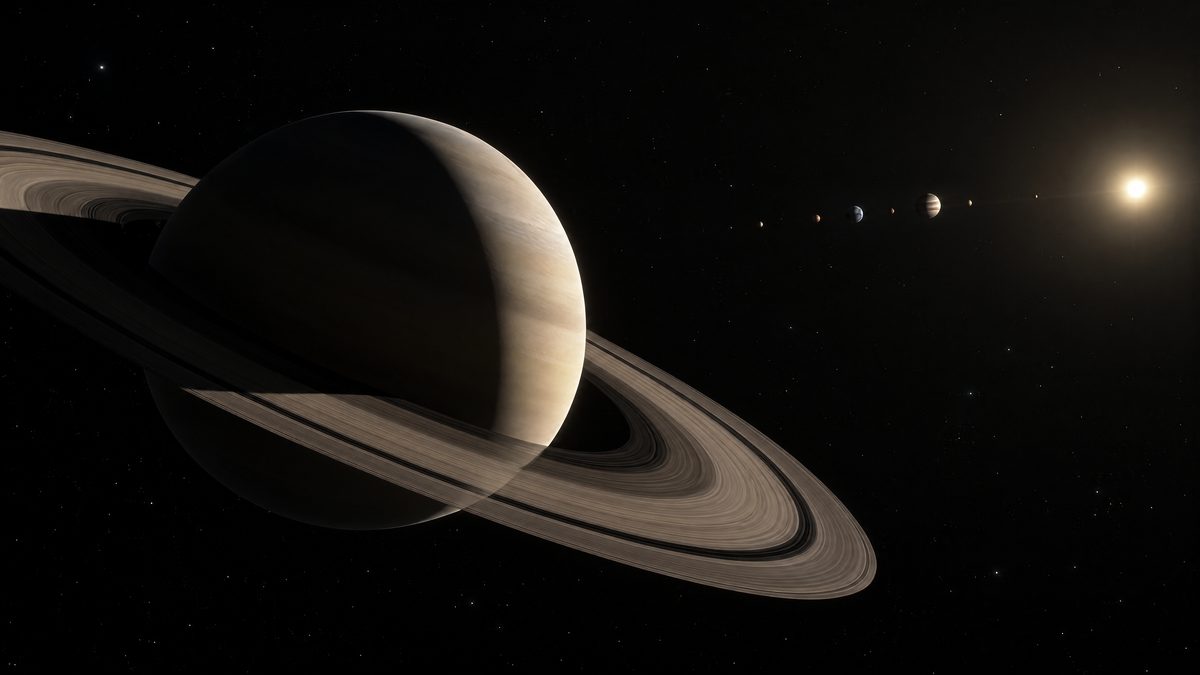
Watching planetary orbits from above explains Kepler's laws, why Venus switches between evening and morning, and how retrograde motion and oppositions arise.
Textbook diagrams of the Solar System usually show the planets lined up neatly to one side of the Sun. The real sky behaves differently. Venus shines in the evening for months, vanishes, and then turns up before dawn. Mars can dominate the night for a season and then disappear for most of a year. A star chart does not explain any of this, but watching the planetary orbits from above, with time running forward, makes the pattern plain: the calendar of the night sky is written by where the planets are relative to one another.
This article is about what becomes clear once the orbits are watched in motion: Kepler's three laws, why the inner planets keep overtaking Earth, and how conjunctions, oppositions and retrograde motion arise. It closes with a few criteria for choosing a tool. By the end, a question such as "Why has Venus disappeared lately?" can be answered with a simple picture of the Solar System.
Planetary orbits and Kepler's laws, made simple
Early in the 17th century Johannes Kepler summed up the motion of the planets in three rules that still describe it remarkably well.
- Orbits are ellipses. The Sun sits not at the centre of the ellipse but at one of its two foci. Most planetary orbits are close to circular, though. Earth's eccentricity (a measure of how far an orbit departs from a circle) is only about 0.017, yet that is enough for Earth to pass closest to the Sun every year in early January.
- Planets move faster when closer to the Sun. A line from the Sun to a planet sweeps out equal areas in equal times. Near the Sun the line is short, so the planet has to move faster to cover the same area. The effect is strongest for Mercury, whose eccentricity is about 0.206. On Earth it is small but measurable: the stretch from the March equinox to the September equinox lasts about 186 days, while the return trip takes about 179. Because Earth moves a little faster around its January closest approach, the northern autumn and winter are roughly a week shorter than spring and summer.
- Farther planets take far longer. The square of the orbital period is proportional to the cube of the orbit's size. Periods therefore grow more steeply than distances.
NASA's planetary figures show how large the differences are.
| Planet | Orbital period | Mean speed |
|---|---|---|
| Mercury | 88 days | 47.4 km/s |
| Venus | 225 days | 35.0 km/s |
| Earth | 365 days | 29.8 km/s |
| Mars | 687 days | 24.1 km/s |
| Jupiter | ~11.9 years | 13.1 km/s |
| Saturn | ~29.4 years | 9.7 km/s |
| Uranus | ~84 years | 6.8 km/s |
| Neptune | ~164 years | 5.4 km/s |
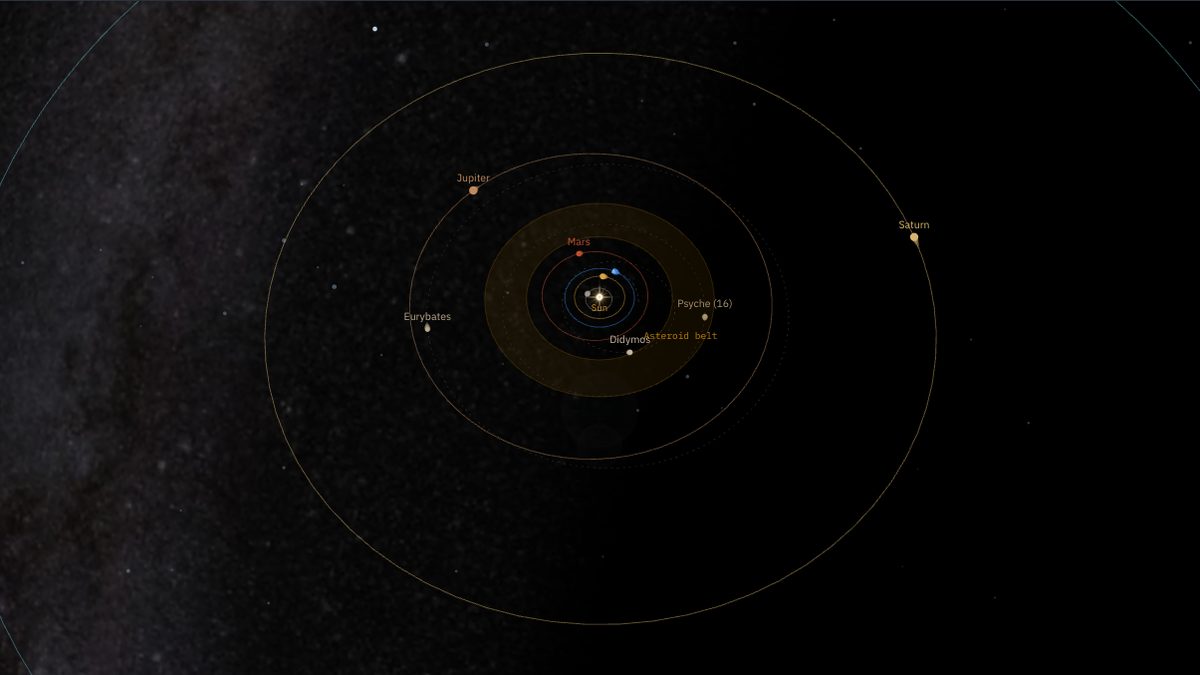
Inner planets have shorter tracks and run faster along them; Mercury completes around 680 orbits while Neptune completes one. Neptune is about 30 times farther from the Sun than Earth, so with the whole system on one screen the four inner planets huddle near the Sun while the outer gaps open into wide empty space.
Why the inner planets keep overtaking Earth
Letting time run makes the table tangible: Mercury and Venus repeatedly lap Earth, while Jupiter and Saturn barely move. That overtaking is the root of the whole observing calendar.
How a planet appears from Earth does not follow its own orbital period. It follows the synodic period, the time it takes Earth and that planet to return to the same arrangement relative to the Sun. Think of two runners on a circular track: how often the faster one laps the slower one depends on the difference between their lap times.
- Venus. With its 225-day orbit, Venus takes about 584 days to lap Earth once. Its cycle from evening star to morning star and back therefore repeats roughly every 19 months.
- Mars. Here Earth is the faster runner. Earth catches up with Mars, which takes 687 days per orbit, about every 780 days, or a little over two years. That is why Mars is well placed for a long stretch and then stays out of view for a long stretch.
- Jupiter and Saturn. They move only a short way along their orbits in a year, so Earth needs just a little more than a year to line up with them again. They return to the evening sky at about the same season each year, shifting later by roughly a month (Jupiter) or a couple of weeks (Saturn).
Conjunctions, oppositions and retrograde motion come from geometry
Pushing the same idea one step further turns the unfamiliar terms on astronomy calendars into a single picture.
| Arrangement | Meaning | In the sky |
|---|---|---|
| Inferior conjunction | Venus or Mercury between Earth and Sun | lost in the glare |
| (Superior) conjunction | planet beyond the Sun | lost in the glare |
| Greatest elongation | inner planet at its widest from the Sun | easy at dusk or dawn |
| Opposition | Earth between Sun and outer planet | up all night, brightest |
Real dates make it concrete: Venus passes inferior conjunction on 24 October 2026 and moves from the evening sky to the morning sky. Jupiter reaches opposition on 11 February 2027, and Mars follows on 19 February 2027. Setting an orbit view to those dates shows Earth, Venus and the Sun nearly in a line on the first, and the Sun, Earth and the outer planet nearly in a line on the others.
Retrograde motion is the visual effect of that overtaking around opposition. An outer planet normally drifts slowly eastward against the background stars, but for the few months when Earth catches up with it on the inside track, it appears to move backwards, westward. It is like passing a slower car on a motorway, which seems to slide backward against the scenery. The middle of a retrograde loop therefore coincides with opposition. Mars, for example, is expected to be stationary on 10 January 2027, move westward until about 1 April 2027, and reach opposition in between. Seen from above, both planets keep circling the same way; only the line of sight from Earth swings back and forth. The loops ancient astronomers explained with epicycles become this simple once the Sun is at the centre.
Earth, the Moon and Saturn's rings up close
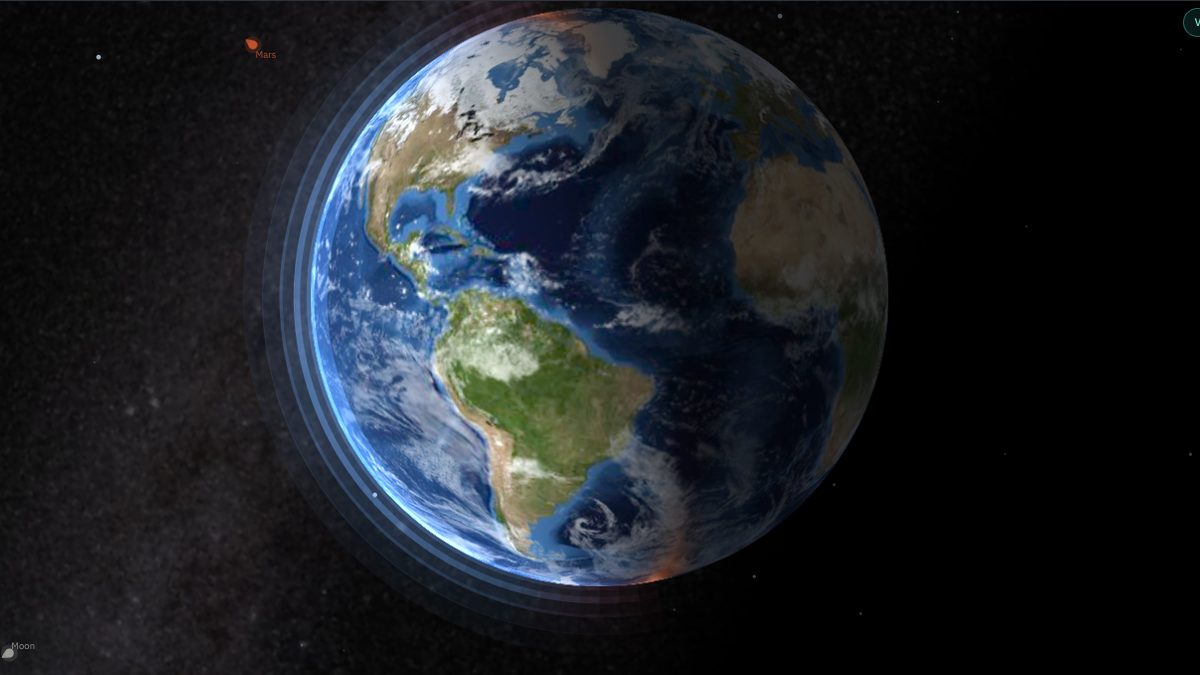
Zooming in from the full view reveals orbits within orbits. The Moon circles Earth at an average distance of about 384,000 km, completing one orbit relative to the stars every 27.3 days, while the cycle of phases takes 29.5 days. The two-day difference is another case of overtaking: while the Moon goes around once, Earth also moves along its orbit, so the Moon needs a little extra travel to line up with the Sun again.
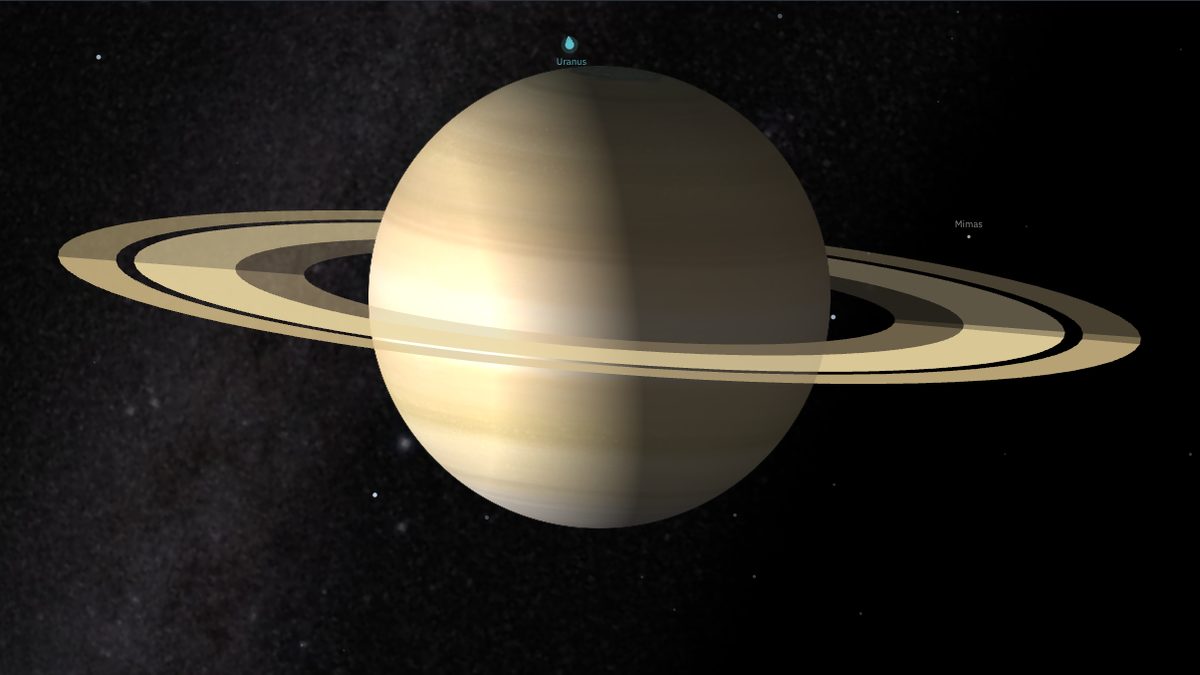
Saturn's main rings stretch from about 7,000 km to 80,000 km above the equator, yet are typically only 10 metres to 1 km thick, and made almost entirely of water ice. Between the A and B rings lies the Cassini Division, a gap about 4,800 km wide found by Giovanni Cassini in 1675. Tilting the view until the ring plane is seen edge-on shows just how thin they are. Earth passed through that plane in March 2025, an alignment that comes around roughly every 13 to 16 years, when the rings narrow to little more than a line as seen from Earth.
Spacecraft obey the same rules: a probe that bends sharply past a planet is borrowing that planet's gravity, and between encounters it orbits the Sun like everything else.
How to choose a Solar System simulator for watching orbits
What makes a tool good for seeing all of this? A few features matter.
- Real positions. The tool should compute where the planets actually are on a given date, not arrange them for decoration. Only then do conjunction and opposition dates match what is on screen.
- Time control. Play, rewind and jump to a date. Synodic periods and retrograde loops only show up when time moves.
- Smooth zoom and tracking. It should be possible to go from the whole Solar System to a single planet and its moons without losing context.
- A tiltable view. Switching between a top-down and an edge-on view reveals orbital tilts and the thinness of Saturn's rings.
Several tools meet these criteria. NASA's Eyes on the Solar System adds spacecraft trajectories from real mission data, and desktop software such as Stellarium suits in-depth study alongside the view from the ground. The NowSky orbit view, used for the screens in this article, is another option, and it can step through the dates around the 2027 oppositions of Jupiter and Mars.
Frequently asked questions
Do all the planets orbit in the same plane?
Nearly, but not exactly. Each orbit is tilted slightly. Because the tilts are small, the planets always appear near the ecliptic, the path the Sun traces across the sky.
Do the planets ever line up in a straight row?
Several planets often gather on one side of the sky, which is usually what a "planet parade" refers to. Because every period is different, though, an exact straight line seen from above essentially never happens.
Final thoughts
Watching planetary orbits from above shows that evening and morning stars, conjunctions, oppositions and retrograde loops all come from planets on ellipses, moving at their own speeds and overtaking one another. Real positions and time control are all it takes to see these rules at work. A planet that seems to reverse course in the sky turns out to be travelling steadily in one direction the whole time, and that image tends to stick longer than any explanation.
Open the screens from this post
- Watch the Solar System orbitplanets at their real positions today
- Close up on Saturnrings and moons