Andromeda Galaxy
What is Andromeda Galaxy?
Galaxies· Distance 2.5 million ly. Our neighbour galaxy, 2.5 million light-years away, usually named as the farthest thing the naked eye can see. It holds about a trillion stars and is moving toward the Milky Way at 110 km per second.
📍 Visible from where you are right now — computed in your browser
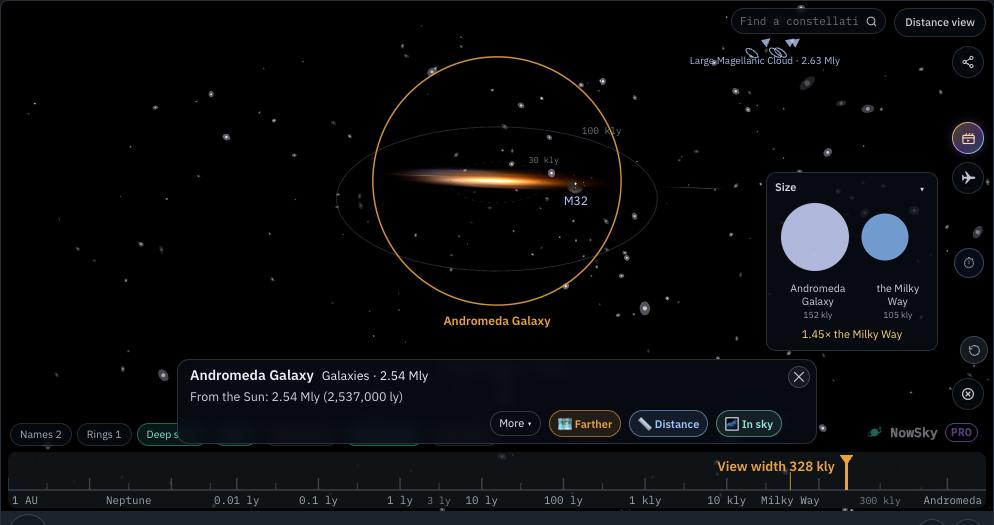 ▶ Open this view in the simulator
Its place in the sky
A galaxy, in the direction of Andromeda, spanning about 190 arcminutes of sky — 6.1 times the width of the full Moon.
Distance and scale
| Distance | 2.5M ly |
|---|---|
| Stars | ~1 trillion |
| Future | may merge with us — about 50% within 10 Gyr (2025 study) |
Figures are representative approximations. Source: compiled from NASA and IAU public data.
Discovery and name
Recorded as a "little cloud" by al-Sufi in 964; in 1923 Hubble found a Cepheid here and proved it lies beyond our galaxy.
Andromeda spans six full Moons, so why does it look small?
In the sky, the Andromeda Galaxy stretches more than 3 degrees, as wide as six full Moons side by side. Yet to the naked eye or through binoculars it looks like a hazy oval about the size of a single Moon. The outer disc spreads its light so thinly that the eye cannot pick it up. What we see is only the bright centre, where stars are packed closely together.
The great spiral in photographs comes from cameras collecting light over long exposures. So the popular pictures showing Andromeda larger than the Moon are true, but they are not what the eye sees. From a dark site far from cities, looking slightly to one side of the galaxy makes the oval appear a little longer. A telescope about 10 cm wide can also show a dark lane of dust crossing the disc.
The galaxy in depth
The Andromeda Galaxy is a large spiral galaxy close to our own, 2.5 million light-years away. That means the light reaching your eyes tonight set off 2.5 million years ago. Around then, early human ancestors on Earth were just beginning to chip stones into tools. Andromeda holds about a trillion stars, probably more than the Milky Way.
A hundred years ago Andromeda was thought to be a hazy cloud, a nebula, inside our own galaxy. Then in 1923 Edwin Hubble found Cepheid variable stars in it. A Cepheid's true brightness can be worked out from how fast it pulses, so it can be used to measure distance. Hubble's measurement showed that Andromeda lies far beyond the Milky Way and is a separate galaxy. It was the moment people learned that the universe is full of galaxies.
Andromeda is now approaching the Milky Way at 110 km per second. For years this led to the prediction that the two galaxies would collide and merge in about 4.5 billion years. A study published in 2025, however, took the pull of other nearby galaxies into account and found only about an even chance that they will merge within 10 billion years. Even if they do, stars will almost never hit each other, because the space between stars in a galaxy is mostly empty.
Frequently asked
- How far is Andromeda Galaxy from Earth?
- The distance of Andromeda Galaxy is 2.5M ly.
- Where in the sky is Andromeda Galaxy?
- Andromeda Galaxy lies in the direction of Andromeda.
- In one line, what is Andromeda Galaxy?
- Galaxies — Our neighbour galaxy, 2.5 million light-years away, usually named as the farthest thing the naked eye can see.
Related
Figures are representative approximations. Simulated positions use J2000 mean elements.