Sagittarius A*
What is Sagittarius A*?
Black holes & quasars· Distance ~26,000 ly. The giant black hole at the centre of our galaxy. Stars racing around an invisible point gave it away, and in 2022 the Event Horizon Telescope photographed its shadow.
📍 Visible from where you are right now — computed in your browser
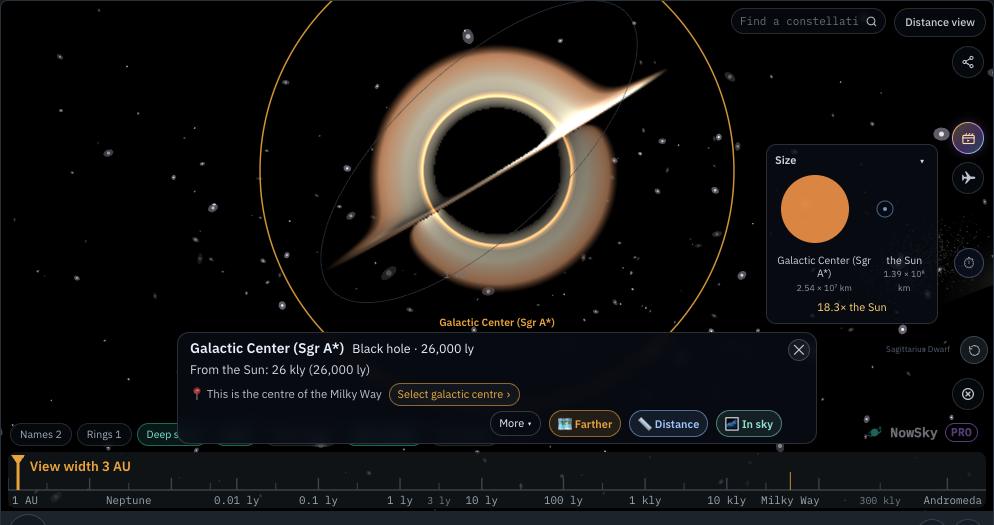 ▶ Open this view in the simulator
Its place in the sky
A black hole, in the direction of Scorpius.
Mass, distance, nature
| Distance | ~26,000 ly |
|---|---|
| Mass | 4.3 million solar masses |
| What | our galaxy's central black hole |
| How the mass is measured | tracking stars such as S2 orbiting it for over 30 years (2020 Nobel Prize) |
Figures are representative approximations. Source: compiled from NASA and IAU public data.
Discovery and name
A radio source found in 1974. Thirty years of tracking stars orbiting it revealed a 4-million-Sun black hole (Nobel 2020).
Why the picture of Sagittarius A* came later than M87*
The picture of Sagittarius A* was released in May 2022, three years after the first black-hole picture of M87*, although both were observed together in April 2017. The delay came down to size. M87* is about 1,500 times heavier and correspondingly larger, so gas takes days to weeks to circle it, and during one night of observing it seems to stand still.
Gas around Sagittarius A*, by contrast, goes around in minutes. It is like photographing a fast-moving object with the shutter held open: the image blurs. The team had to recover the blurred data with several different methods and check the results against one another. The size of the finished ring agreed with the mass worked out from the stars' orbits and with the size predicted by Einstein's general theory of relativity.
The black hole in depth
At the centre of the Milky Way lies Sagittarius A*, a black hole with the mass of about 4.3 million Suns. A black hole is an object whose gravity is so strong that not even light can escape. It is about 26,000 light-years away, so the radio waves reaching us from there set out long before people on Earth began farming.
Because a black hole cannot be seen, scientists watched the stars around it for decades. One star, S2, circled something invisible about every 16 years, and at its closest it moved at about 7,650 km per second — fast enough to cross from London to New York (about 5,570 km) in under a second. Such an orbit is only possible if a huge mass is packed into a very small space. The two scientists who led this work shared the 2020 Nobel Prize in Physics.
The solar system circles this centre too, taking about 230 million years for one lap. The last time it was in its present position, dinosaurs were just appearing on Earth. Dust hides the galactic centre from our eyes, but it lies in the direction where the summer Milky Way looks thickest, low in the south. In the Sky view a marker shows the galactic centre toward Sagittarius.
Frequently asked
- How far is Sagittarius A* from Earth?
- The distance of Sagittarius A* is ~26,000 ly.
- What is the mass of Sagittarius A*?
- The mass of Sagittarius A* is 4.3 million solar masses.
- What kind of object is Sagittarius A*?
- Sagittarius A* is a our galaxy's central black hole.
- Where in the sky is Sagittarius A*?
- Sagittarius A* lies in the direction of Scorpius.
Related
Figures are representative approximations. Simulated positions use J2000 mean elements.