Antares
What is Antares?
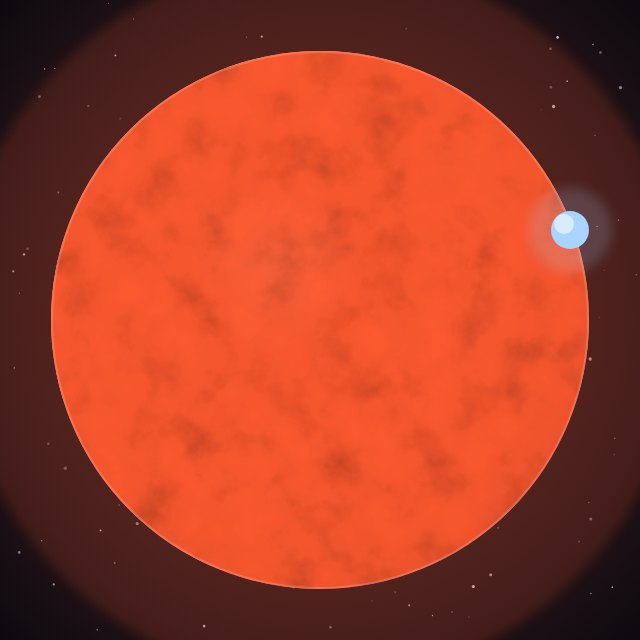
Stars· Distance 550 ly · size ~680× Sun. The red supergiant glowing at the heart of Scorpius. Put in the Sun's place, it would reach past the orbit of Mars into the asteroid belt. Its name means 'rival of Mars'.
📍 Visible from where you are right now — computed in your browser
Distance and spectral type
Antares is about 554 light-years away, a red supergiant (spectral type M1Ib), in the constellation Libra. Its apparent magnitude is 1.1, visible to the naked eye.
Stellar figures
| Distance | ~550 ly |
|---|---|
| Magnitude | 1.0 (varies 0.6–1.6) — fifteenth brightest |
| Type | M1.5 red supergiant |
| Constellation | Scorpius |
Figures are representative approximations. Source: compiled from NASA and IAU public data.
Behind the name
Greek "rival of Ares (Mars)" for its red color. In the Sun's place it would engulf Mars's orbit.
The companion that looks green beside red Antares
Right next to Antares sits a small 5th-magnitude companion, Antares B, less than 3 arcseconds away. It was first reported in 1819 while the Moon was passing in front of Antares: the Moon covered the bright main star first, and for a moment the companion was left showing on its own. Antares B is really a hot blue-white star. Yet many people who see the two together in a telescope describe it as green.
The green is a trick of the eye. Our eyes tend to see a colour right next to strong red light as greener than it really is, and in a telescope the light of the two stars also mixes a little. When the Moon hides the main star and only the companion shows, it looks bluish. The two stars are bound together and are thought to orbit each other over more than a thousand years. The companion is about seven times as massive as the Sun, but the red main star is about sixty times brighter, so it is easily lost in the glare.
The star in depth
Antares is the brightest star in Scorpius. Its average brightness, magnitude 1.0, makes it the fifteenth-brightest star in the night sky. But its brightness does not stay the same. Its outer layers swell and shrink irregularly, so it wanders between magnitudes 0.6 and 1.6. It is about 550 light-years away and marks the heart of the Scorpion.
Antares is a red supergiant, a star that has swollen to enormous size. Its radius is about 680 times the Sun's. Put in the Sun's place, it would reach well past the orbit of Mars into the inner asteroid belt. Its surface is about 3,500 K, cooler than the Sun's, so it looks red. Yet because it is so large, it gives off about 75,000 times as much light as the Sun. It is well over ten times as massive as the Sun and is expected to explode as a supernova one day.
The name is Greek for 'rival of Ares'. Ares was the Greek god of war, known to the Romans as Mars, the name of the red planet. Antares lies close to the path the planets follow across the sky, so red Mars often passes near it and the two red lights appear side by side. To ancient observers they seemed to be competing in colour.
From June to August, look low in the southern evening sky for the S-shaped curve of Scorpius; the red star in its middle is Antares. From New York it climbs only about 23 degrees at its highest, and from London about 12, so a spot with a clear view to the south helps. In the Sky view, choose a July night and select Scorpius to find it.
Frequently asked
- How far is Antares from Earth?
- The distance of Antares is ~550 ly.
- How bright is Antares (apparent magnitude)?
- The magnitude of Antares is 1.0 (varies 0.6–1.6) — fifteenth brightest.
- What kind of object is Antares?
- Antares is a M1.5 red supergiant.
- Which constellation is Antares in?
- Antares lies in the constellation Libra.
Related
Figures are representative approximations. Simulated positions use J2000 mean elements.