Betelgeuse
What is Betelgeuse?
Stars· Distance ~548 ly · radius ~700× Sun. The red supergiant on Orion's shoulder. Put in the Sun's place, it would reach well past the orbit of Mars, and it is expected to explode as a supernova within about 100,000 years.
📍 Visible from where you are right now — computed in your browser
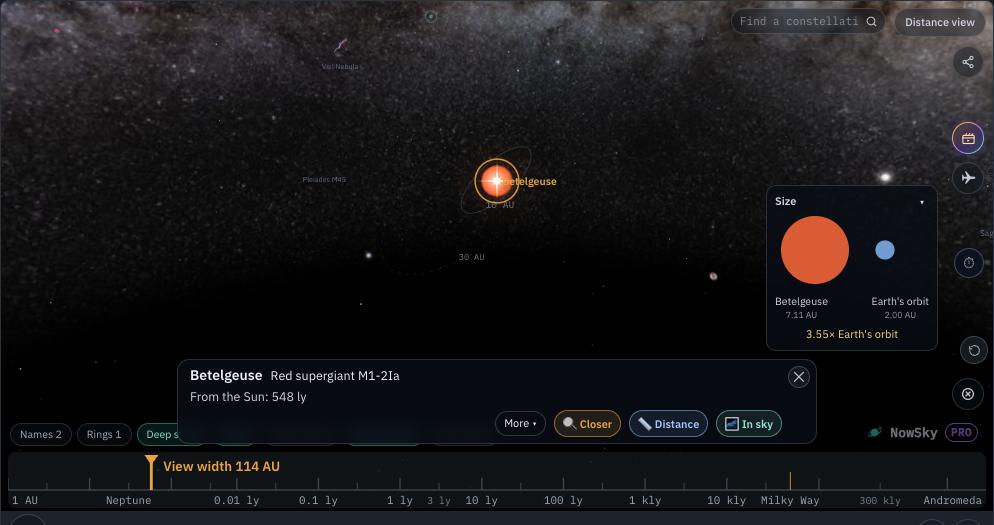 ▶ Open this view in the simulator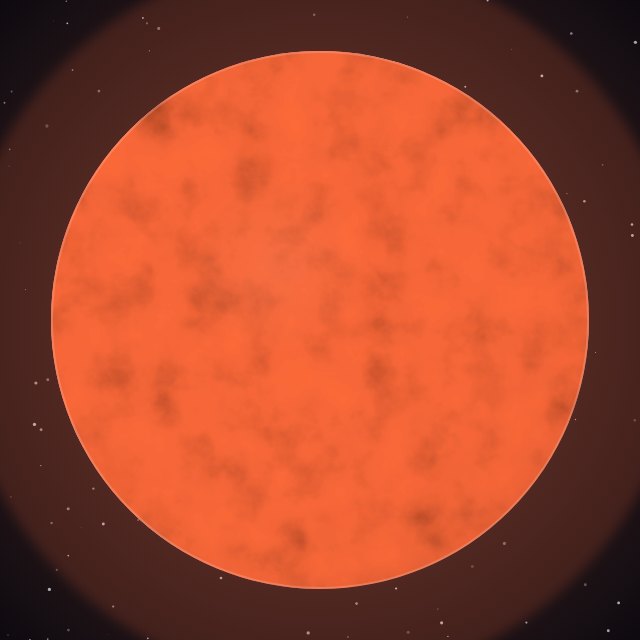
Distance and spectral type
Betelgeuse is about 498 light-years away, a red supergiant (spectral type M2Ib), in the constellation Orion. Its apparent magnitude is 0.5, visible to the naked eye.
Stellar figures
| Distance | ~548 ly |
|---|---|
| Size | radius ~700× the Sun (est. 640–760) |
| Age | ~10 million years |
| Constellation | Orion |
| Fate | supernova within ~100k yr |
Figures are representative approximations. Source: compiled from NASA and IAU public data.
Behind the name
Its name is a garbled Arabic "hand of the giant" (often mistold as "armpit"). The Great Dimming of 2019–20 sparked supernova rumors — it was a dust cloud.
1920: Betelgeuse becomes the first star to have its size measured
On 13 December 1920, Albert Michelson and Francis Pease at Mount Wilson Observatory in the United States tried a new experiment. They fixed a 6-metre beam on top of the 2.5-metre telescope and combined the light collected by mirrors at its two ends. This kind of device is called an interferometer. It showed that Betelgeuse spans 0.047 arcseconds in the sky. It was the first time the size of any star other than the Sun had been measured directly.
Using the distance accepted at the time, that meant Betelgeuse was about 280 times as wide as the Sun, larger than Earth's whole orbit. Betelgeuse was chosen first because it is huge and fairly close, so it looks larger than almost any other star. Even today it is one of the few stars whose surface can be photographed. During the Great Dimming of 2019, telescopes captured the southern part of its disc growing dark.
Yet the size of Betelgeuse is still hard to pin down, because its distance is uncertain. The Hipparcos satellite gave about 430 light-years in 1997, radio observations about 640 in 2008, and a 2020 study about 548. A different distance gives a different size. The star's edge is also fuzzy, so its measured size changes with the colour of light used. That is why its radius is written with a wide range, 640 to 760 times the Sun's.
The star in depth
Betelgeuse is the red star on Orion's shoulder. Because it is a swollen red star of enormous size, it is called a red supergiant. Its radius is about 700 times the Sun's. Put in the Sun's place, it would swallow the orbits of Mercury, Venus, Earth and Mars and reach into the asteroid belt. It looks red because its surface is cooler than the Sun's.
Betelgeuse is only about 10 million years old, very young compared with the 4.6-billion-year-old Sun. Yet it is already near the end of its life, because heavy stars use up their fuel very quickly. Scientists expect it to explode as a supernova within about 100,000 years. It will then shine as brightly as a half Moon for more than three months, visible even in daylight. At 548 light-years away, though, it will do no harm to life on Earth.
In late 2019 Betelgeuse suddenly became much fainter than usual, and rumours spread that it was about to explode. The real cause was different. A cloud of dust thrown off by the star blocked some of its light, while part of its surface cooled for a while. The event is called the Great Dimming. In 2025 astronomers also announced that the Gemini North telescope had imaged a candidate for a small companion star that had long been suspected.
On winter evenings, look at Orion's upper-left shoulder in the southern sky to find red Betelgeuse. Its colour stands out against blue Rigel at the lower right. It is 548 light-years away, so tonight's light left it in the late fifteenth century. In the Sky view, find Orion to see the red glow of Betelgeuse.
Frequently asked
- How far is Betelgeuse from Earth?
- The distance of Betelgeuse is ~548 ly.
- Which constellation is Betelgeuse in?
- Betelgeuse lies in the constellation Orion.
- In one line, what is Betelgeuse?
- Stars — The red supergiant on Orion's shoulder.
Related
Figures are representative approximations. Simulated positions use J2000 mean elements.