Sirius
What is Sirius?
Stars· Distance 8.6 ly · size 1.7× Sun. The brightest star in the night sky. It looks so bright largely because it is close, just 8.6 light-years away, and it has a small, dense white-dwarf companion, Sirius B.
📍 Visible from where you are right now — computed in your browser
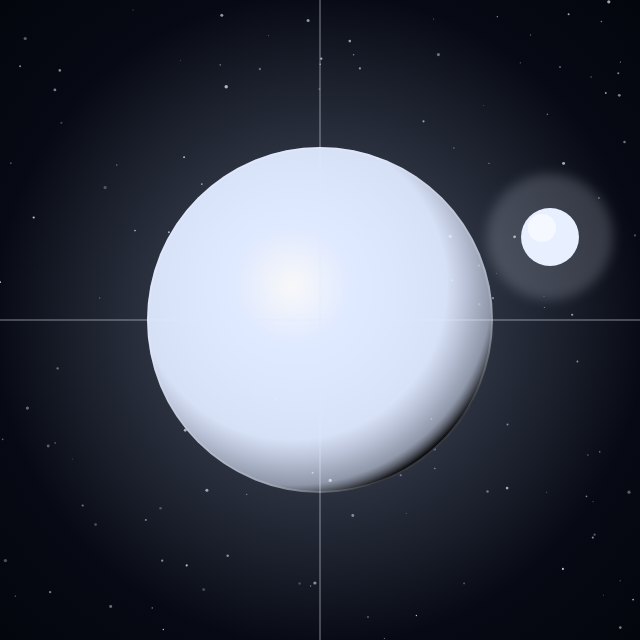
Distance and spectral type
Sirius is about 9 light-years away, a white star (spectral type A0m...), in the constellation Aquila. Its apparent magnitude is -1.5, visible to the naked eye.
Stellar figures
| Distance | 8.6 ly |
|---|---|
| Magnitude | −1.46 — brightest star |
| Constellation | Canis Major |
Figures are representative approximations. Source: compiled from NASA and IAU public data.
Behind the name
Greek "scorching". Ancient Egypt timed the Nile flood and the new year by its dawn rising.
The puzzle of the ancient red Sirius
Around AD 150 the Greek astronomer Ptolemy listed Sirius in his Almagest as a reddish star, and the Roman philosopher Seneca wrote that it was redder than Mars. Today, though, Sirius is plainly blue-white. A star changing colour that much in only two thousand years would be very hard to explain with what we know about how stars live.
Many explanations have been offered. Perhaps the writers described Sirius low on the horizon, flashing red through the air; perhaps red was simply a way of saying very bright. Some suggested that Sirius B had been a red giant at the time, but B became a white dwarf more than a hundred million years ago, so that cannot be right. In the same era the Chinese historian Sima Qian recorded Sirius as white. The widely accepted view is that the puzzle lies in the texts, not the star.
Sirius A and B circle each other about every fifty years. The early 2020s are the time when the two appear farthest apart, so a telescope of about 20 cm can pick out B. Because A is roughly ten thousand times brighter, this works only on clear, steady nights.
The star in depth
Sirius, in the constellation Canis Major, shines at magnitude −1.46, brighter than any other star in the night sky. That is not because it is a giant but because it is close: 8.6 light-years away, so its light takes about eight years and seven months to reach us. It has about twice the Sun's mass and gives off about 25 times as much light.
Sirius has a small companion, Sirius B. It is a white dwarf, the leftover core of a star that was once heavier than Sirius is now and has used up its fuel. It packs about the Sun's mass into a ball the size of Earth, so a piece the size of a sugar cube would weigh more than two tonnes.
The way Sirius B was found is a story in itself. In 1844 the German astronomer Friedrich Bessel noticed Sirius weaving slightly as it moved across the sky and predicted that an unseen companion was tugging on it. Eighteen years later, in 1862, the American telescope maker Alvan Clark spotted that companion while testing a new lens.
In ancient Egypt, the first reappearance of Sirius in the dawn sky signalled that the Nile flood was near, so the star marked the start of the year. From mid-northern latitudes it shines blue-white in the southern sky on winter nights, and from the Southern Hemisphere it rides high on summer nights; in the Sky view, look below and to the left of Orion.
Frequently asked
- How far is Sirius from Earth?
- The distance of Sirius is 8.6 ly.
- How bright is Sirius (apparent magnitude)?
- The magnitude of Sirius is −1.46 — brightest star.
- Which constellation is Sirius in?
- Sirius lies in the constellation Aquila.
Related
Figures are representative approximations. Simulated positions use J2000 mean elements.