Vega
What is Vega?
Stars· Distance 25 ly · size 2.4× Sun. The bright star overhead on summer nights, in Lyra, known in East Asia as the Weaver Star. Because Earth's axis slowly changes direction, Vega will serve as the pole star in about 12,000 years.
📍 Visible from where you are right now — computed in your browser
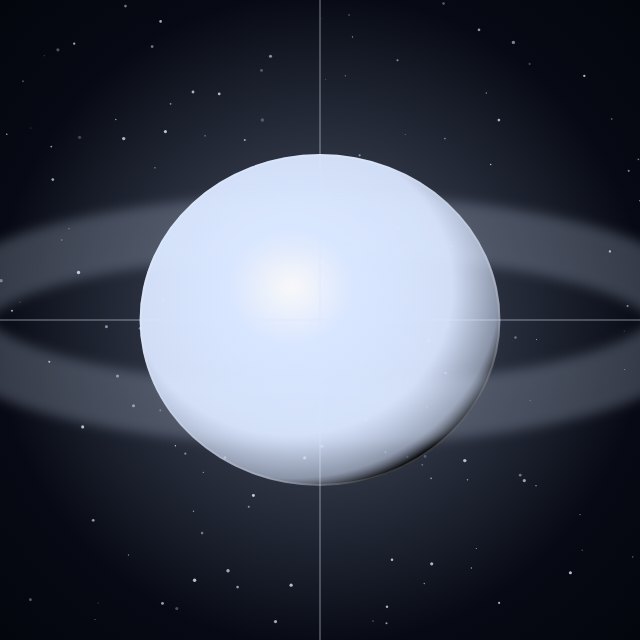
Distance and spectral type
Vega is about 25 light-years away, a white main-sequence star (spectral type A0Vvar), in the constellation Cygnus. Its apparent magnitude is 0, visible to the naked eye.
Stellar figures
| Distance | 25 ly |
|---|---|
| Constellation | Lyra |
| Note | the pole star in ~12,000 yr |
Figures are representative approximations. Source: compiled from NASA and IAU public data.
Behind the name
Arabic "the swooping eagle". It defined magnitude zero and was the first star ever photographed (1850).
Vega, a flattened star that spins in 12.5 hours
Vega spins once about every 12.5 hours, roughly fifty times faster than the Sun, which takes about 25 days. Its equator moves at about 236 km/s, around 90 percent of the speed at which the star would start to fly apart. As a result Vega bulges at the equator, where its radius is about 19 percent larger than at the poles.
The bulging equator is about 2,000 degrees cooler than the poles. We happen to see Vega almost pole-on, so it looks round, and for a long time it was taken for an ordinary, slowly spinning star. In 2006, observations with interferometers, which link several telescopes to work as one, confirmed its rapid spin.
Vega was also one of the first stars whose distance was measured. In the late 1830s the astronomer Friedrich Struve measured the tiny shift in Vega's position as Earth circles the Sun, and his value was very close to today's. Around the same time Bessel and Henderson published distances to two other stars, giving the first numerical proof of how far away the stars are.
The star in depth
Vega is the brightest star in Lyra, a blue-white star 25 light-years away. It shines overhead on summer nights and forms the Summer Triangle with Deneb in Cygnus and Altair in Aquila. In East Asia it is the Weaver Star, known from the tale of the weaver and the herdsman (Altair), who are allowed to meet across the Milky Way once a year on the seventh night of the seventh month.
For a long time Vega was astronomy's reference star. The magnitude scale used to measure star brightness was long set so that Vega was magnitude zero. In 1850 it became the first star other than the Sun to be photographed. In 1983 an infrared satellite found a disc of dust around Vega, an early sign that other stars also have the raw material for planets.
Earth's axis slowly swings around like a wobbling top, completing one circle about every 26,000 years. This is called precession. Today the axis points near Polaris, but in about 12,000 years it will point near Vega, and Vega will become the northern sky's pole star.
Vega's declination of +38.8° almost matches the latitude of Washington, D.C. (38.9°N) and is close to New York's (40.7°N). So on summer nights there, when Vega is at its highest, it passes within about two degrees of the point straight overhead. Look up at the middle of a summer night sky in the Sky view and it is the first star you notice.
Frequently asked
- How far is Vega from Earth?
- The distance of Vega is 25 ly.
- What is notable about Vega?
- The note of Vega is the pole star in ~12,000 yr.
- Which constellation is Vega in?
- Vega lies in the constellation Cygnus.
Related
Figures are representative approximations. Simulated positions use J2000 mean elements.