[Stargazing]
How to find the Andromeda Galaxy with the naked eye — star-hopping from the Great Square
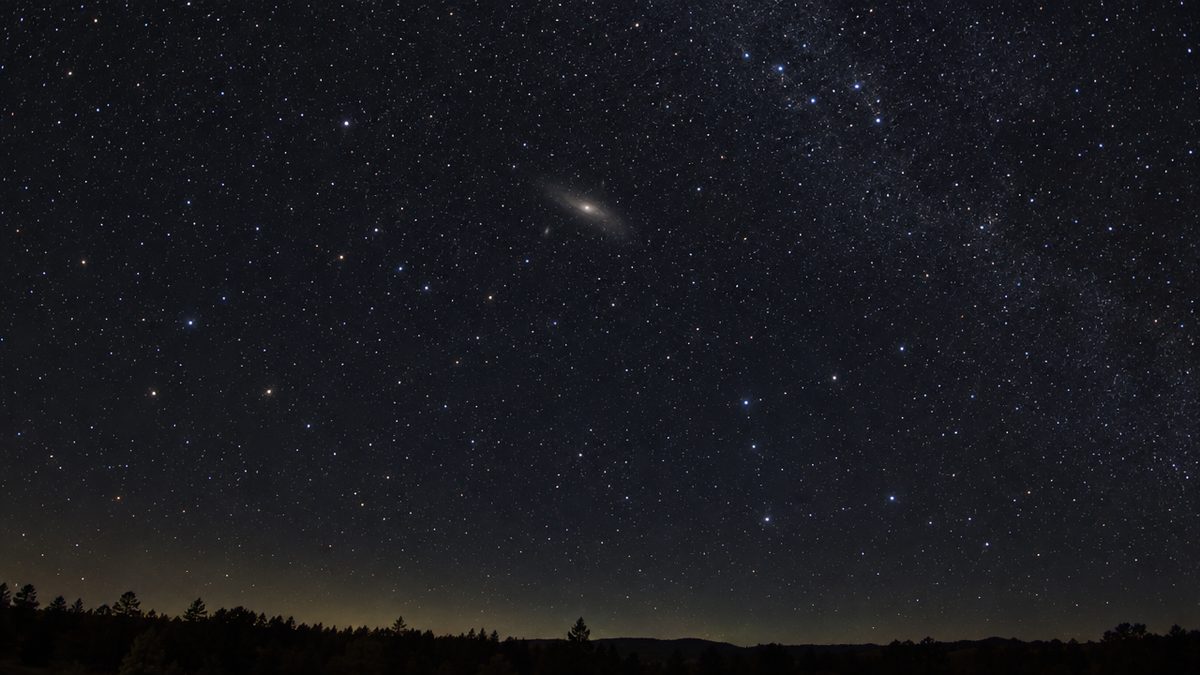
How to find the Andromeda Galaxy by star-hopping from Pegasus or Cassiopeia, what it looks like by eye and in binoculars, and when to look.
Almost everyone has seen a photograph of the Andromeda Galaxy: a great tilted spiral, its arms wrapped in dark dust lanes, filling the frame. That picture is also why many first attempts fail: anyone searching for something large and bright walks straight past it. Knowing how to find the Andromeda Galaxy starts with knowing that, to the eye, it is neither a point of light nor a spiral, but a faint, soft smudge.
This guide sets out the route to that smudge. It starts from two of the easiest patterns of the autumn sky, the Great Square of Pegasus and the W of Cassiopeia, then hops a few stars to the galaxy. It also covers what the naked eye and binoculars actually show, when to look from northern and southern latitudes, and how light pollution changes the picture. The result is a way to point, on a clear autumn evening, at light that left its source about 2.5 million years ago.
What the Andromeda Galaxy really looks like
It pays to know the target before going out. The Andromeda Galaxy, also catalogued as M31, has an apparent magnitude (brightness as seen from Earth, where smaller numbers mean brighter) of about 3.4. The catch is that a star concentrates its light into a point, while M31 spreads the same amount of light over a large patch of sky. Its surface is therefore much dimmer than the magnitude suggests.
| Property | Value |
|---|---|
| Distance | about 2.5 million ly |
| Apparent magnitude | about 3.4 |
| Size on the sky | about 3.2° × 1° |
| Diameter | about 152,000 ly |
At more than three degrees long, the galaxy spans about six full Moons placed side by side. That figure, though, comes from long-exposure images that record its faint outer disc. The eye and binoculars pick up only the brighter core and the area around it, so in practice M31 appears as an elongated, misty oval with no sharp edge, slightly brighter towards the middle.
A technique called averted vision helps a great deal. The outer part of the retina is more sensitive to dim light than the centre, so looking slightly to one side of a faint object makes it easier to see.
How to find the Andromeda Galaxy from the Great Square
The most common route begins at the Great Square of Pegasus, a large box of four second- and third-magnitude stars that stands high on autumn evenings in the northern hemisphere. Moving from one known star to the next until the target appears is called star-hopping.
- Find the Square. On an autumn evening, look high in the east to south for four similar stars forming a big, nearly empty box.
- Pick Alpheratz, the north-east corner. It is the corner nearest Cassiopeia. Officially this star belongs to Andromeda, not Pegasus.
- Follow the line east-north-east. A chain of stars runs away from Alpheratz. Past one third-magnitude star, the next second-magnitude star is Mirach, a red giant with a faint orange tint.
- Turn north-west at Mirach. Two fainter stars, around fourth magnitude, lead from Mirach towards the galaxy. The first is Mu Andromedae, the second Nu Andromedae.
- Look just beyond Nu. A short way past Nu lies an elongated, hazy glow. That is M31.
From Mirach to M31 is about eight degrees, a little less than a fist held at arm's length. Under a bright suburban sky Mu and Nu may be invisible. In that case, note the direction from Mirach towards where Mu should be, move about one fist along it, and sweep the area with binoculars.
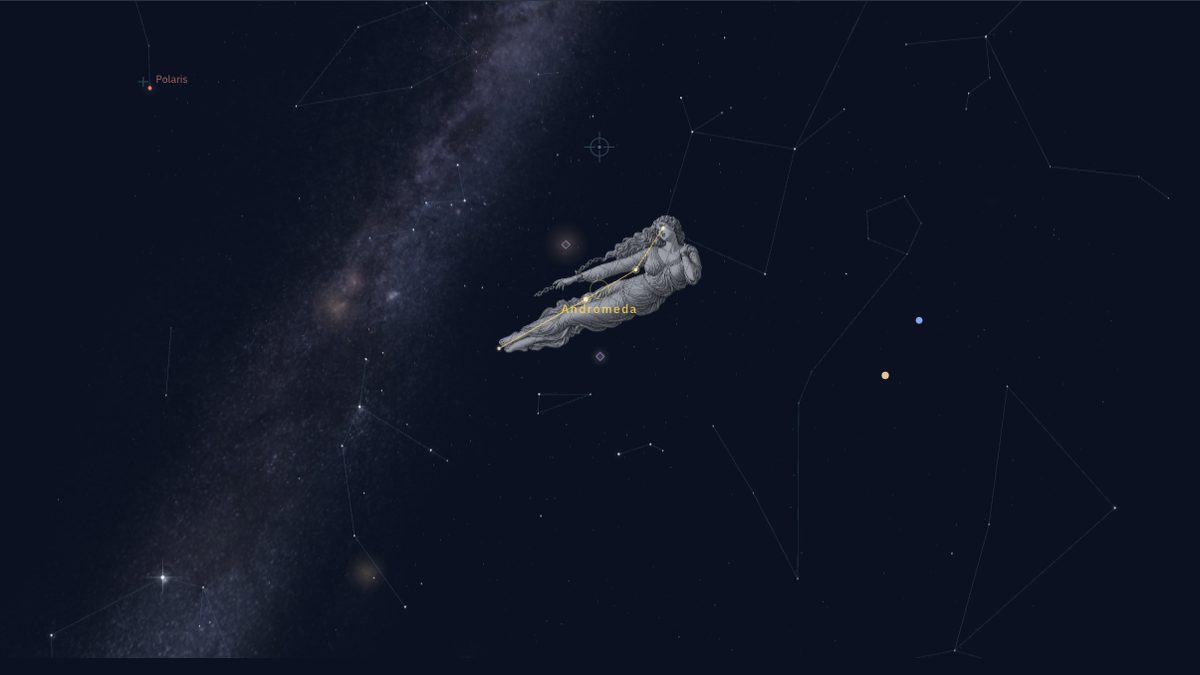
The route down from Cassiopeia
When the Square is blocked by a building, or still low early in the season, there is a second route from the W of Cassiopeia in the northern sky.
Pick Schedar, usually counted as the brightest star in Cassiopeia: it is the second star of the W, counting from Caph, the end nearest the Square. M31 lies about fifteen degrees almost directly south of it, roughly one and a half fists. The two objects sit at nearly the same right ascension (the sky's equivalent of longitude), so the line from Schedar runs straight towards the galaxy. A simpler way to remember it is that M31 lies roughly halfway between the W and the Square.
When the hop from the Square and the drop from Cassiopeia land on the same patch of sky, the identification is almost certain.
What binoculars add
Once the naked-eye position is pinned down, binoculars are the natural next step. A standard 7× or 10× pair fits the whole galaxy in one field. The faint smudge becomes a definite oval with a small, bright, almost star-like core, and the tilt of the disc is easy to see.
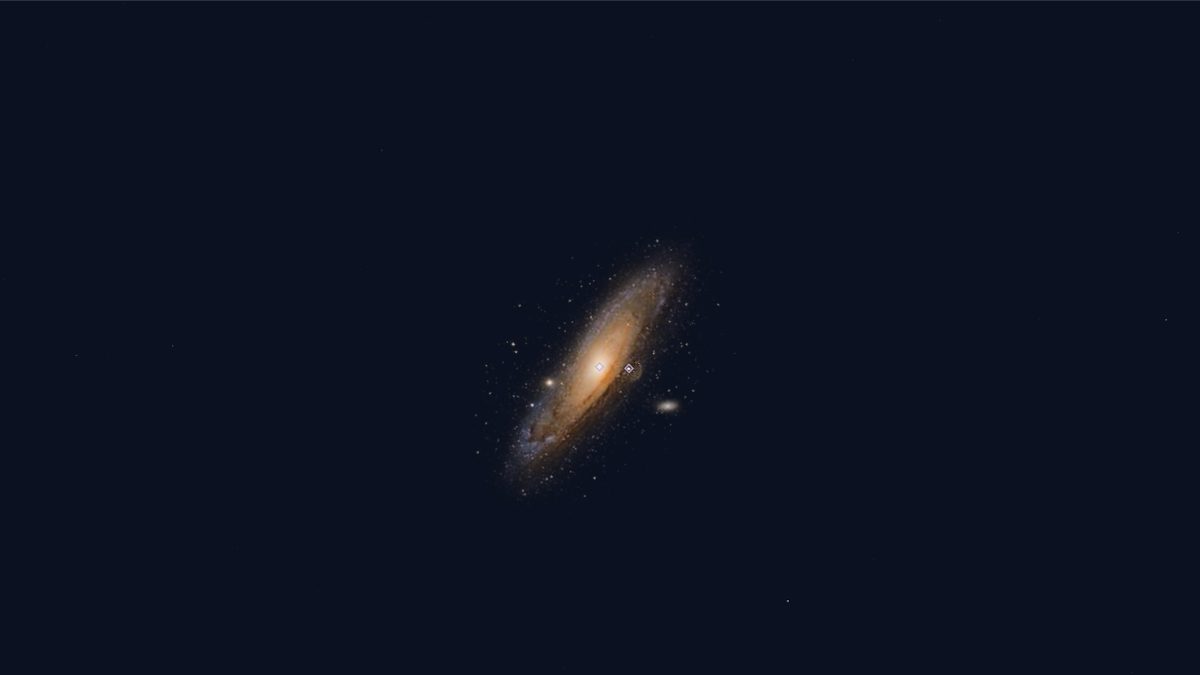
From a dark site, two small companion galaxies, M32 and M110, may appear as tiny faint patches nearby. The spiral arms and dust lanes in photographs, however, are not visible in binoculars. Those come from long camera exposures.
Steady binoculars show faint light much better. Because M31 passes almost overhead from mid-northern latitudes, a reclining chair or a mat on the ground makes a long look far more comfortable.
When and where to look, north and south
M31 is an autumn and early-winter evening object, because in those months it is already high when the sky gets dark.
| Month | Around 8–9 pm local time (mid-north) |
|---|---|
| September | Halfway up in the north-east |
| October–November | High in the east to overhead |
| December | Overhead, moving north-west |
| January | Sinking in the north-west |
The galaxy's declination, its position north or south of the celestial equator, is about +41°. From New York, at a latitude of about 41° north, it passes almost exactly overhead; in mid-November that happens at around 9 pm EST. From London it culminates about 80° up at roughly the same local time. Note that in 2026 clocks in New York fall back from EDT to EST on 1 November, and in London from BST to GMT on 25 October.
The southern hemisphere is a different story. From Sydney or Cape Town, both at about 34° south, M31 never climbs higher than about 15° above the northern horizon, and it does so around 10 pm local summer time in mid-November. The view is also upside down compared with northern charts: the Great Square stands higher in the sky and the galaxy hangs below it, closer to the horizon, so the hop from Alpheratz to Mirach and then to M31 runs downwards. Cassiopeia never rises from these latitudes, so the Schedar route does not work there. Observers there need a clear, dark northern horizon, with no buildings or city glow in that direction, and binoculars are almost essential.
The Moon matters too. Moonlight within a few days of full brightens the sky enough to wipe out a faint smudge. The best nights fall between the last quarter and a few days after new Moon, when the evening sky is dark.
Light pollution is a major obstacle. From a city centre the galaxy is hard to see by eye, and binoculars are often needed just to find it. Standing with streetlights behind you, switching off the phone screen and giving the eyes fifteen to twenty minutes to adapt changes what is visible from the same spot.
Light that left 2.5 million years ago
At about 2.5 million light-years, the light reaching the eye tonight left Andromeda about 2.5 million years ago, when the distant ancestors of humans were living in Africa.
It has only been about a century since the glow was shown to be a separate galaxy. The Persian astronomer al-Sufi described it as a small cloud in the tenth century, but it was not until the 1920s that Edwin Hubble identified Cepheid variable stars in it (stars whose pulsation period reveals their true brightness), measured its distance and showed that it lies far beyond the Milky Way. The galaxy is estimated to contain around a trillion stars.
Andromeda is approaching the Milky Way at about 110 km per second. For years this led to the prediction that the two would collide in about 4 billion years and then merge over a few billion more. A 2025 study led by Till Sawala in Nature Astronomy, using Hubble and Gaia data and accounting for the pull of the Triangulum Galaxy and the Large Magellanic Cloud, put the chance of a merger within the next 10 billion years at roughly 50 percent. The collision is a probability, not a certainty.
Frequently asked questions
Can the Andromeda Galaxy be seen from a city?
Rarely by eye. On a moonless night from an area with moderate light pollution it can be visible without optical aid, but from a city centre it usually takes binoculars, aimed using the star-hop, to make out the faint glow.
Is a telescope better than binoculars for M31?
Not necessarily. The galaxy spans more than three degrees, so a telescope at higher magnification shows only the core. For a first look, wide-field binoculars give a better sense of its overall shape.
Final thoughts
How to find the Andromeda Galaxy comes down to a short sequence: from Alpheratz to Mirach, across two faint stars to Nu Andromedae, and onto the glow just beyond, with the drop south from Schedar as a check. The view is modest next to the famous photographs. In my view that modesty is part of its appeal, since a faint oval seen with nothing but the eye is still light that has travelled for 2.5 million years.
Open the screens from this post
- Locate the Andromeda GalaxyM31 in the sky view
- See the constellation AndromedaWith the Great Square