[Stargazing]
How to find constellations from a light-polluted city — a first-night plan
How to find constellations from a light-polluted city: which stars survive the glow, using bright stars, planets and the Moon as anchors, and a first-night plan.
Most people who try to find constellations from a city run into the same problem. They study a star chart, step outside, and see only a handful of stars above the streetlights and lit windows, with no obvious way to match any of them to the chart. The reason is simple: most star charts are drawn for a dark country sky, not for a sky lit up by a city.
This guide starts from the sky most people actually have. It covers which stars survive light pollution, how to use bright stars, planets and the Moon as anchors, and how to spend a first night outside, with notes for northern cities such as London and New York and southern ones such as Sydney and Cape Town. The aim is realistic: two or three constellations named from a garden, balcony or rooftop.
Which stars survive a city sky?
City lights scatter in the air and brighten the whole background of the sky, so faint stars sink into the glow. Astronomers describe this with the Bortle scale, from class 1, the darkest skies on Earth, to class 9, an inner-city sky. Under a class 1 sky the faintest star visible to the naked eye is around magnitude 7.6 to 8. In a city sky (class 8) that limit drops to about magnitude 4.1 to 4.5, and in an inner-city sky (class 9) to 4 or brighter. Magnitude is a brightness scale where smaller numbers mean brighter stars, so losing three or four magnitudes removes the great majority of stars.
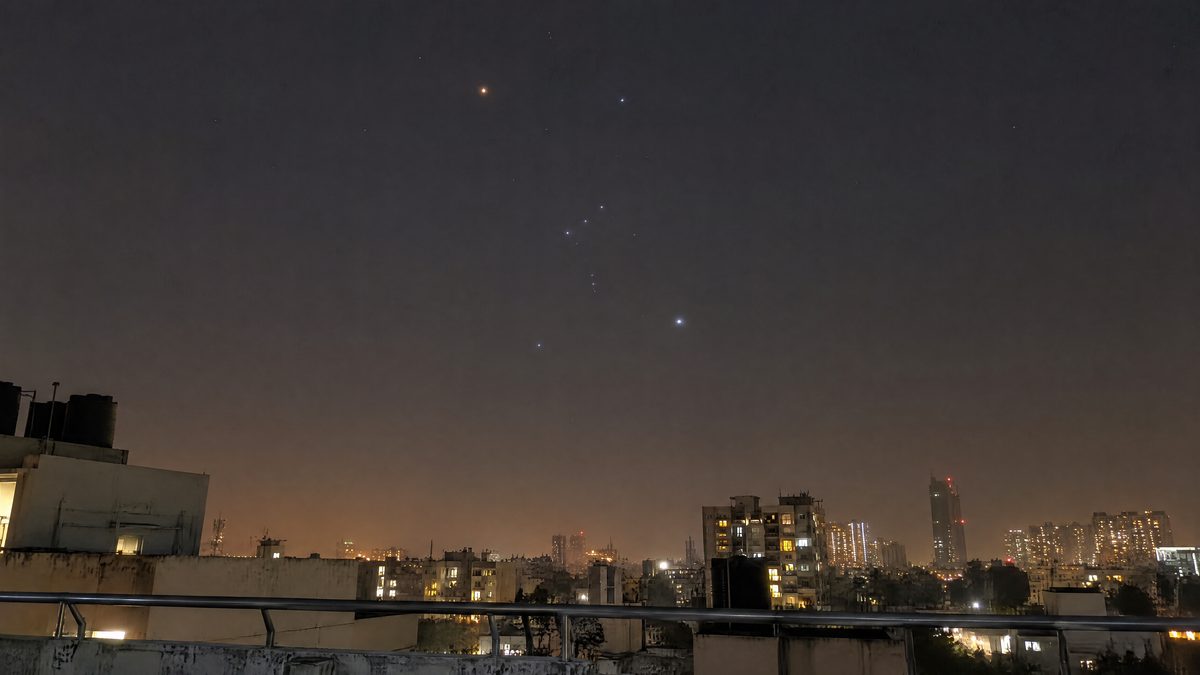
In a city, then, the task is not to see a whole constellation but to find its skeleton: the few bright stars that carry its shape. Three groups usually make it through.
| Group | Examples | In a city |
|---|---|---|
| First-magnitude stars | Sirius, Vega, Acrux | Almost always |
| Simple 2nd-mag shapes | Plough, Cassiopeia | On clear nights |
| Planets and the Moon | Jupiter, Venus | First to appear |
Only 22 stars in the whole sky are brighter than magnitude +1.5, and no single place on Earth sees all of them. Those few are the landmarks of a city sky, followed by simple shapes made of second-magnitude stars. Six of the seven stars of the Big Dipper, known in Britain and Ireland as the Plough, are second magnitude, so its outline usually holds up under orange skies. The W of Cassiopeia is built from five stars of similar brightness and is easy to catch on a clear night.
Constellations spread over faint stars, such as Pisces or much of Virgo, are close to impossible to trace from a city and are better left for later. That leaves a short list of bright points, and the next step is to name them.
Start from the brightest point, not the shape
In a city the usual order is reversed: start from the brightest point and work outwards, the way a boat drops anchor before exploring the shore.
- Pick the brightest point that is not too close to the horizon.
- Decide whether it is a star or a planet. A point that is unusually bright and twinkles less than its neighbours is very likely a planet.
- Look for two or three points of similar brightness nearby. A triangle, a square or a ladle is the skeleton.
- Name the skeleton by matching it against a sky view prepared in advance.
Which anchors are available depends on hemisphere and season. On October evenings from London or New York, the Summer Triangle of Vega, Deneb and Altair is still well up in the west. Each is the brightest star of its constellation (Lyra, Cygnus, Aquila), so one triangle fixes three at once. Later in the night, and on winter evenings, Orion takes over.
From Sydney or Cape Town, at about 34° south, the picture is different. Most of the Plough never rises; only its handle skims the northern horizon at best, and Cassiopeia does not rise at all. Southern observers use the Southern Cross (Crux) instead. Its brightest star, Acrux, is magnitude 0.8, and from these latitudes the Cross stays above the horizon all night or very nearly so, though in October evenings it sits low in the south-west and is easily hidden by buildings. The two bright Pointers, Alpha and Beta Centauri, lead the eye to it. Orion is the shared landmark: it lies on the celestial equator, so it is visible from both hemispheres, appearing upside down from the south, where its belt and sword are often called the Saucepan.
Using planets and the Moon as guides
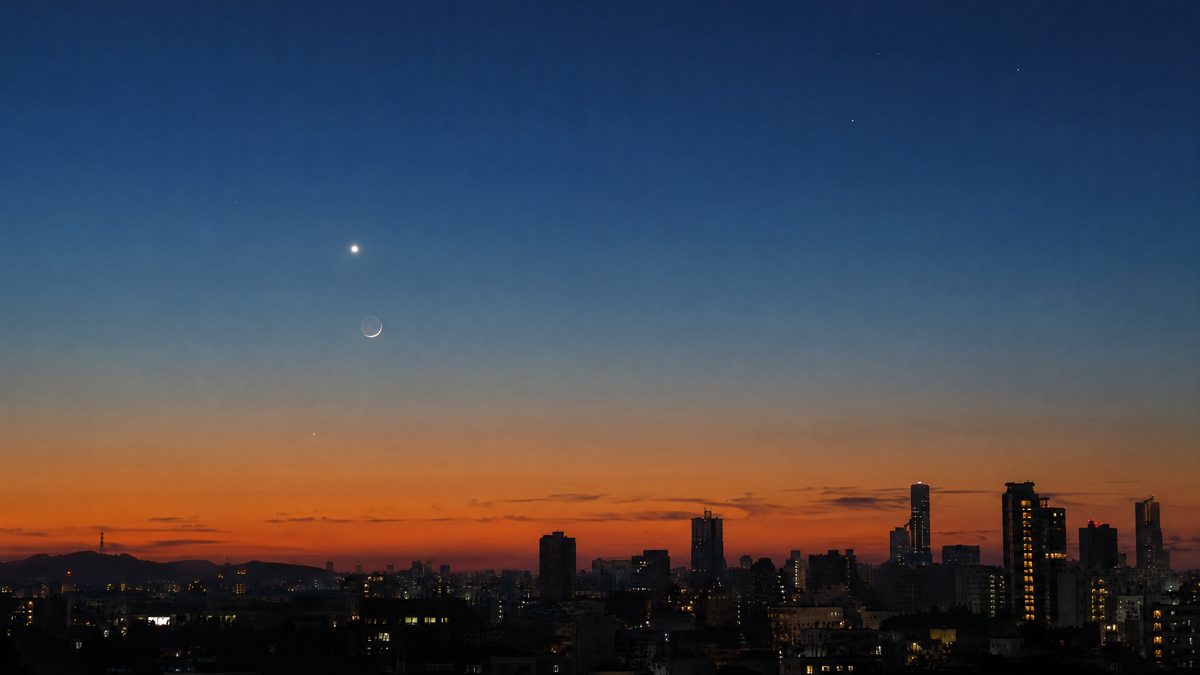
The first objects to appear over a city are usually planets and the Moon, which light pollution barely affects.
Planets stay close to the ecliptic, the Sun's path across the sky, so a planet always sits in or near a zodiac constellation. During late 2026 and early 2027, for example, Jupiter is in Leo, not far from Leo's brightest star, Regulus, and its opposition in February 2027 keeps it up all night. Find that unusually bright point, and the first-magnitude star close by is Regulus.
The Moon follows nearly the same path. It completes a lap of the sky against the stars in about 27.3 days, so it shifts roughly 13° eastward each night, a little more than the width of a fist held at arm's length. The evening it passes a bright star, that star is easy to name. A full Moon washes out its surroundings, so a crescent or half Moon makes a better guide.
A first-night plan for finding constellations in the city
Rehearse on screen before going out. Set a sky simulator to the home city and the planned hour, note where the brightest points will be, and memorise only their skeleton — the screen shows far more stars than the city will.
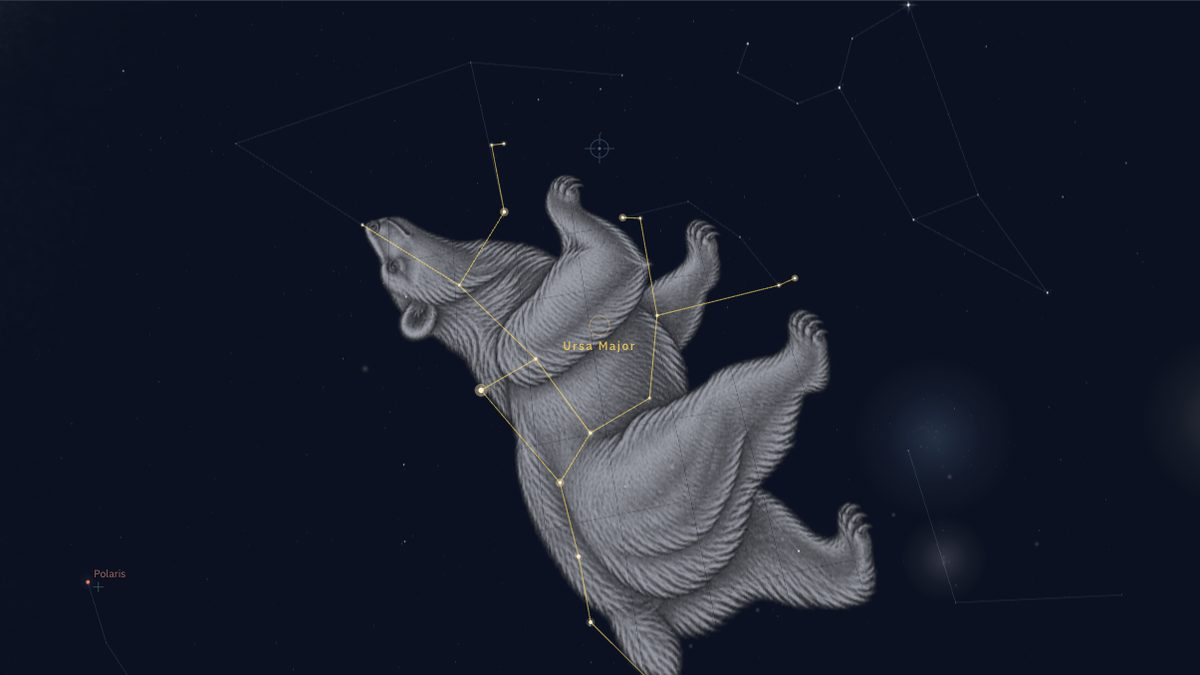
On northern spring evenings the Plough stands high in the north, as above, and is usually the first skeleton to appear over a city; the rest of the bear stays hidden in the glow. In NowSky's sky view this rehearsal means choosing a city, setting the time and selecting a constellation to see its lines and artwork.
Choose the darkest corner nearby. Standing with a streetlight behind you, or in a building's shadow, already adds stars; a park, garden or rooftop with one open side of sky is enough. Then switch off the phone screen and let the eyes adjust. Most of the gain comes in the first 20 to 30 minutes, and a red light preserves it far better than a white one.
One bright point, one skeleton, one direction. Three goals are plenty for a first night: the name of the brightest point, one shape next to it, and a reference for north or south.
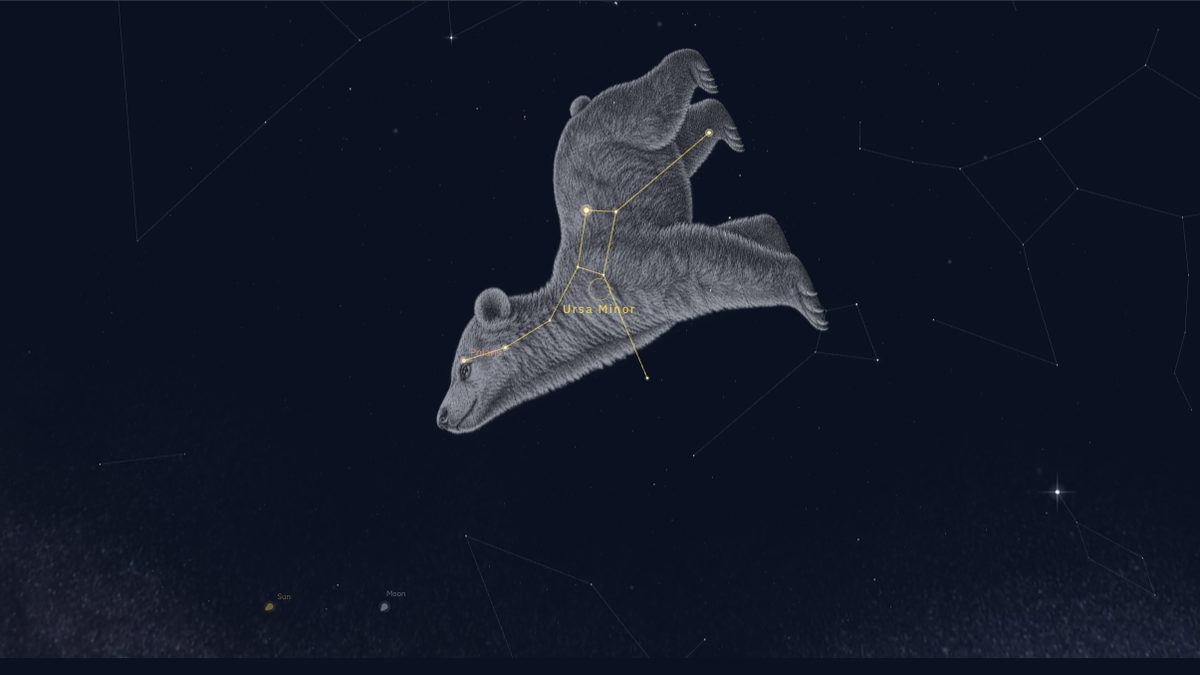
For northern observers that reference is Polaris. At about magnitude 2 it looks ordinary from a city, but it sits almost alone in its patch of sky, and that isolation is the clue. The two stars at the outer edge of the Plough's bowl, Dubhe and Merak, point towards it. Its height above the horizon roughly equals the observer's latitude: about 51° from London and about 41° from New York. On autumn evenings the Plough lies low along the northern horizon and is easily blocked by buildings, so it pays to start with whatever is high instead.
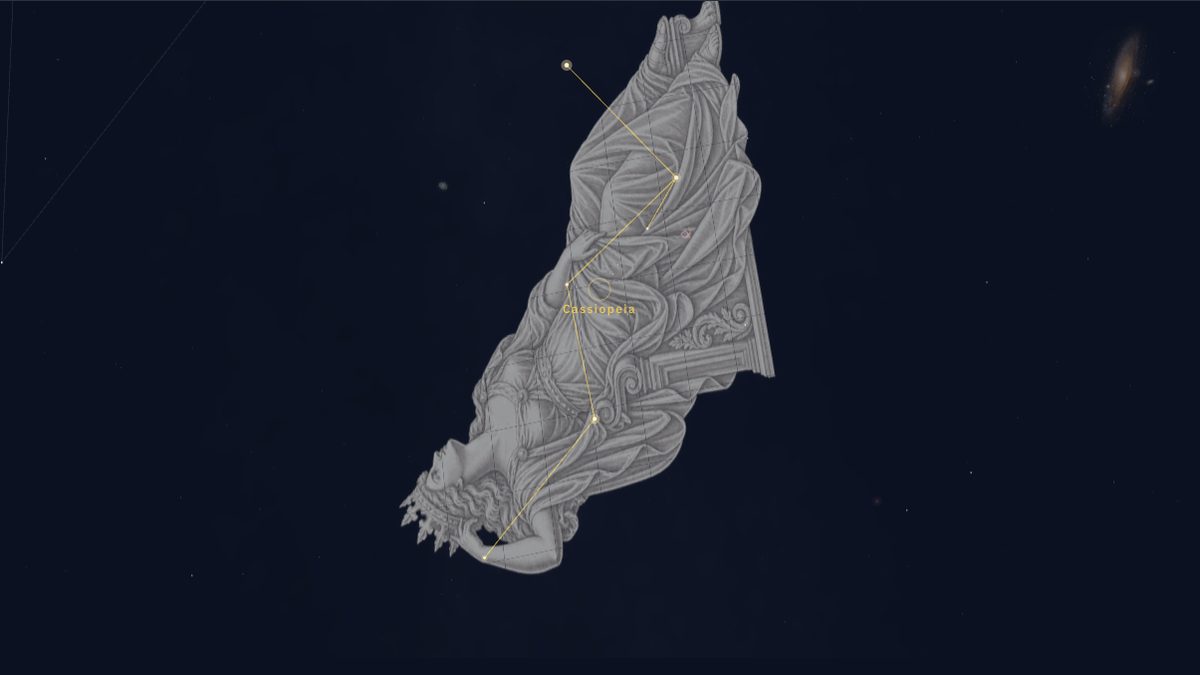
On October evenings that means Cassiopeia, a W of five stars high in the north-east, which shows clearly between rooftops. It lies on the opposite side of Polaris from the Plough, so Polaris sits roughly halfway between the two. For southern observers the reference is the south celestial pole, which has no bright star of its own: extending the long axis of the Southern Cross about four and a half times its length lands near it. Once a shape is found, sketching it as a few dots in a notebook helps fix it, and finding it again at the same time the next evening is when recognition starts to come from the eyes rather than memory.
Frequently asked questions
Can the Milky Way be seen from a city?
Generally not. The Milky Way is the combined light of countless faint stars, and a bright city background swamps it. It is worth saving for a trip to a darker site.
Why don't constellations look like the pictures?
Star-chart figures are artwork laid over the stars by ancient storytellers. In a city only a skeleton of bright stars shows, so simple shapes such as a ladle, a W, a cross or a triangle are the quickest route.
Can southern observers see the Plough or Polaris?
Polaris never rises from the southern hemisphere, and from Sydney or Cape Town only part of the Plough skims the northern horizon. The Southern Cross with its Pointers, and Orion, serve as the starting shapes there instead.
Final thoughts
The key to finding constellations from a city is to start from the brightest point rather than from a shape. With first-magnitude stars, planets and the Moon as anchors, and the simple skeletons beside them as the next step, two or three constellations are well within reach even under heavy light pollution.
A sky with only a few stars is also a sky with fewer stars to confuse. For learning the way around, a city sky is a better classroom than it first appears.
Open the screens from this post
- Find the PloughUrsa Major selected
- Find PolarisPolaris selected