Why does the Moon change phase, and when is it best to observe?
The Moon's phase depends on how much of its sunlit half faces Earth, and that share changes as the Moon circles us. One full cycle, from new moon to new moon, takes 29.5 days on average, and the Moon rises about 50 minutes later each day. Quarter phases are best for seeing craters, while the days around new moon are best for faint stars.
The Moon is always half lit
The Moon makes no light of its own; what we see is reflected sunlight. Like Earth, it always has a day side facing the Sun and a night side facing away. The phase we see is simply our angle of view on that day side.
When the Moon lies in roughly the same direction as the Sun, its lit half faces away from us and the Moon is all but invisible, lost in the Sun's glare. This is new moon. Half an orbit later the Moon sits opposite the Sun, its whole day side faces Earth, and we see a full moon. In between come the waxing crescent, first quarter, waxing gibbous, waning gibbous, last quarter and waning crescent, giving the eight named phases. You can reproduce the effect with a ball and a lamp: walk the ball around the lamp while watching it, and its lit part grows and shrinks in the same order. A common mistake is to think Earth's shadow causes the phases. Earth's shadow only falls on the Moon during a lunar eclipse.
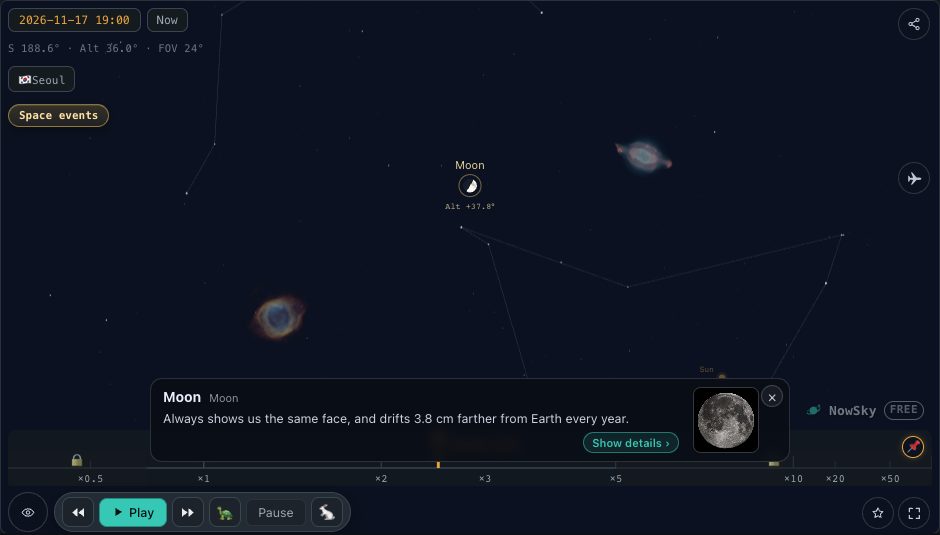 ▶ Open in the simulator
 Why the phase cycle is two days longer than the orbit
Measured against the stars, the Moon completes one orbit in about 27.3 days, a period called the sidereal month. The cycle of phases, the synodic month, is longer: 29 days, 12 hours and 44 minutes on average, or about 29.5 days.
The extra two days come from Earth's own motion around the Sun. By the time the Moon has returned to the same place among the stars, the Sun's direction has shifted, so the Moon must travel a little further before it lines up with the Sun again. Calendars based on the Moon, which alternate months of 29 and 30 days, follow this synodic cycle. The two periods describe the same orbit; they differ only in what counts as one full lap, the stars or the Sun.
Each phase keeps its own hours
The Moon moves about 12 degrees east along its orbit each day, so on average it rises around 50 minutes later than the day before. Earth turns 15 degrees an hour, so catching up with those extra 12 degrees takes close to 50 minutes. This ties each phase to a time of day. Taking a simplified day with sunrise at 06:00 and sunset at 18:00 local time, the new moon rises with the Sun, crosses the sky in daylight and sets with it.
The first quarter rises around noon, stands high in the evening sky at dusk and sets near midnight. The full moon rises at sunset, is highest around midnight and sets at dawn, because it sits opposite the Sun and stays above the horizon for as long as the Sun is below it. The last quarter rises near midnight, is high in the morning and sets around noon. Real times shift by an hour or two with season and latitude, but one rule always holds: a thin Moon in the west after sunset is waxing, and a thin Moon in the east before dawn is waning.
Craters stand out along the terminator
The line dividing the Moon's day and night sides is called the terminator. Along it, the Sun is just rising or setting as seen from the lunar surface, so light arrives at a low angle. Craters and mountains cast long shadows there, and the terrain looks sharply three-dimensional.
At full moon the light comes from straight behind us, shadows almost vanish and the surface looks flat. With binoculars or a small telescope, the best views come a few days after new moon through first quarter, and again around last quarter. The terminator moves a little every night, so the same crater changes its look from one evening to the next.
Near the crescent phases you may also see the dark part of the disc glowing faintly. This is earthshine: sunlight reflected by Earth, mostly by its clouds, lighting the Moon's night side. It is easiest to see in a waxing crescent after dusk or a waning crescent before dawn.
Planning dark-sky nights around moonlight
A full moon is up all night and reflects so much sunlight that it washes out most faint stars. For the Milky Way or the Andromeda Galaxy you need a night without the Moon in the sky.
The best window is a few days either side of new moon. Around last quarter the Moon does not rise until about midnight, so the evening stays dark. After first quarter the opposite happens: the Moon brightens the evening and only sets after midnight. If your night out is fixed, look up the moonrise and moonset times first and plan around the hours when the Moon is below the horizon. Bright planets and the brightest stars remain easy targets even under a full moon, so moonlit nights are still good for them.
The lit side flips between hemispheres
From the Northern Hemisphere, a waxing Moon is lit on its right side and a waning Moon on its left. From the Southern Hemisphere, in Sydney or Cape Town for example, the view is rotated by 180 degrees: the waxing Moon is lit on the left and the waning Moon on the right.
Near the equator a crescent often lies on its back, with the horns pointing up. The phase itself is the same for everyone on a given date; only the Moon's tilt and which side looks bright depend on where you stand.
Try it in the simulator
- See tonight's Moon →Select the Moon to see its phase and its rise, transit and set times on the card.
- Find the moonless hours →Move the time back and forth to see when the Moon drops below the horizon.
- Follow Earth in the orbit view →Watch the Earth–Sun geometry shift from day to day.
FAQ
- Why can I see the Moon in daytime?
- Depending on its phase, the Moon spends part of its time above the horizon in daylight. A first-quarter Moon is up in the afternoon and a last-quarter Moon in the morning, both easy to spot in a clear blue sky.
- Why do we always see the same face of the Moon?
- The Moon turns once on its axis in the same time it takes to orbit Earth. This synchronous rotation keeps one hemisphere facing us all the time.
- Why isn't every full moon an eclipse?
- The Moon's orbit is tilted about 5.1 degrees to Earth's orbital plane, so most full moons pass above or below Earth's shadow. An eclipse happens only when full moon falls near the points where the two planes cross.
Related reading
- Object Moon
- Sky news Total lunar eclipse — Pacific & Asia
- Guide How do you start stargazing with just your eyes?