Is that bright point a planet or a star? How to tell them apart
Planets shine with a steadier light than stars, appear only along the ecliptic, the Sun's yearly path across the sky, and drift against the background stars over days and weeks. A point brighter than Sirius, the brightest star of the night, is very likely Venus or Jupiter.
Why stars twinkle and planets mostly don't
Stars twinkle because of Earth's atmosphere, not because the stars themselves flicker. They are so distant that they appear as points with no measurable size, and that single thread of light is bent back and forth as it passes through turbulent layers of air, making it brighten, dim and jitter from moment to moment.
Planets are far closer, and although they look like points to the eye, each is really a tiny disc. Jupiter spans between about 30.5 and 50.1 arcseconds, and Venus between 9.7 and 66 arcseconds. Light from different parts of the disc is disturbed independently, and the disturbances average out, so a planet usually glows with a calm, even light. NASA's skywatching guidance puts it the same way: planets tend to shine steadily where stars often flicker.
The test depends on height. Close to the horizon, light passes through a much longer path of air, and even planets can twinkle, while a bright star such as Sirius may flash through different colours. Compare objects when they are reasonably high in the sky.
Planets stay close to the ecliptic
The ecliptic is the apparent path the Sun follows through the constellations over a year. Because the planets orbit the Sun in nearly the same plane, the Moon and planets also appear close to this line as seen from Earth. A band roughly 20 degrees wide centred on the ecliptic is known as the zodiac.
Today the ecliptic passes through thirteen constellations: Pisces, Aries, Taurus, Gemini, Cancer, Leo, Virgo, Libra, Scorpius, Ophiuchus, Sagittarius, Capricornus and Aquarius. An unfamiliar bright point far from that band, for example near Polaris or the Big Dipper, is very unlikely to be a planet.
The ecliptic roughly follows the arc the Sun takes across the daytime sky. For observers at mid-northern latitudes it curves across the southern part of the sky; for observers at mid-southern latitudes, such as in Sydney or Cape Town, it crosses the northern part. Scan along that arc, in the western sky after sunset, the eastern sky before dawn, or high in the sky around midnight, and a bright steady point is a strong planet candidate.
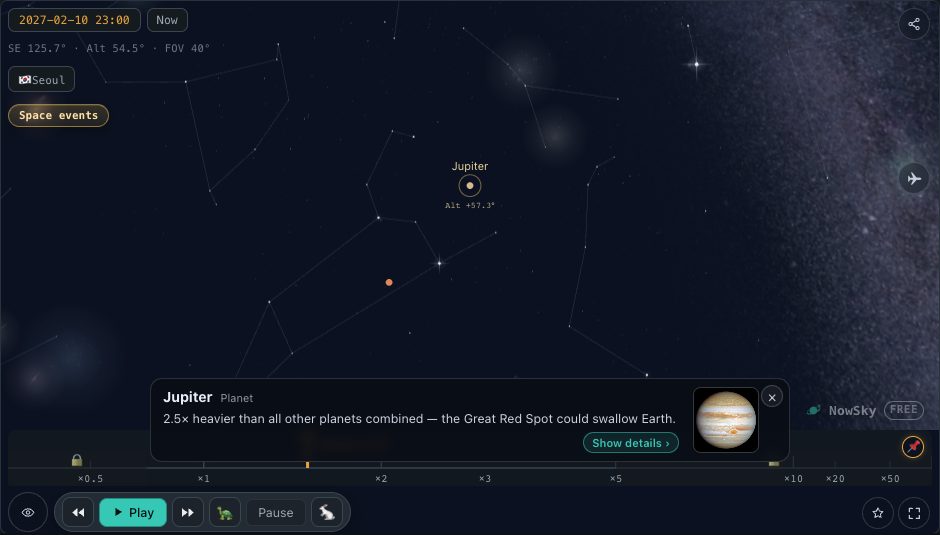 ▶ Open in the simulator
 Watch for a few nights and a planet moves
The patterns of the stars barely change over a human lifetime, but planets travel slowly through the constellations; the ancient Greek name for them meant wanderers. Note the position of a bright point relative to the stars around it, then look again at the same time a few nights or weeks later. If it has shifted, it is a planet.
Each planet moves at its own pace. Mars circles the Sun in about 687 days, so its position changes noticeably within a few weeks. Jupiter takes about 11.86 years per orbit, which works out to roughly 30 degrees a year, about one zodiac constellation. Saturn needs around 29.4 years and drifts more slowly still.
Planets usually move eastward against the stars, but when Earth overtakes an outer planet, the planet appears to stop and back up for a while before resuming. This apparent retrograde motion lasts about 121 days for Jupiter. Stepping time forward a few days at a time in the Sky view shows the planets sliding through the fixed pattern of stars.
Brighter than Sirius usually means Venus or Jupiter
Sirius, the brightest star in the night sky, has an apparent magnitude of −1.46. Venus ranges between about −4.92 and −2.98, and Jupiter between −2.94 and −1.66, so both planets outshine Sirius even at their faintest. Apart from the Moon, a point clearly brighter than Sirius is almost always one of these two.
Mars varies the most. Around opposition, when it is closest to Earth, it can reach magnitude −2.94, a match for Jupiter; when it is far away it fades to +1.86 and looks like an ordinary star. Saturn ranges from −0.55 to +1.17, comparable to the brighter first-magnitude stars.
Colour is another clue. Iron oxide on its surface gives Mars a distinct red-orange tint, and Saturn looks pale yellow. Venus and Jupiter appear brilliant white. Red stars such as Antares and Betelgeuse exist too, so combine colour with position and steadiness rather than relying on it alone.
Venus and Mercury never stray far from the Sun
Venus and Mercury orbit closer to the Sun than Earth does, so they never appear far from it in the sky. Their greatest angular distance from the Sun, called greatest elongation, is 45 to 47 degrees for Venus and only 18 to 28 degrees for Mercury. Neither planet is ever seen high in the sky in the middle of the night.
Venus therefore appears either in the western sky after sunset or in the eastern sky before sunrise, which is why it has long been called the evening star and the morning star. A dazzling, steady point low in twilight is very likely Venus; it is bright enough to be noticed before the sky is fully dark.
Mercury hugs the Sun even more closely and is seen only briefly, low over the horizon shortly after sunset or before sunrise. It can reach magnitude −2.48, but twilight makes it hard to spot, so the best chances come near greatest elongation, from a site with a clear, flat horizon.
Telling Jupiter, Mars and Saturn apart
The outer planets, Mars, Jupiter and Saturn, are brightest around opposition, when Earth passes between them and the Sun; they then rise at sunset and stay up all night. Jupiter comes to opposition about every 399 days and Saturn about every 378 days, so each has one almost every year. Mars reaches opposition only about every 780 days, a little over two years.
Jupiter is often the brightest point in the sky for the whole night. With binoculars or a small telescope you may see tiny points strung out in a line beside it: its four large moons, first seen by Galileo. Saturn is recognisable by its steady pale-yellow light, and resolving its rings clearly needs a telescope magnifying at least about 30 times.
Mars stands out through its colour and its changing brightness. Near opposition it becomes a red point rivalling Jupiter; a few months later it has faded noticeably. Selecting Jupiter or Saturn in the Sky view shows where the planet is tonight and which constellation it is passing through, making it easy to match against the real sky.
Try it in the simulator
- Jupiter tonight →Shows tonight's direction to Jupiter and the stars around it.
- Saturn tonight →Shows where Saturn sits along the ecliptic tonight.
- Sirius for comparison →Shows the brightest star, a handy yardstick for planet brightness.
- Follow Mars in orbit →Shows Earth and Mars orbiting, and why oppositions of Mars are rare.
FAQ
- How many planets can be seen with the naked eye?
- Five are easy: Mercury, Venus, Mars, Jupiter and Saturn. Uranus is at the very edge of naked-eye visibility under dark skies, and Neptune always needs binoculars or a telescope.
- If a bright point moves while I watch, is it a planet?
- If it visibly moves within minutes, it is a satellite or an aircraft, not a planet. A planet's motion against the stars only becomes noticeable over days. Aircraft usually show blinking navigation lights.
- Do planets ever appear close together?
- Yes. Because all the planets travel along the ecliptic, they sometimes pass close to one another in the sky, an event called a conjunction. On 21 December 2020 Jupiter and Saturn came within about 6.1 arcminutes of each other, their closest great conjunction since 1623.
Related reading
- Object Venus
- Object Jupiter
- Object Mars
- Object Saturn
- Sky news The Great Conjunction of 2020