Proxima Centauri
What is Proxima Centauri?
Stars· Distance 4.25 ly · size 0.15× Sun. The star nearest to the Sun. It is a faint red dwarf, invisible to the naked eye, yet it has a planet, Proxima b, orbiting at a distance where liquid water could exist.
📍 Visible from where you are right now — computed in your browser
 ▶ Open this view in the simulator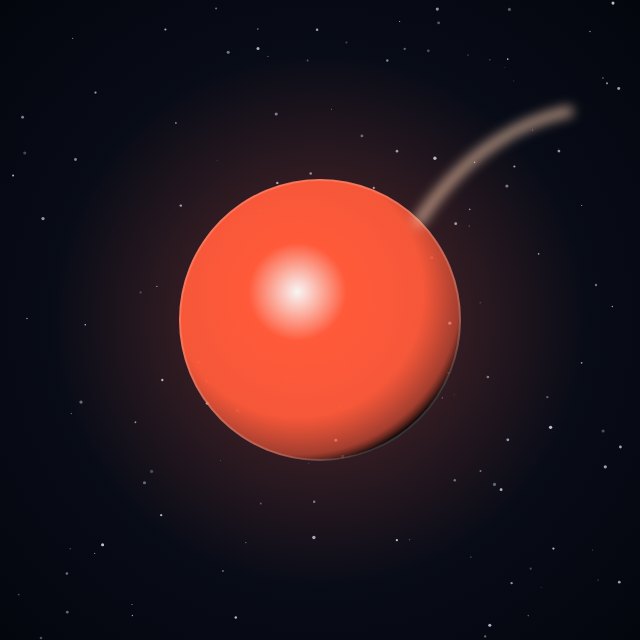
Stellar figures
| Distance | 4.25 ly — nearest star |
|---|---|
| Type | red dwarf |
| Planets | Proxima b (habitable zone) |
Figures are representative approximations. Source: compiled from NASA and IAU public data.
Proxima's planets: b, d and the candidate c
In 2016 a planet was found circling Proxima, named Proxima b. It has at least about 1.1 times Earth's mass and goes around the star in a little over 11 days. That is very close, but because Proxima is so dim, this is just the right distance for liquid water to exist on the planet's surface. In 2022 a smaller planet, Proxima d, was confirmed even closer in, taking only five days per orbit. At about a quarter of Earth's mass, it is one of the lightest planets found by this method.
In 2019 a larger planet, Proxima c, was proposed much farther out, orbiting about every five years, but it has not yet been firmly confirmed. Whether life could exist on Proxima b is also unknown. The star's violent flares may have stripped away the planet's air, and because it orbits so close, it probably keeps one side always facing the star. Astronomers plan to study the planet's atmosphere directly with very large telescopes on the ground.
As the nearest star, Proxima is also a dream destination for a spacecraft. A concept called Breakthrough Starshot proposes fitting tiny, very light probes with thin sails and pushing them with powerful lasers from Earth. At 20 percent of the speed of light, the calculation says they could arrive in about 20 years. For now it is only a concept, and many technical problems would need solving to make it real.
The star in depth
Proxima Centauri is the star nearest to the Sun, 4.25 light-years away. Even light takes more than four years to cross that gap, and at Voyager 1's speed the trip would take over 70,000 years. Proxima is a small star called a red dwarf, with about an eighth of the Sun's mass. Its light is so weak that it shines at only magnitude 11. So although it is the closest star, it cannot be seen with the naked eye.
Proxima was discovered in 1915 by Robert Innes, an astronomer in South Africa. He found a faint star moving across the sky in the same direction and at the same rate as bright Alpha Centauri. It soon turned out to be slightly closer than Alpha Centauri, and it was named Proxima, Latin for 'nearest'. In 2017 measurements confirmed that it is bound by gravity to Alpha Centauri A and B, circling the pair about once every 550,000 years.
Small stars use their fuel sparingly, so red dwarfs like Proxima can shine for trillions of years, hundreds of times the present age of the universe. But Proxima is not a calm star. It often has flares, sudden bursts of strong light and energy from its surface. These flares could be a serious threat to any life on nearby planets.
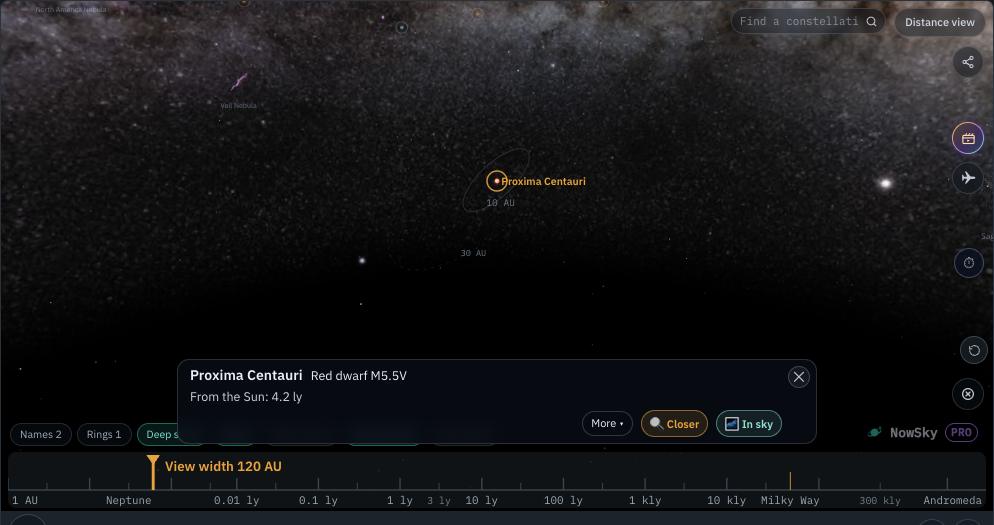
Proxima lies so far south that it never rises from Europe or most of the United States, and even from the southern hemisphere it needs a telescope. In the sky it appears about 2 degrees from Alpha Centauri, but in space it is some 13,000 AU from the pair. In the 3D neighbourhood view, Proxima appears as a small red point beside the bright Alpha Centauri pair, at its true position.
Frequently asked
- How far is Proxima Centauri from Earth?
- The distance of Proxima Centauri is 4.25 ly — nearest star.
- What kind of object is Proxima Centauri?
- Proxima Centauri is a red dwarf.
- In one line, what is Proxima Centauri?
- Stars — The star nearest to the Sun.
Related
Figures are representative approximations. Simulated positions use J2000 mean elements.