[Space facts]
Could a black hole have a habitable zone? What physics allows, and what it rules out
Can a black hole have a habitable zone? A look at accretion discs, the time-dilated cosmic background behind Miller's planet, and companion stars like Gaia BH1.
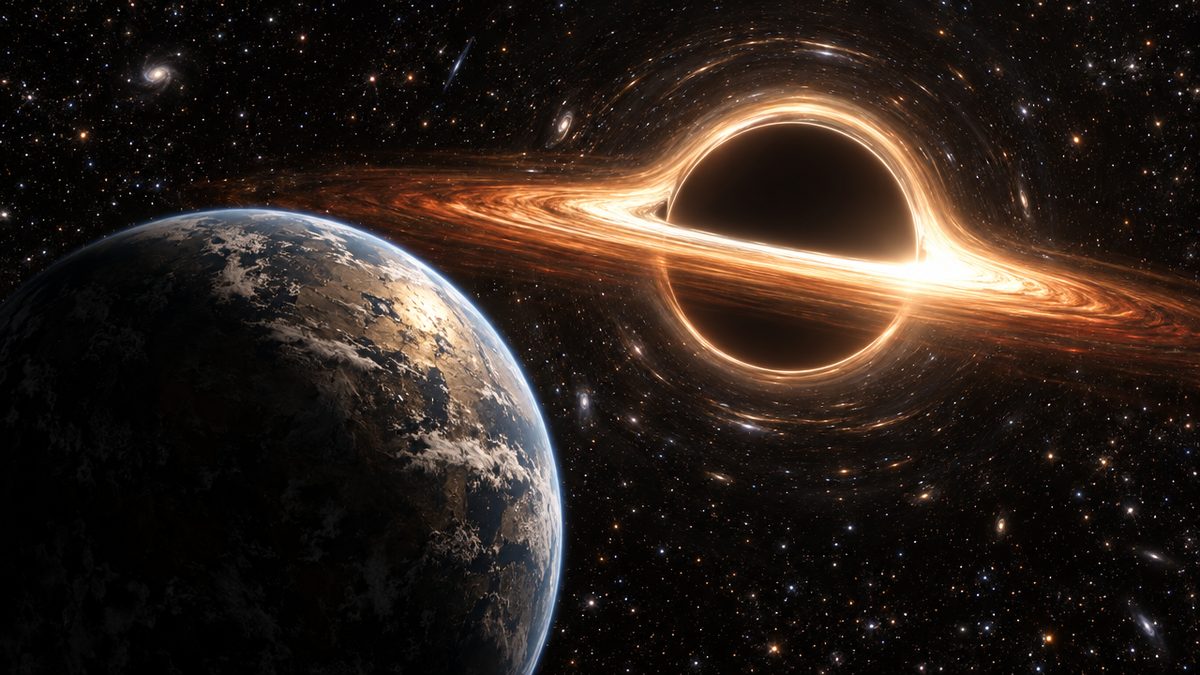
Interstellar viewers tend to wonder about Miller's planet: an ocean world circling a giant black hole, where an hour costs seven years back home. Ordinary stars have a "Goldilocks zone" where a planet is neither too hot nor too cold. A black hole, though, gives off no light of its own. So is a black hole habitable zone even a meaningful idea?
This piece covers what a habitable zone requires, then the three ways a planet near a black hole could stay warm, separating established physics, published thought experiments and the film, to show where the answer is "yes, in principle" and where it is "no".
What a black hole habitable zone would need
A habitable zone is the range of distances from a star where a planet's surface could hold liquid water. Too close and the water boils away; too far and it freezes. In the Solar System it runs roughly from near Earth's orbit to near Mars's, with the exact edges depending on how much atmosphere and greenhouse warming each study assumes. The core requirement is simple: the planet needs a steady supply of energy.
That is where a black hole starts at a disadvantage. In practice it emits nothing. Theory does predict a faint thermal glow called Hawking radiation, but its temperature falls as the mass rises. A black hole of one solar mass would sit at about 60 billionths of a kelvin; Gaia BH1, at roughly nine solar masses, works out to around 7 billionths of a kelvin and an output far below a single watt. The cosmic microwave background — the leftover heat of the Big Bang, about 2.7 K — is much warmer than that, so a black hole formed from a star actually absorbs more radiation than it gives off.
Any warmth has to come from somewhere else. There are three candidates:
- An accretion disc of gas falling into the black hole
- The cosmic microwave background, made hot by the slowing of time near the black hole
- An ordinary companion star orbiting alongside it
First, can a planet even stay there?
Survival comes before warmth, and two limits get in the way.
- Tidal forces, the difference in gravity between the near and far side of an object. Around a black hole of nine solar masses, the stretch across a 2-metre human body becomes unbearable (around ten times Earth's gravity) within a few thousand kilometres. An Earth-sized planet would be torn apart much farther out, very roughly within one to two million kilometres (both are back-of-the-envelope estimates).
- The innermost stable circular orbit (ISCO). Inside it, no circular orbit lasts; anything there eventually spirals in. For a non-spinning black hole it sits at three times the event-horizon radius. The faster the black hole spins, the closer this orbit hugs the horizon.
Tidal forces near the horizon drop with the square of the mass, so a supermassive black hole of around a hundred million Suns can host a planet just outside the horizon without ripping it apart. That is why Miller's planet orbits a giant rather than the remnant of a single star.
Can an accretion disc act as a heater?
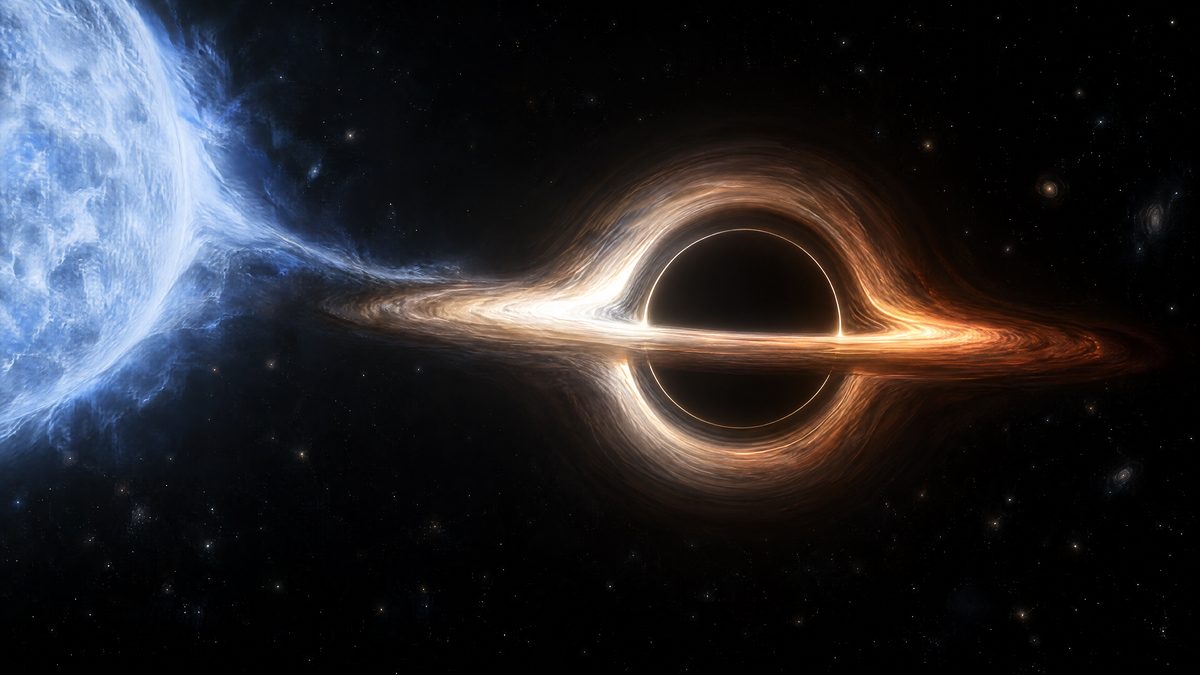
The obvious energy source is the accretion disc: gas spiralling inward, heated by friction until it glows. The trouble is the kind of light it produces.
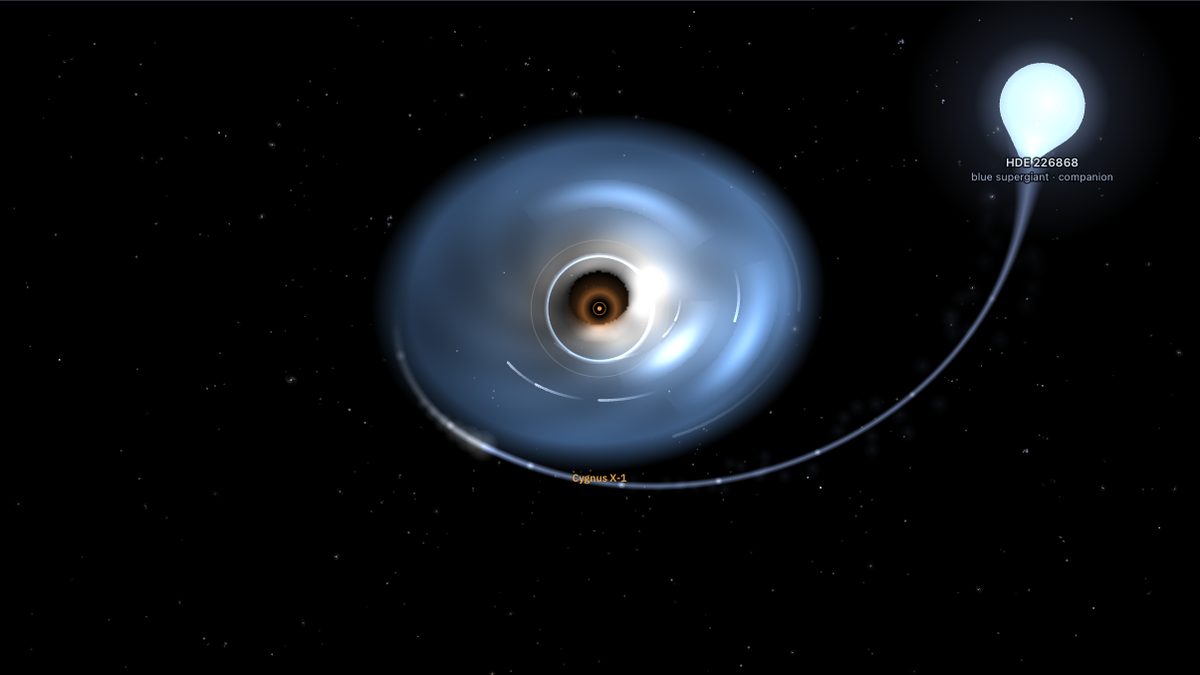
- Discs around stellar-mass black holes reach millions of degrees and shine in X-rays. X-ray binaries like Cygnus X-1, where a black hole strips gas from a companion, are among the brightest X-ray sources in the sky.
- Even the discs around supermassive black holes peak at around 100,000 K, putting most of their light in the ultraviolet.
- Disc brightness follows the inflow of gas and can swing over hours or years.
In a 2019 paper, Jeremy Schnittman of NASA's Goddard Space Flight Center worked through this problem using Miller's planet as the example. His conclusion: for disc heating to keep a planet habitable, the planet would need to be very far from the black hole, or the inflow of gas would have to be vanishingly small. With so little gas, he noted, the disc would likely stop being a thin disc and become a hot, tenuous flow.
A cold black hole and a hot sky: the case of Miller's planet
The second option turns the usual arrangement around. On Earth, energy arrives from the hot Sun and leftover heat is dumped into the cold night sky. In a paper posted in 2016 and published in the American Journal of Physics in 2017, Tomáš Opatrný and colleagues in the Czech Republic proposed the reverse: use the cosmic background filling the whole sky as the heat source, and the cold black hole as the place to dump waste heat. The black hole becomes a kind of "black sun".
A 2.7 K background sounds useless, but close to a black hole time runs slower, so light arriving from outside appears blueshifted — carrying more energy. For a planet orbiting fast near the horizon, a narrow strip of sky ahead of it glows especially hot.
Now the film. Kip Thorne, the film's science adviser, gave Gargantua a mass of about a hundred million Suns and a spin very close to the theoretical maximum. On Miller's planet one hour equals about seven years on Earth, a slowdown of roughly 60,000 times. The two papers calculate the following.
| Scenario | Result | Source |
|---|---|---|
| Miller's orbit | Incoming light ~420 kW/m²<br>Equilibrium ~890 °C | Opatrný et al. |
| Orbit allowing water | Background looks ~30,000 K<br>Time slowed ~2,000× | Schnittman |
| Adding galactic-centre starlight | Even at a water-friendly orbit,<br>Sun-like starlight looks ~600,000 K | Schnittman |
At Miller's orbit the planet would receive about 300 times the sunlight Earth does — hot enough to melt aluminium (the paper adds that the film's giant waves might be molten aluminium). Move a little farther out and, on temperature alone, a water-friendly orbit appears. But its sky is a thin band glowing at around 30,000 K, which means intense ultraviolet. Schnittman compared it to orbiting a white dwarf at 0.2 AU (a fifth of the Earth–Sun distance). A real galactic centre is also crowded with stars whose blueshifted light would dominate.
One condition is easy to miss. Blueshifts this strong need a stable orbit hugging the horizon, and only a black hole spinning close to its maximum offers one. Around a non-spinning black hole, time at the innermost stable orbit runs only about 1.4 times slower, and by Opatrný and colleagues' calculation the sky ahead warms by only a factor of about two. A 2.7 K sky becomes a few kelvin, still ice-cold.
A companion star doing the heating: the case of Gaia BH1
The third and most ordinary route is to take light from a normal star sharing the system. Gaia BH1 is a good test. About 1,560 light-years away in the direction of Ophiuchus, a black hole of roughly nine solar masses and a G-type star slightly lighter than the Sun circle each other every 185 days. Their average separation is about 1.4 AU, and because the orbit is quite elongated (eccentricity about 0.43), it swings between roughly 0.8 and 2 AU.
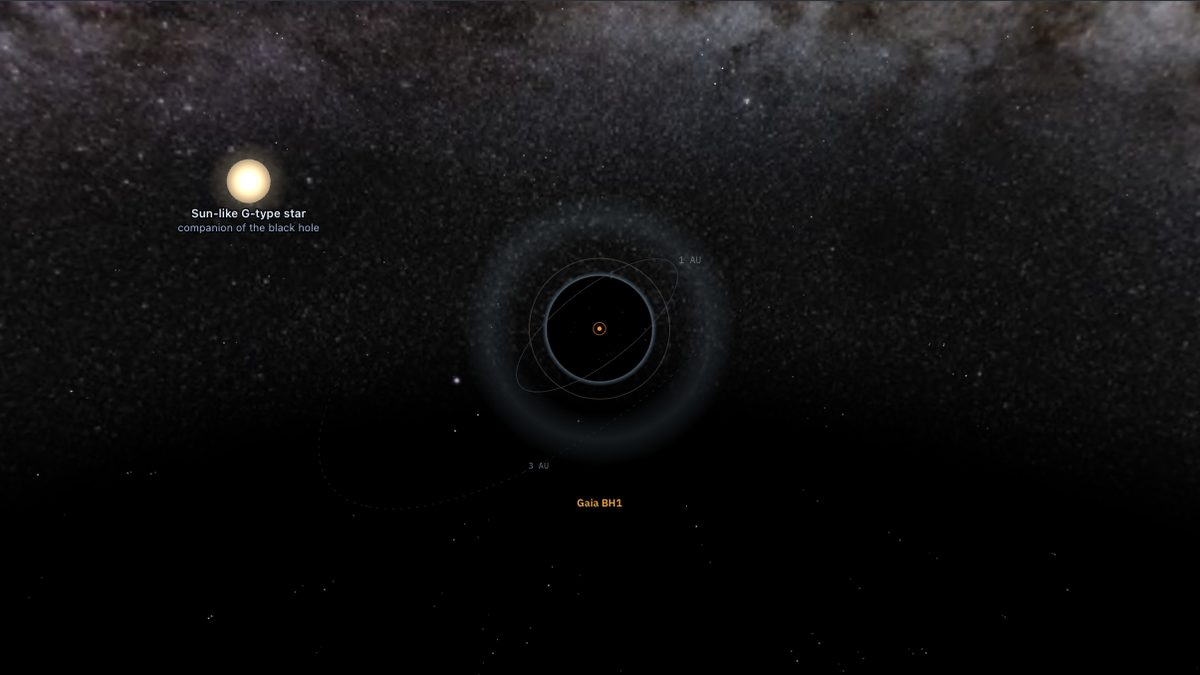
The habitable zone of that G-type star lies at roughly 1 AU — exactly the range the black hole sweeps through. Plugging Gaia BH1's values into a widely used empirical rule for stable orbits in binary systems (Holman and Wiegert, 1999) gives roughly this. These are rough estimates from the rule, not published results:
- A planet orbiting the star alone would need to stay within about 0.1 AU. That is far inside the habitable zone, and far too hot.
- A planet orbiting both bodies would need to be beyond about 5 AU. There the starlight drops to a few percent of what Earth receives, and it is far too cold.
So Gaia BH1 has no place where a stable orbit and a comfortable temperature overlap. A wide binary, with the black hole much farther out, could be different, but no planet has yet been found in such a system. The closest hint is a candidate announced in 2020 and published in 2021: an object slightly smaller than Saturn seen dimming X-rays from an X-ray binary (a black hole or neutron star) in the galaxy M51. It remains unconfirmed.
In summary, the strands of this topic have very different standing:
| Category | Content |
|---|---|
| Established physics | Hawking radiation negligible<br>Tides, ISCO, time dilation |
| Published thought experiments | "Black sun" heated by the CMB<br>"Blanets" forming in discs |
| Film | Gargantua and Miller's planet |
| Observation | No habitable planet near a black hole |
Frequently asked questions
Has a planet ever been found orbiting a black hole?
As of 2026, no planet orbiting a black hole has been confirmed. The candidate in an M51 X-ray binary is unverified, and the 2019 proposal by a Japanese team (Wada and colleagues) that planets — "blanets" — could form in the dusty discs around supermassive black holes remains theoretical.
Is Miller's planet scientifically accurate?
Its time dilation and tides follow Kip Thorne's calculations, and a planet could indeed survive that orbit around a giant, fast-spinning black hole. Papers that calculate the radiation reaching it, however, find it far too hot and bathed in strong ultraviolet.
Wrapping up
A black hole habitable zone is conceivable only under very narrow conditions: a giant black hole spinning near its limit, a quiet disc, and some way of surviving harsh radiation — and nothing like it has been observed. The most interesting part of the question, in my view, is the imagination it took to work out how a cold sky could become a heater beside an object that sends out no light at all.
Open the screens from this post
- Gaia BH1 in 3Da black hole with a Sun-like companion