[Stargazing]
The Pleiades star cluster — how many stars can you see?
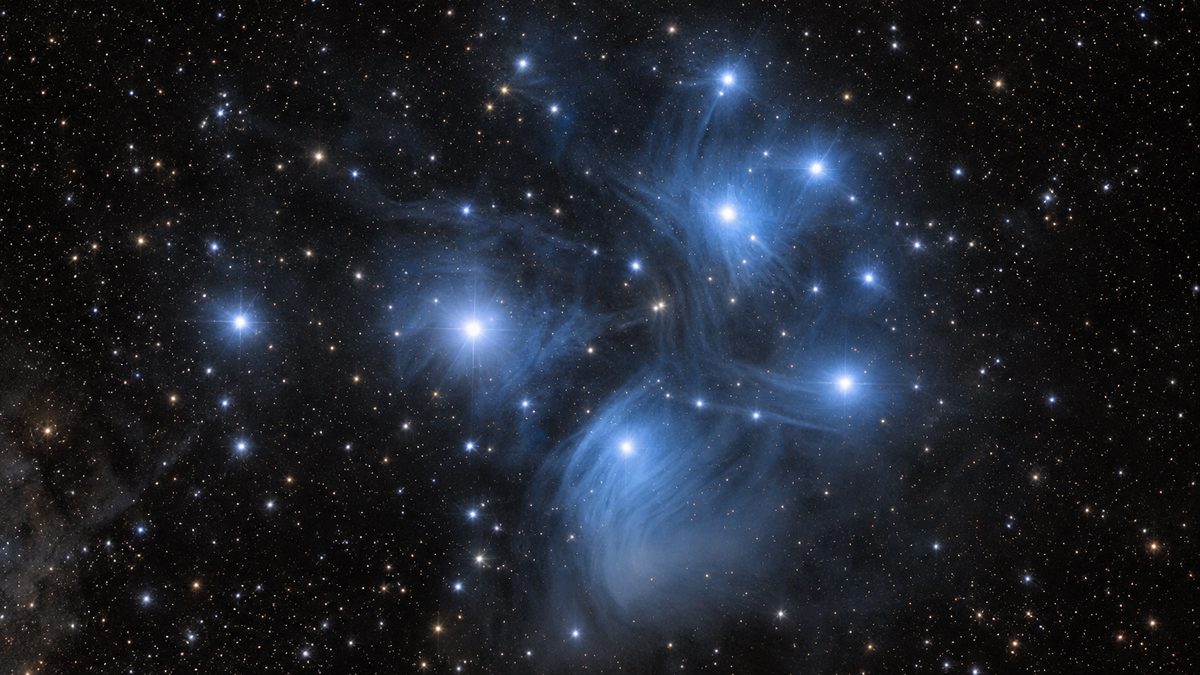
How to find the Pleiades star cluster (M45) on winter evenings, why most people count six "Seven Sisters", what binoculars add, and how far away it really is.
On a late-autumn evening, low in the east, there is a small patch of light that is too fuzzy to be a single star and too sparkly to be a cloud. Look straight at it and it blurs; glance slightly to one side and it breaks into several points. That patch is the Pleiades star cluster, also known as the Seven Sisters and catalogued as M45.
The Pleiades come with a question attached: how many stars can you actually see? This guide covers how to find the cluster, why the count changes from person to person and from place to place, what binoculars and photographs show, and the long argument over its distance. By the end, the number you count tonight should mean something specific.
Where is the Pleiades? Start from Orion's belt
The Pleiades is an open cluster in the constellation Taurus. An open cluster is a group of stars born together from the same cloud of gas that have not yet drifted apart. Taken as a whole, the cluster shines at about magnitude 1.6, which is bright enough to locate even from a city.
Orion is the easiest signpost:
- Find Orion's belt, the three evenly spaced bright stars in a short line.
- Follow the line of the belt up and to the right (northwest) for a little over 20 degrees, about two fist-widths at arm's length. It leads to Aldebaran, an orange first-magnitude star marking the eye of the bull.
- Keep going in the same direction for roughly 14 degrees, about a fist and a half. The tight knot of small stars there is the Pleiades.
It can also be found coming down from Perseus, which stands high in the northeast on autumn evenings, but the route from Orion's belt is harder to get wrong.
For northern observers in New York or London, the cluster is in the east within an hour or two after sunset in November and climbs higher as the night goes on. In mid-December 2026 it reaches its highest point in the south at around 10 to 11 pm local time. From New York it then stands about 73 degrees above the horizon, and from London about 63 degrees. The higher it is, the less air its light has to pass through, which helps when counting faint stars.
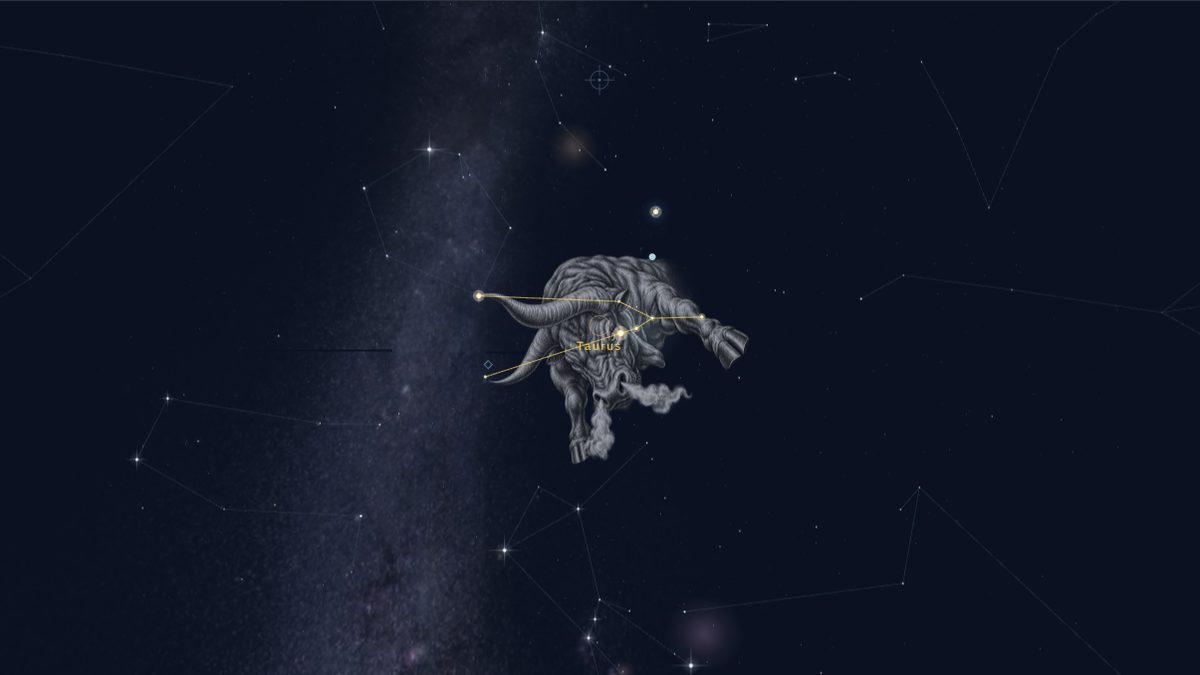
From the southern hemisphere
The Pleiades lies north of the celestial equator, so from Sydney, Cape Town or Auckland it never climbs high. On summer evenings in December and January it crosses the northern sky at a maximum altitude of around 30 degrees, and the whole scene is flipped compared with northern charts: Orion stands on his head, and the dipper shape of the cluster appears upside down. The star-hop still works — follow the belt to Aldebaran and on to the cluster — just in mirrored directions.
How many stars of the Pleiades can you see?
The name Seven Sisters suggests the answer is seven, yet most people who try it say six. The brightness of the leading stars explains why (higher magnitudes are fainter):
| Star | Magnitude |
|---|---|
| Alcyone | 2.9 |
| Atlas | 3.6 |
| Electra | 3.7 |
| Maia | 3.9 |
| Merope | 4.2 |
| Taygeta | 4.3 |
| Pleione | about 5.1 (variable) |
| Celaeno | 5.4 |
| Asterope | 5.6 |
Six stars sit brighter than magnitude 4.3, and then the list drops a full step to the fifth magnitude. The seventh, Pleione, also lies very close to Atlas, so to the eye the two tend to merge into one point. Many observers therefore stop at six even under fairly decent skies.
A rough guide:
- Bright city centre: a hazy smudge or three or four stars. The glowing sky background swallows the fourth-magnitude stars.
- Suburban sky: around six. This is the most common answer.
- Dark, clear rural sky: seven to nine or more. Under excellent conditions, counts of up to 14 are on record.
Counting the Pleiades is sometimes described as a traditional test of keen sight, but the origins of that story are hard to pin down in reliable sources, and it is a stargazing exercise, not a way to measure vision. The count depends on how dark the sky is, how well the eyes have adapted to the dark, and whether the eye can split stars that sit close together. The same person might see four downtown and eight in the countryside. The number is better read as a measure of how dark and clear tonight's sky is where you stand.
To push the count higher:
- Allow 20 to 30 minutes for dark adaptation. A glance at a phone screen sets it back.
- Use averted vision. Looking slightly to one side of the cluster places its light on the edge of the retina, which is more sensitive to faint light.
- Count when the cluster is high. Near the horizon, haze and light pollution cost a star or two.
Binoculars and the blue haze in photographs
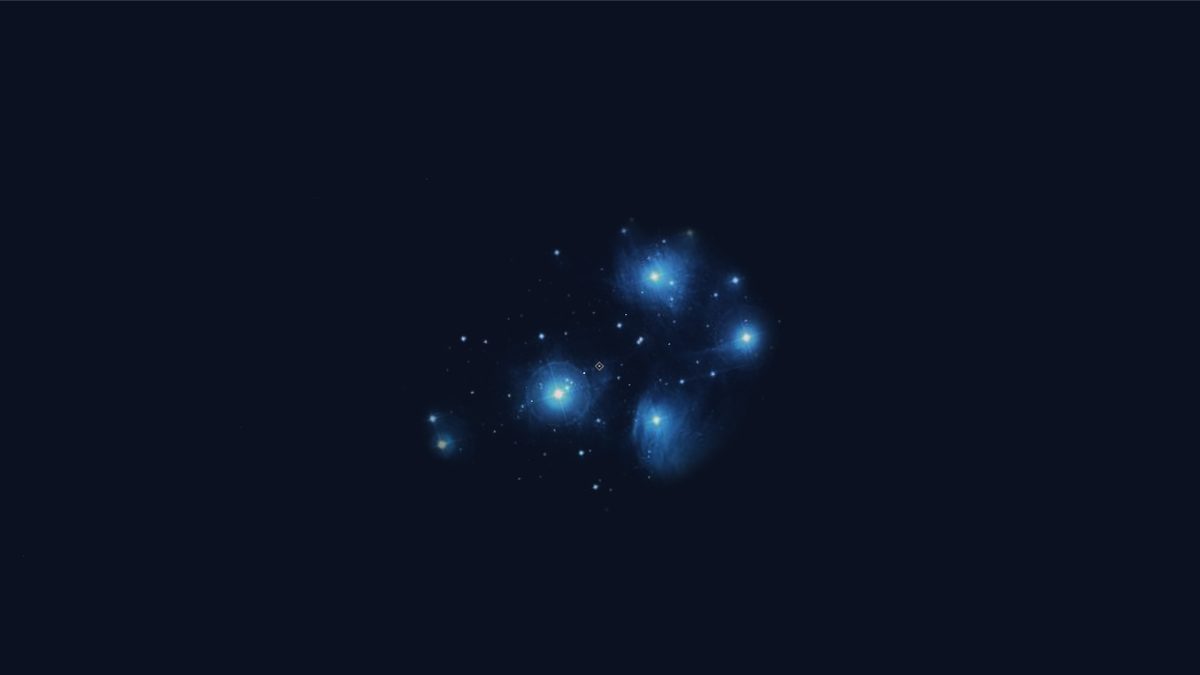
Binoculars are where the cluster comes into its own. The Pleiades spans about two degrees, so it fits comfortably in the six- to seven-degree field of ordinary 7× or 10× binoculars. Six stars become dozens, a loose spray of blue-white points. A telescope at high power actually shows less of it, because the cluster overflows the field of view.
Long-exposure photographs show the stars wrapped in blue haze. This is reflection nebulosity: dust near the cluster scattering the light of its hot stars. The best-known part is the Merope Nebula (NGC 1435). It was once taken for leftover material from the cluster's birth, but the current view is that the cluster is simply passing through a dusty region of interstellar space. The nebulosity is very faint and is essentially a photographic object; it is not visible to the naked eye, and in binoculars any haze around the stars is more likely to be dew on the lenses or thin cloud.
How far away is the Pleiades?
The accepted distance is about 444 light-years (136 parsecs), but it took a long dispute to settle.
| Measurement | Distance |
|---|---|
| Hipparcos (1999) | about 386 ly |
| Hubble (2004) | about 439 ly |
| VLBI radio (2014) | about 444 ly |
| Gaia DR3 | about 443 ly |
In 1999 the Hipparcos satellite, which measured parallax (the small shift in a nearby star's position as Earth orbits the Sun), put the cluster at about 386 light-years. Methods based on the stars' brightness and colour pointed to the mid-440s. A gap of more than ten percent meant that either the measurement was wrong or something in the physics of stars was. Hubble and ground-based studies sided with the larger figure, and in 2014 a network of radio telescopes using very long baseline interferometry (VLBI) measured about 444 light-years. Gaia, the successor to Hipparcos, then confirmed the same value. The Hipparcos discrepancy is widely attributed to systematic errors in how its data were processed.
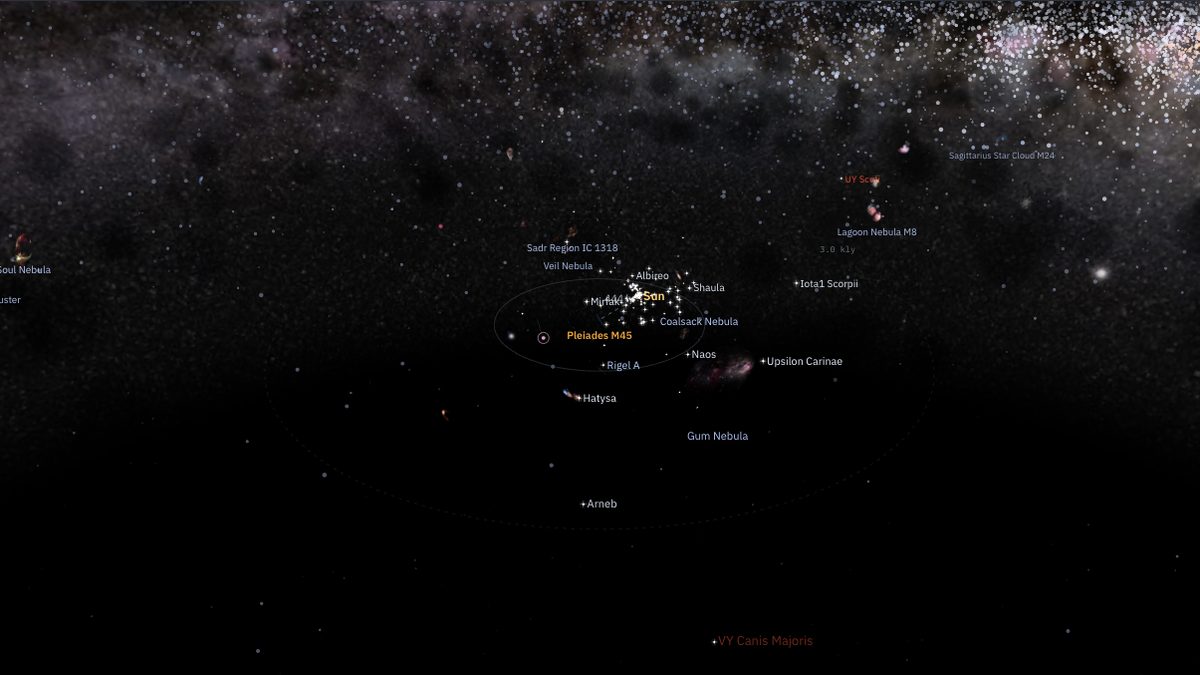
The cluster is young: roughly 100 million years old, with estimates ranging from about 75 to 150 million years and recent studies pointing to roughly 115 to 125 million. It contains more than a thousand member stars, and the pull of the galaxy is expected to scatter them within about 250 million years.
Subaru, Matariki and the Seven Sisters
A cluster this distinctive has collected names worldwide. In Greek myth the Pleiades were the seven daughters of Atlas and Pleione, and the brightest stars carry their names. In Japan the cluster is Subaru, a name associated with gathering together; the six stars on the carmaker's badge are the Pleiades. To the Māori of New Zealand it is Matariki, whose reappearance in the pre-dawn sky in June or July marks the start of the new year; since 24 June 2022 New Zealand has marked it with an annual public holiday. In Korea the cluster is called jomsaengi-byeol, roughly "the little stars," and was once watched beside the crescent Moon in early spring to forecast the year's harvest from how closely the little stars trailed the Moon.
Frequently asked questions
Can the Pleiades be seen from a city?
Yes, although in heavy light pollution it often appears first as a small hazy patch rather than separate stars. Binoculars resolve it into a cluster at once.
Why do most people stop at six?
Six is the most common count under ordinary skies, because there is a full step in brightness between the sixth and seventh stars. The same person will count more under a darker sky, so the count says little about vision.
When in the year is it visible?
In the evening sky, roughly from late October to March. By April it is low in the west after sunset, and around May it is too close to the Sun to see for a few weeks.
Wrapping up
The Pleiades star cluster is one of the easiest deep-sky objects to find: follow Orion's belt past Aldebaran and keep going. How many stars appear depends largely on sky darkness and dark adaptation. Counting four from a city street and eight from a dark field is, in the end, a way of measuring the sky overhead.
Open the screens from this post
- Find the Pleiades tonightSky view with M45 selected
- Taurus and OrionStar-hop from Orion's belt
Related posts
 [Stargazing] How to find constellations from a light-polluted city — a first-night plan
 [Sky apps & sites] How to choose a stargazing app or website — what actually matters
 [Stargazing] How to find the Andromeda Galaxy with the naked eye — star-hopping from the Great Square
 [Stargazing] Meteor shower calendar 2026–2027 and how to watch one