[Space facts]
Every star within 10 light-years — the nearest stars to the Sun and their planets
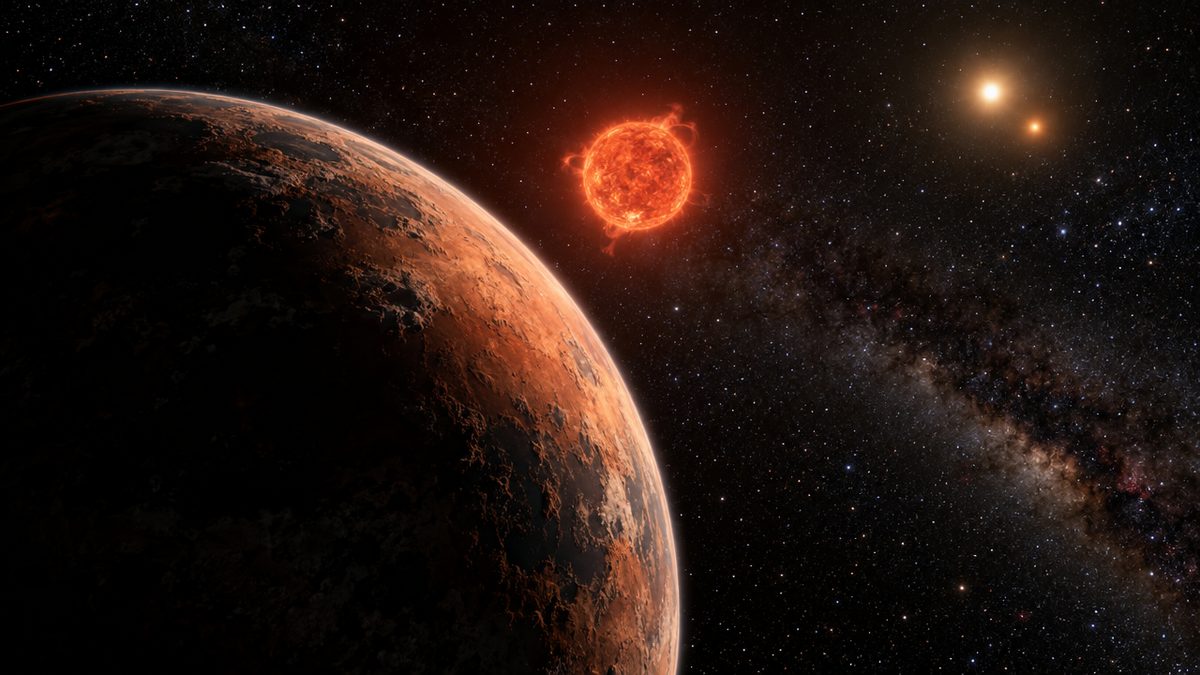
The nearest stars to the Sun, all nine systems within 10 light-years, with distances, star types, confirmed exoplanets and which ones you can see with the naked eye.
Ask people to name the nearest stars to the Sun and the answers tend to be bright ones: Sirius, perhaps Polaris, perhaps whatever caught their eye last night. It seems reasonable that the stars that look brightest are the ones closest to us. Count every star within 10 light-years, though, and most of them turn out to be small, dim, reddish objects that never show up in a naked-eye sky.
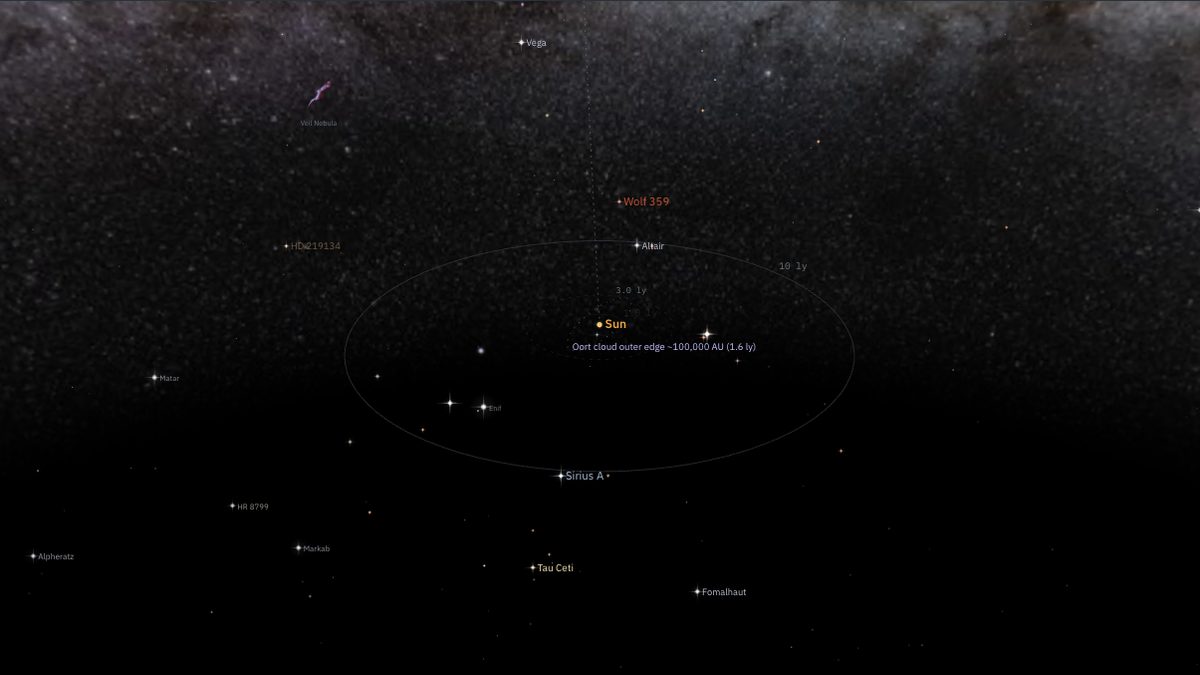
This guide goes through all nine star systems known within 10 light-years as of 2026, in order of distance. It covers what kind of object each one is, which have confirmed exoplanets and which only have candidates, and which ones can actually be seen from New York, London, Sydney or Cape Town. The result is a fairly complete picture of our immediate neighbourhood in the galaxy.
The full list: every system within 10 light-years
A light-year is the distance light travels in a year, about 9.46 trillion km (5.88 trillion miles). A sphere with a radius of 10 light-years around the Sun is a speck inside a galaxy some 100,000 light-years wide, but it is also the volume of space that astronomers have surveyed most thoroughly. Drawing on Wikipedia's list of nearest stars and the individual star entries, the census looks like this. Distances vary slightly between measurements, so they are rounded to one decimal place.
| System | Distance (ly) | Type | Confirmed planets |
|---|---|---|---|
| Proxima Centauri | 4.2 | red dwarf | 2 (b, d) |
| Alpha Centauri A & B | 4.3 | Sun-like star + orange dwarf | none (1 candidate at A) |
| Barnard's Star | 6.0 | red dwarf | 4 (b, c, d, e) |
| Luhman 16 A & B | 6.5 | pair of brown dwarfs | none |
| WISE 0855−0714 | 7.4 | very cold brown dwarf | none |
| Wolf 359 | 7.9 | red dwarf | none |
| Lalande 21185 | 8.3 | red dwarf | 2 (b, c) |
| Sirius A & B | 8.7 | white star + white dwarf | none |
| Gliese 65 (BL & UV Ceti) | 8.8 | pair of red dwarfs | none (1 candidate) |
| Ross 154 | 9.7 | red dwarf | none |
Proxima Centauri is gravitationally bound to Alpha Centauri A and B, so the three count as one system. That leaves nine systems and 14 individual objects besides the Sun. Seven are red dwarfs, three are brown dwarfs (WISE 0855−0714 is only a few times the mass of Jupiter, which puts it on the blurry line between brown dwarf and free-floating planet), and one is a white dwarf. Only three are bright, full-sized stars: Alpha Centauri A, Alpha Centauri B and Sirius A.
Mostly red dwarfs, plus a few oddities
Red dwarfs are small, cool stars with about 8 to 60 percent of the Sun's mass. Their surfaces sit at roughly 2,400 to 3,900 K, compared with about 5,800 K for the Sun, and they give off only a tiny fraction of its light. They burn their fuel slowly and will outlive the Sun by a wide margin. Several of our neighbours are flare stars, prone to sudden outbursts: Proxima, Wolf 359 and both members of Gliese 65. In 1952 UV Ceti brightened about 75-fold in roughly 20 seconds, and it became the prototype for this whole class of variable star.
Brown dwarfs are objects too light to sustain hydrogen fusion in their cores. They glow faintly in infrared and almost not at all in visible light. Both Luhman 16 and WISE 0855−0714 were found by Kevin Luhman in data from NASA's WISE infrared survey telescope, announced in 2013 and 2014. The fact that the third- and fourth-nearest systems to the Sun were discovered only in the 2010s suggests that more cold, dark neighbours may still be waiting. WISE 0855−0714 is the coldest brown dwarf known, with a surface temperature close to the freezing point of water.
The white dwarf is Sirius B, the exposed core of a star that has already burned out, packing roughly the Sun's mass into a ball about the size of Earth. Alvan Graham Clark first spotted it in 1862, and it orbits Sirius A every 50 years or so.
Which of the nearest stars have planets?
As of 2026, three of the nine systems have confirmed planets, eight in total. Every one was found by the radial-velocity method, which measures the tiny back-and-forth wobble a planet's gravity induces in its star.
- Proxima Centauri. Proxima b, announced in 2016, has at least 1.06 Earth masses and orbits every 11.2 days. That is very close in, but Proxima is so dim that b still falls within the habitable zone, the range of distances where liquid water could exist on the surface. Proxima d, announced in 2022, is about a quarter of Earth's mass and orbits every 5.1 days. A third signal, Proxima c, proposed in 2019, remains disputed.
- Barnard's Star. Planet b was confirmed in 2024 with the ESPRESSO spectrograph on ESO's Very Large Telescope. Planets c, d and e followed in 2025 from combined ESPRESSO and MAROON-X data. All four are lightweights at roughly 19 to 34 percent of Earth's mass, on orbits of two to seven days well inside the habitable zone. The result closed a story of several earlier planet claims around this star that did not hold up.
- Lalande 21185. This red dwarf in Ursa Major has two confirmed planets: b, at least 2.7 Earth masses on a 12.9-day orbit, and c, at least 13.6 Earth masses on an orbit of about eight years. A third signal, d, is still a candidate.
Then there are the maybes. In images taken in August 2024 and published in August 2025, the James Webb Space Telescope picked up a possible giant planet, estimated at around Saturn's mass, beside Alpha Centauri A, but follow-up observations did not recover it and its status is still open. Gliese 65 has a reported 2024 candidate of about 40 Earth masses, a little over twice Neptune's mass. Other claims have fallen away: a planet announced around Alpha Centauri B in 2012 was shown in 2015 to be an artefact of data processing, and one of the Wolf 359 candidates turned out to be a signal from the star's own rotation. Any list of planets around the nearest stars should be read as a snapshot that can change from one year to the next.
Which nearest stars can you see with the naked eye?
Of the 14 objects, only two points of light are visible without optical aid: Sirius A, and Alpha Centauri, whose A and B components merge into a single star to the eye. Lalande 21185, at magnitude 7.5, needs binoculars. Barnard's Star (9.5) and Proxima (11.1) need a telescope, and the brown dwarfs are out of reach without infrared instruments.
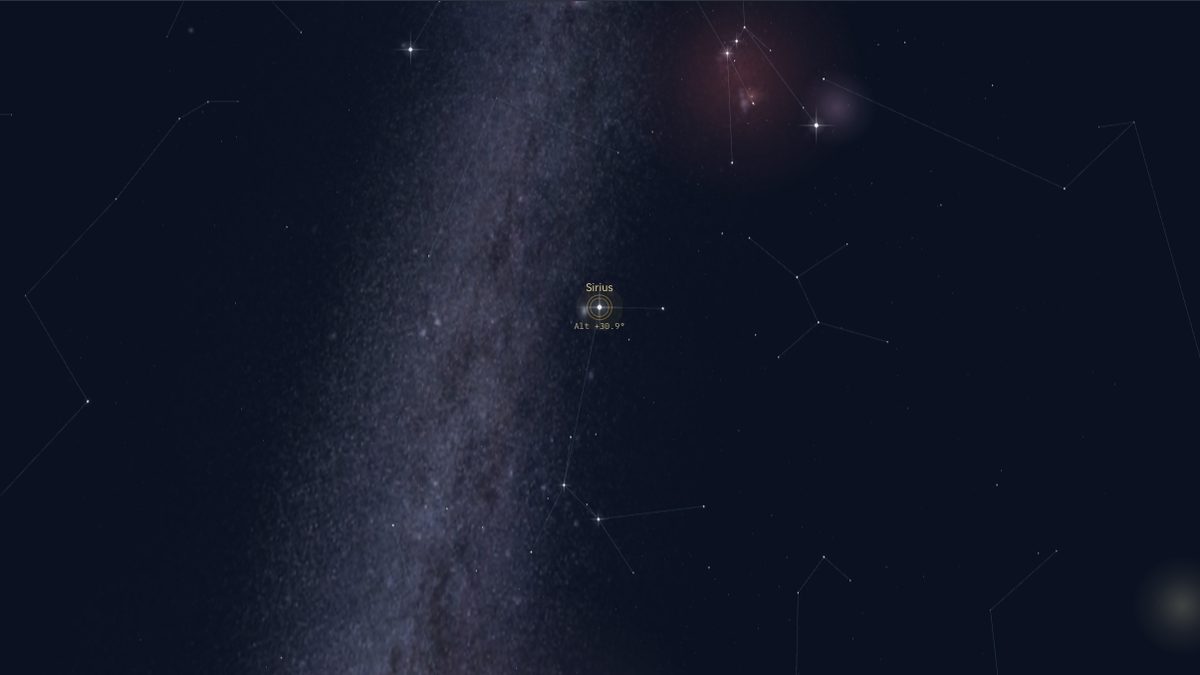
- Sirius is the brightest star in the night sky at magnitude −1.46, because it is both about 25 times more luminous than the Sun and only 8.7 light-years away. From New York or London it is a winter object, rising below and to the left of Orion and reaching about 33 degrees above the southern horizon from New York, and lower still from London. From Sydney or Cape Town it climbs much higher, passing about 73 degrees up during the southern summer evenings.
- Alpha Centauri is the third-brightest star in the sky, at a combined magnitude of −0.27, but it sits deep in the southern sky. North of about latitude 29°N it never rises at all, so it is invisible from New York, London and most of the United States and Europe. From Sydney and Cape Town, both south of 29°S, it never sets and can be found every night of the year near the Southern Cross.
In other words, most of the bright stars in a typical night sky are not near at all. They are intrinsically luminous stars seen across hundreds of light-years. Our real neighbours are mostly too faint to notice.
What the nearest stars say about our neighbourhood
Widening the sphere does not change the picture much. Within 20 light-years, 78 of the 133 known objects are red dwarfs, more than half. Stars as bright as the Sun are the minority, and planets are not unusual. Among our nearest neighbours, red dwarfs are also where most of the recent planet discoveries have come from, partly because a small, dim star wobbles more noticeably when a planet tugs on it.
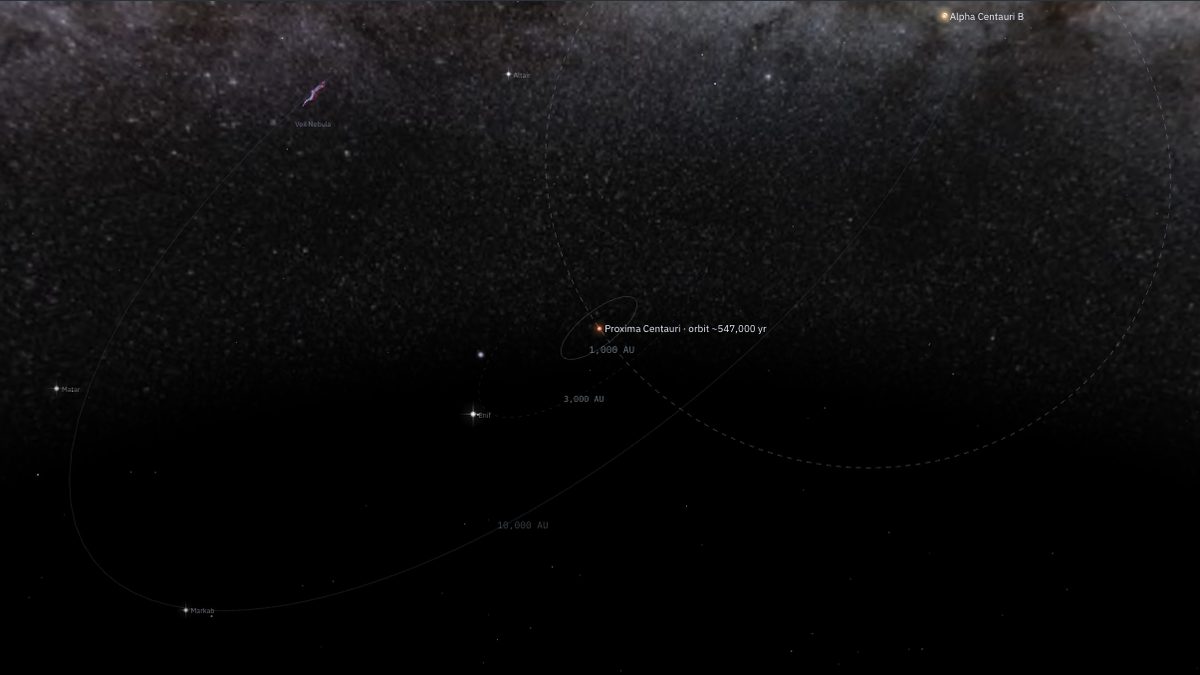
In NowSky's Space 3D view, typing Proxima Centauri or Barnard's Star into the search box flies the camera to that star, shown in its real direction and at its real distance from the Sun. Seen from outside, Alpha Centauri and Proxima sit together in one patch of space in the southern direction, which is a useful way to picture why they are counted as one system.
Frequently asked questions
What is the nearest star to the Sun?
Proxima Centauri, about 4.25 light-years away. Its light takes a little over four years to reach us. Robert Innes discovered it in 1915, and it belongs to the Alpha Centauri system.
What is the nearest known exoplanet?
As of 2026, Proxima b and Proxima d are the closest confirmed exoplanets. If the candidate around Alpha Centauri A is confirmed, it would join them at almost the same distance.
Wrapping up
The nearest stars to the Sun form nine systems within 10 light-years, and most of them are red dwarfs and brown dwarfs that no one can see by eye. Eight confirmed planets orbit three of them, and that count is still moving. What stays with me is that even this small patch of space may not be fully mapped yet.
Open the screens from this post
- Proxima Centauri in 3D4.2 light-years, the nearest star
- Barnard's Star in 3D6 light-years, a red dwarf with four planets