[Space facts]
When launch gets cheap, space changes — Starship commercialization, part 1
Starship launch cost targets against the history of cost per kilogram to orbit, plus full reuse, orbital refueling and a 9 m payload bay.
Read enough space news and the same caveats keep coming back. The telescope had to fold up to fit inside its rocket. The probe dropped instruments to save weight. The mission slipped because the budget ran out. Trace those stories back and most of them end at one number: the price of lifting a kilogram into Earth orbit. Starship launch cost matters because SpaceX is trying to change that number, not by a little but by an order of magnitude or more.
On 28 September 2026, Starship Flight 14 reached orbit for the first time and released Starlink V3 satellites. The test-flight history is told elsewhere on NowSky. This piece looks forward instead. It sets out how cost per kilogram has fallen so far, what Starship is aiming for, what full reuse and orbital refueling actually mean, and why a payload bay 9 metres wide matters as much as the price tag.
How the cost per kilogram has fallen
Rockets carry very different loads, so price per launch is a poor yardstick. The usual comparison is the cost of putting one kilogram into low Earth orbit, a few hundred kilometres up. That figure is slippery. It changes a great deal depending on whether development costs are included, whether the price is a list price or a contract, and which year's dollars are used. The table below gives rough estimates of the kind widely cited, many of them from a 2018 paper by Harry Jones at NASA Ames Research Center.
| Vehicle | Estimated cost per kg |
|---|---|
| Space Shuttle (1981–2011) | ~$16,000–54,000 |
| Falcon 9 | ~$2,700–4,200 |
| Falcon Heavy | ~$1,400 |
| Starship (target) | hundreds of dollars → under $100 |
The Shuttle was sold as a reusable spaceship, yet it was expensive. It could lift about 27.5 tonnes to low orbit. Taking only the cost of a single flight, about $450 million in 2011 terms, gives roughly $16,000 per kilogram. Spread the full programme cost of about $211 billion across its 135 flights and each launch comes to around $1.5 billion, or more than $50,000 per kilogram. The orbiter flew again, but its main engines were pulled and serviced, its solid boosters were fished out of the ocean and rebuilt, and the giant external tank was thrown away every time. It was less reuse than refurbishment.
Falcon 9 made booster landings routine. At its 2018 advertised price of $62 million for up to 22.8 tonnes, the figure comes to about $2,700 per kilogram, roughly a twentieth of the Shuttle. The 2026 list price is $74 million, and when the booster is recovered the payload falls to around 17 tonnes, which works out to about $4,000 per kilogram. Reuse is now ordinary: one booster has flown 37 times. Falcon Heavy, three Falcon 9 cores strapped together, gets down to roughly $1,400 per kilogram at its maximum expendable payload.
What full reusability actually reuses
Falcon 9 recovers its first-stage booster and its fairing halves. The upper stage, which goes all the way to orbit, is discarded on every flight. Starship is designed to bring back that last piece too. Both the Super Heavy booster and the Starship upper stage are meant to return and fly again. That is what full reusability means.
- Super Heavy: the first stage, with 33 Raptor engines. It is caught in mid-air by mechanical arms on the launch tower, a manoeuvre first achieved in October 2024.
- Starship: the upper stage and cargo hold, with six engines. It re-enters behind a heat shield and is also meant to return to the tower.
- Propellant: liquid methane and liquid oxygen. Methane burns cleaner than kerosene, which helps engines fly many times, and it can in principle be made from local resources on Mars.
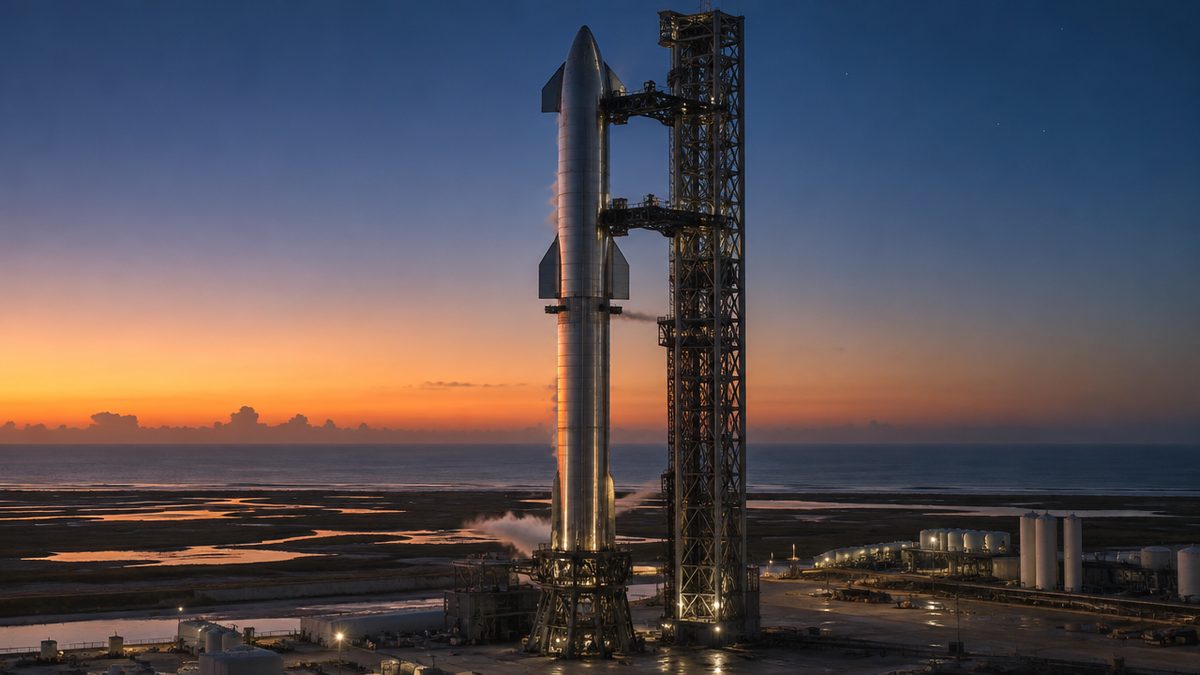
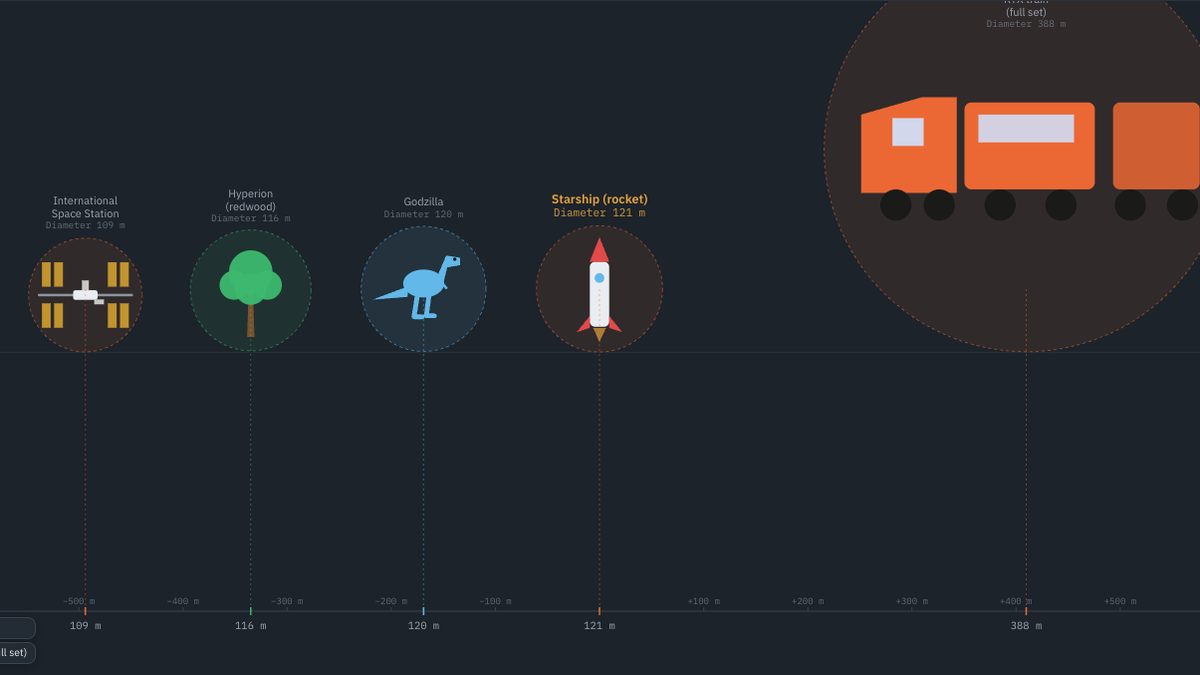
In its Block 3 form the stacked vehicle stands about 124 metres tall and 9 metres across, taller than the Saturn V that carried Apollo crews to the Moon (about 110 metres).
Airliners are not scrapped after one trip. They are refuelled, inspected and flown again, so the cost of the aircraft is spread across thousands of flights. If rockets work the same way, the hardware, which dominates the cost of a launch, stops being a one-off expense. In 2022 Elon Musk said he was "highly confident" a Starship launch would eventually cost less than $10 million. With a payload of around 100 tonnes, that would mean roughly $100 per kilogram. These are goals, not achieved costs. As of October 2026 Starship has only just reached orbit for the first time; recovering the upper stage and flying it again quickly are still steps to come.
Orbital refueling: the hard part
Full reuse is only half the plan. Most of a rocket's propellant is spent simply climbing from the ground to low orbit. A Starship that reaches orbit with a heavy load arrives with its tanks nearly empty and cannot go on to the Moon or beyond. The answer is orbital refueling: launching tanker Starships that carry only propellant and transferring it into a ship waiting in orbit.
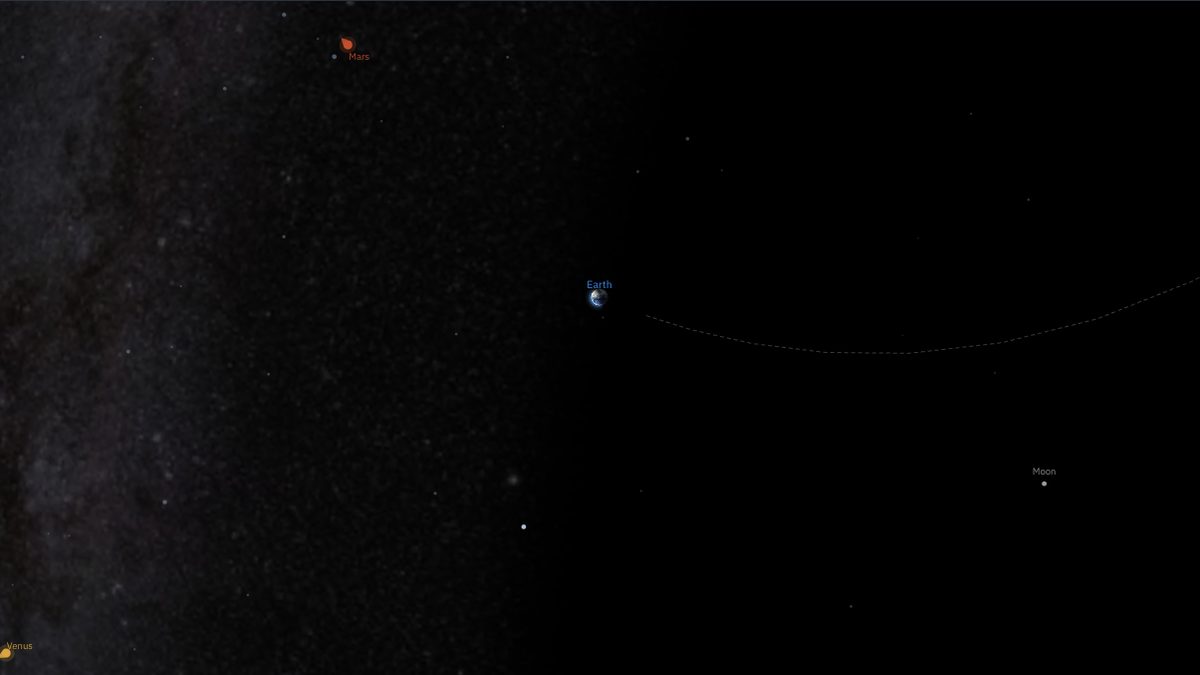
Earth sits in the middle of this view and the small dot at the lower right is the Moon, about 380,000 kilometres away; the dashed line is Earth's own orbit around the Sun. Low Earth orbit is only a few hundred kilometres above the surface, so at this scale it is lost against the planet itself. Climbing into that thin shell takes the most propellant; the remaining 380,000 kilometres or so takes comparatively little. That is why a filling station in low orbit lets a heavy payload travel much farther.
How many tanker flights would that take? Estimates disagree.
| Source | Tanker launches (estimate) |
|---|---|
| Elon Musk (2021) | 4–8 |
| US GAO (2021) | 16 in total |
| NASA official (2023) | high teens |
| SpaceX (2024) | about 10 |
Liquid oxygen and methane are kept at roughly −160 to −180 °C and slowly boil off. Tankers therefore need to fly in quick succession, which in turn depends on fast reuse. Moving propellant between tanks inside a single ship was tested on Flight 3 in 2024, but transferring propellant from one ship to another in orbit had not been demonstrated as of September 2026. It is widely seen as the next major step after Flight 14. For now orbital refueling remains a plan, and it is the biggest single hurdle between cheap launches and deep-space missions.
A 9-metre bay and what cheap heavy lift makes possible
The width of the cargo hold matters alongside the price. The Space Shuttle's payload bay was 4.6 metres wide, and Falcon 9's fairing is 5.2 metres across. Starship's payload section is 9 metres in outer diameter, designed to carry objects up to about 8 metres wide, with an extended version of up to 22 metres in height also described in SpaceX's user guide. That difference changes what engineers can design.
- Large space telescopes: Hubble's primary mirror is 2.4 metres across. The James Webb Space Telescope split its 6.5-metre mirror into 18 segments and folded its tennis-court-sized sunshield to fit inside an Ariane 5 fairing with about 4.57 metres of usable width, and every fold was a point that could fail. NASA's proposed Habitable Worlds Observatory, aimed at the 2040s, is studying a mirror of 6 to 8 metres, and Starship is among the candidate launchers. A telescope that needs less folding can be simpler and sturdier.
- Larger space stations: the International Space Station weighs about 420 tonnes and took more than a decade of assembly flights from 1998. If 100 tonnes per launch became cheap, wide modules could go up in one piece and a large station could be built in far fewer flights.
- More satellites: Starlink V3 satellites are larger units designed to launch on Starship. Cheap launches carrying dozens at a time would let communications and Earth-observation constellations be built and replaced quickly.
The deepest change may be in design philosophy. Spacecraft engineering has always put mass first, which drives expensive materials and long test campaigns. If launch becomes cheap enough, it can make more sense to build something heavier, cheaper and tougher, and to accept that a failure can be followed by another launch.
Frequently asked questions
How much does a Starship launch cost today?
There is no published price. Under $10 million per flight and around $100 per kilogram are goals Musk has stated, and they depend on routinely recovering and reflying the upper stage. Outside estimates of today's actual cost vary widely.
Are reusable rockets really cheaper?
Falcon 9 showed they can be, with single boosters flying dozens of missions. The Shuttle showed the opposite: if a vehicle needs heavy refurbishment between flights, reuse can cost more. What matters is reuse with little handling and a quick turnaround.
Why is orbital refueling so difficult?
Cryogenic propellant keeps boiling off, and in microgravity liquid floats around inside the tank, which makes it hard to pump. Large quantities have to move while two ships stay precisely docked, and the tankers must launch close together.
Final thoughts
The cost of reaching orbit has fallen from tens of thousands of dollars per kilogram in the Shuttle era to a few thousand with Falcon 9, and Starship commercialization aims to cut it by another order of magnitude through full reuse and orbital refueling. If that works, telescopes can fold less, stations can be built bigger and satellites can be launched in larger numbers. Much of this is still on paper, but the size of what can be done in space has always tracked the price of getting there, which makes this number worth watching.
Part 2 looks at what this launch cost could mean for the Moon and Mars, and part 3 covers the outer solar system and the challenges that remain.
Open the screens from this post
- Starship in the size comparisonNext to other giant objects
- Earth and the MoonLow orbit versus lunar distance
Related posts
 [Solar system & orbits] What watching planetary orbits teaches you — from Kepler's laws to retrograde motion
 [Space facts] Every star within 10 light-years — the nearest stars to the Sun and their planets
 [Space facts] When Will Betelgeuse Explode? What the 2019 Great Dimming Revealed
 [Space facts] Could a black hole have a habitable zone? What physics allows, and what it rules out