[Space facts]
When Will Betelgeuse Explode? What the 2019 Great Dimming Revealed
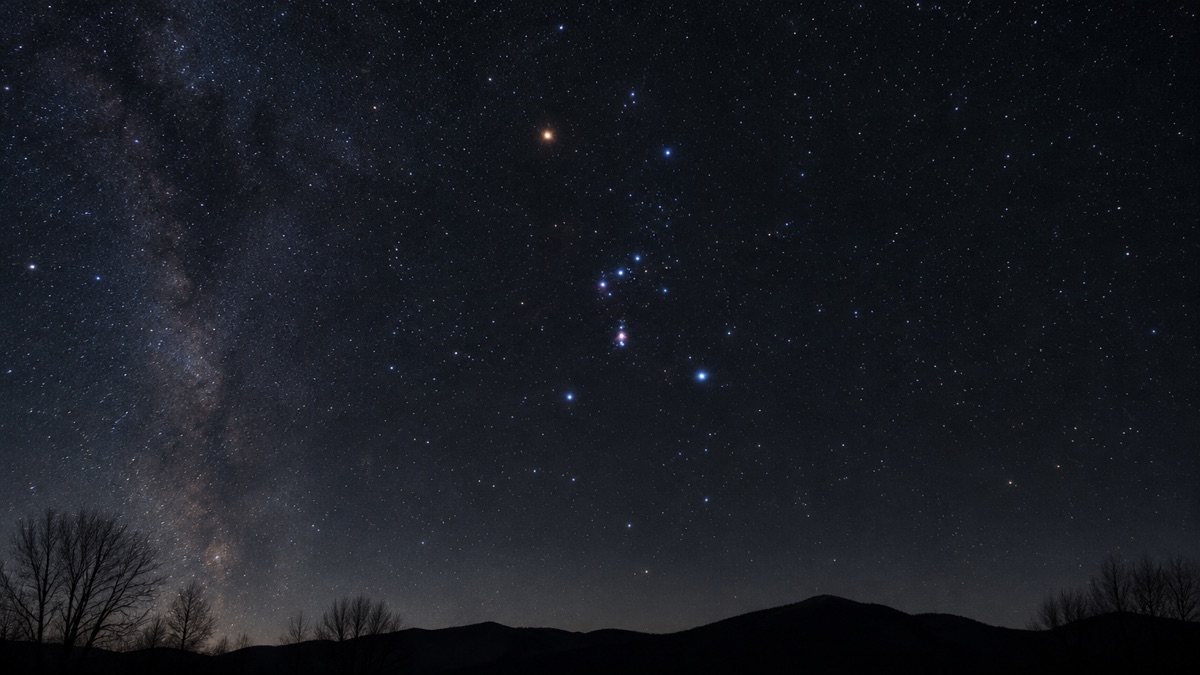
Betelgeuse explosion rumors began with the 2019 Great Dimming. What dimmed the star, when it may go supernova, and how to find it in Orion.
In late 2019, the red star on Orion's shoulder began to fade. Betelgeuse is normally one of the ten brightest stars in the night sky, and within a few months it had lost close to two thirds of its light. Headlines asked whether a Betelgeuse explosion was about to happen. The question returns every time the star brightens or dims, so it is worth knowing what the evidence actually says.
This post covers what happened during the Great Dimming, how astronomers estimate the time left before the star goes supernova, what the explosion would look like from Earth, and how to find Betelgeuse in the sky this season. With that background, the next "Betelgeuse is acting strange" story becomes much easier to judge.
What kind of star is Betelgeuse?
Betelgeuse is Alpha Orionis. From the Northern Hemisphere, Orion stands upright in the southern sky on winter evenings, and Betelgeuse is the orange-red star at his upper-left shoulder, opposite the blue-white Rigel at his lower-right foot. From the Southern Hemisphere — Sydney or Cape Town, for example — Orion appears upside down in the northern sky, so Betelgeuse sits at the lower right instead.
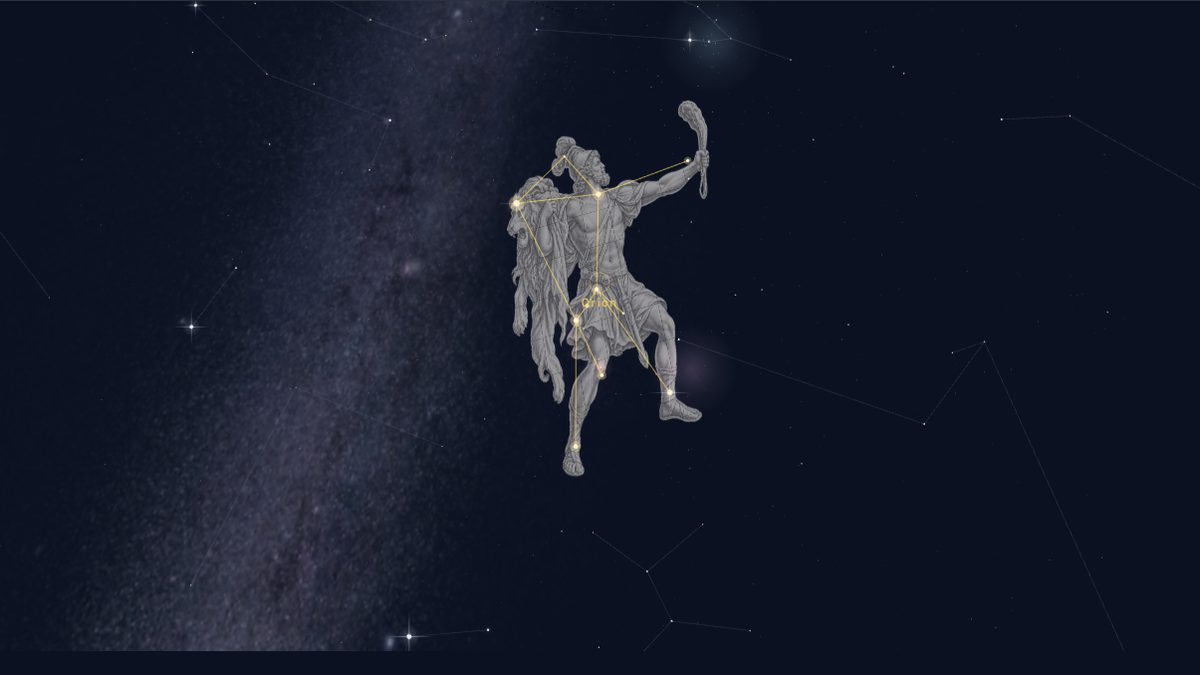
It is a red supergiant: a massive star near the end of its life that has swollen to an enormous size.
| Property | Value |
|---|---|
| Distance | about 550 light-years (recent estimate, uncertain by tens to ~100 ly) |
| Radius | about 640–760 times the Sun |
| Mass | about 14–19 solar masses (studies differ) |
| Age | roughly 8–14 million years (studies differ) |
| Normal brightness | varies between about magnitude 0 and 1.6 |
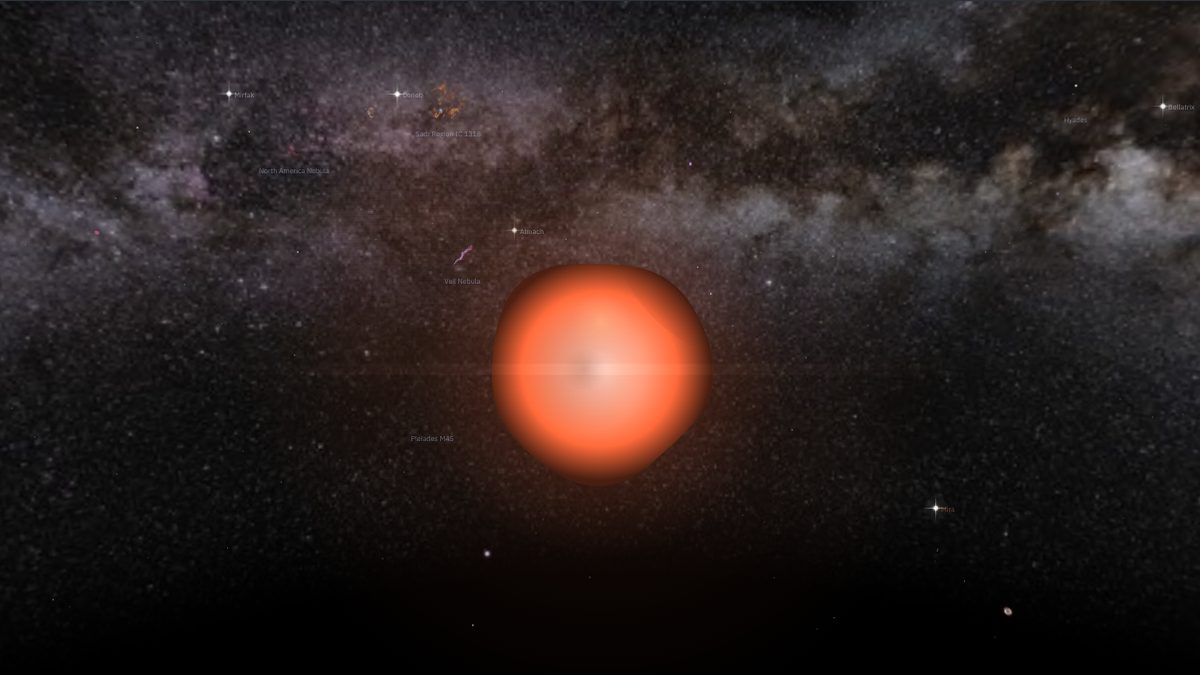
At 760 solar radii, Betelgeuse placed at the Sun's position would reach past the orbit of Mars to around the asteroid belt. A star this large is not calm. Giant convection cells churn its surface, it pulsates with a period of roughly 400 days, and a longer cycle of about 2,100 days (just under six years) is layered on top. Betelgeuse has always been a variable star.
The Great Dimming of 2019–2020
Around October 2019, Betelgeuse started fading faster than usual. By mid-February 2020 it had dropped to about magnitude 1.6, down from its typical value near 0.5 — the deepest dimming since precise brightness measurements began. Astronomers call it the Great Dimming.
Several years of follow-up explained what happened:
- The star ejected material from its surface. Hubble Space Telescope observations showed that in autumn 2019 a large patch of the surface lifted off and was flung outward.
- That material cooled into dust. As the ejected gas cooled, it condensed into a dust cloud that blocked part of the light heading toward Earth.
- Part of the surface was cooler. Images from the European Southern Observatory's Very Large Telescope showed the southern half of the star noticeably darker. A 2021 study explained the dimming as a cool region on the surface combined with the new dust.
The Great Dimming was not a countdown to an explosion. It was closer to a very large sneeze: a giant star shedding material from its outer layers. The star recovered its usual brightness after spring 2020, and in April 2023 it even brightened to about magnitude 0.0. That prompted another round of explosion rumors, but the change again fit within the star's pulsations and surface activity.
When will Betelgeuse explode?
The end of a massive star is judged by what its core is burning. After hydrogen runs out the core burns helium, then carbon, and each later stage is far shorter than the one before. When an iron core finally collapses, the rebound blows off the outer layers in a Type II supernova.
A 2020 study compared Betelgeuse's pulsation periods and brightness with stellar models and concluded that the core is still burning helium, which leaves roughly 100,000 years or more before the explosion. In 2023 another team argued the star might already be in its final carbon-burning stage, but other analyses published the same year disputed that, and there is no consensus yet. The picture most studies support is "soon by astronomical standards, but almost certainly not in our lifetimes."
There is one more wrinkle. Betelgeuse's light takes about 550 years to reach Earth. The star you see tonight is the star as it was in the late 1400s. If it has already exploded, the news is still on its way.
A small companion found in 2025
For decades, astronomers suspected that a smaller star orbiting Betelgeuse drives its long six-year brightness cycle. In 2025, a NASA-led team reported a faint companion using a speckle imager on the Gemini North telescope in Hawaii. Images from 2020, when the companion was predicted to be behind Betelgeuse, showed nothing, but in December 2024 — near the predicted greatest separation — a faint point appeared where it was expected. The team proposed the name Siwarha, Arabic for "her bracelet," and the International Astronomical Union approved it in September 2025. The detection is still tentative; the next best chance to confirm it comes in November 2027.
What would the supernova look like?
When Betelgeuse explodes as a Type II supernova, estimates suggest it will brighten to roughly the brilliance of a half Moon and stay that bright for more than three months. After sunset it would be the most striking object in the sky after the Moon. Over the following months and years it would fade until it vanished from naked-eye view, leaving Orion with an empty shoulder.
Earth would be safe. A supernova needs to be within a few dozen light-years to harm life, and Betelgeuse is more than ten times farther away. In fact, the first sign would likely come from neutrinos streaming out of the collapsing core, which underground neutrino detectors should catch hours before the light arrives.
| When | What to expect |
|---|---|
| Just before | Neutrino detectors register a burst |
| First weeks | Brightens to around half-Moon brightness |
| Three-plus months | Stays very bright |
| Years | Slowly fades from naked-eye view |
How to find Betelgeuse now
You do not need to wait for an explosion. The orange-red color of a supergiant is easy to see with the naked eye, and knowing the star will one day disappear changes how the familiar winter sky feels.
- When: In early November, Betelgeuse rises in the east around 9 p.m. local time and is high in the south before dawn. By December it is well placed around midnight, and in January and February it is highest in the early evening.
- Start with the Belt: Find the three similar stars in a short, straight row.
- Go up to the shoulder: From the Belt, move up and to the left (in the Northern Hemisphere). The red star is Betelgeuse; the blue-white star on the opposite corner below is Rigel.
- Compare colors: Glancing between Betelgeuse, Rigel and nearby Sirius makes the red tint much more obvious.
Frequently asked questions
Will a Betelgeuse supernova be visible in daylight?
If it reaches half-Moon brightness as estimates suggest, it would likely be findable in daylight by anyone who knows where to look. The actual peak depends on the details of the explosion and the material around the star, so this cannot be stated with certainty.
Could the Great Dimming have been the explosion itself?
No. During the dimming the star stayed in place and recovered its brightness, and the cause was traced to dust and a cooler surface region. A supernova would have made the star dramatically brighter, not fainter.
What happens to Orion after Betelgeuse is gone?
Once the supernova fades, no naked-eye star will remain at that spot. Orion will lose a shoulder, and a neutron star or a black hole is expected to be left behind.
Final thoughts
A Betelgeuse explosion could in principle happen at any time, but current evidence points to a timescale of roughly 100,000 years. The Great Dimming was not a warning; it was the first detailed look at a giant star shedding its outer layers. Being able to look up and see a star that will one day vanish is reason enough to spend some time with the winter sky.
Open the screens from this post
- Find Betelgeuse tonightSelect Orion's red shoulder star in Sky view
- See Betelgeuse up closeSee its distance from the Sun in Space 3D
Related posts
 [Space facts] Every star within 10 light-years — the nearest stars to the Sun and their planets
 [Stargazing] The Pleiades star cluster — how many stars can you see?
 [Space facts] When launch gets cheap, space changes — Starship commercialization, part 1
 [Space facts] Could a black hole have a habitable zone? What physics allows, and what it rules out