How far are an AU, a light-year and a parsec?
An astronomical unit (AU) is the average distance between Earth and the Sun, about 150 million km, and it is the natural ruler inside the Solar System. A light-year, the distance light travels in a year, is about 9.46 trillion km, and a parsec is about 3.26 light-years; both are used for stars and galaxies. Light takes about 1.3 seconds to reach the Moon, 8 minutes 19 seconds to arrive from the Sun and about 4.2 years from the nearest star, and those travel times are the easiest way to feel the difference between the units.
Why kilometres stop being useful
The average distance from Earth to the Moon is about 384,400 km, a figure that is still easy to handle in kilometres. The Sun, however, is about 150 million km away, and Proxima Centauri, the nearest star, is about 40 trillion km away. Written in kilometres, the distance to the Andromeda Galaxy becomes a twenty-digit number.
Numbers that large are hard to read and harder to compare, so astronomers choose a unit that suits the job. Inside the Solar System they use the astronomical unit, which sets the Earth–Sun distance to 1. For stars and galaxies they use the light-year, the distance light covers in a year, or the parsec, which comes from measuring stellar parallax. It is the same idea as switching between centimetres, metres and kilometres on Earth.
The astronomical unit: a ruler for the Solar System
The astronomical unit began as the average radius of Earth's orbit. Because the orbit is slightly elliptical, Earth's distance from the Sun ranges from about 0.983 AU at its closest to about 1.017 AU at its farthest. In 2012 the International Astronomical Union stopped tying the unit to observations and fixed it at exactly 149,597,870,700 metres.
Measured in AU, the layout of the Solar System becomes easy to read. Earth sits at 1 AU by definition, and as of August 2026 Voyager 1, the most distant spacecraft, was about 171 AU from Earth, a little over 170 times the Earth–Sun distance after nearly half a century of travel.
Switching on the Grid chip in the Orbit view draws reference lines across the plane of the planets, with each square labelled in AU. It gives a direct way to compare how far each planet lies from the Sun.
A light-year is a distance, not a time
The word year makes it easy to mistake the light-year for a unit of time, but it measures distance: the distance light travels in a vacuum in one Julian year of 365.25 days. That is about 9.46 trillion km, or about 63,241 AU.
Because light moves at about 300,000 km per second, expressing distance as light travel time gives an intuitive scale. The Moon is about 1.3 light-seconds away and the Sun about 8 minutes 19 seconds, or 8.3 light-minutes. Voyager 1 is expected to reach one light-day from Earth, a distance light needs a full day to cross, around November 2026. Proxima Centauri lies about 4.25 light-years away, Sirius about 8.6 and the Andromeda Galaxy about 2.5 million.
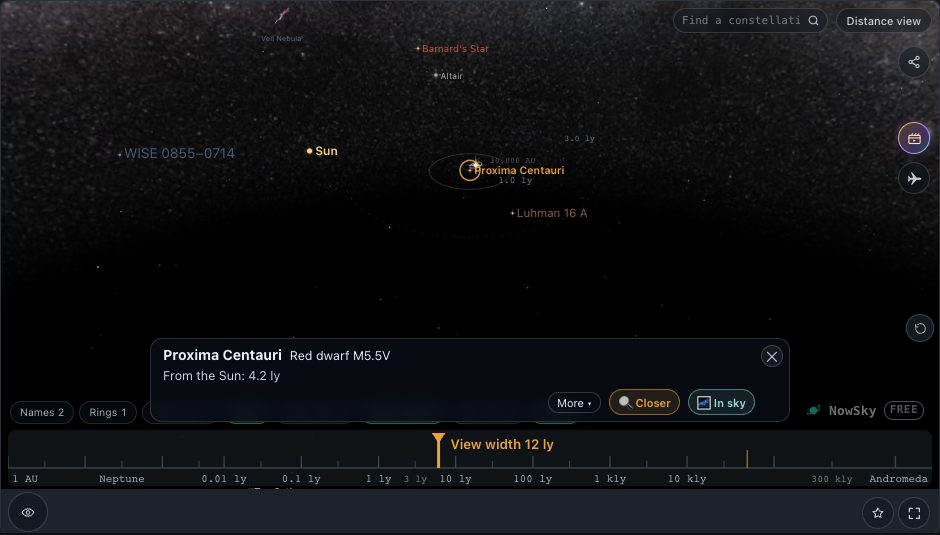
These figures are also look-back times. The Sun we see is the Sun of roughly eight minutes ago, and the light now arriving from the Andromeda Galaxy set out about 2.5 million years ago. In the 3D Stars map, the card for each selected star shows its distance together with its light travel time.
 ▶ Open in the simulator
 The parsec comes from stellar parallax
As Earth moves around the Sun, a nearby star appears to shift very slightly against much more distant background stars. Half of that apparent shift, measured as an angle, is called the star's annual parallax. Closer stars show larger parallaxes and more distant stars smaller ones, just as a finger held near your face jumps back and forth when you close one eye and then the other.
The word parsec is short for parallax of one arcsecond, a name coined by the British astronomer Herbert Hall Turner in 1913. An arcsecond is 1/3,600 of a degree, and one parsec is about 206,265 AU, 3.26 light-years or 30.9 trillion km. Once a star's parallax is measured in arcseconds, its distance in parsecs is simply one divided by that number.
Professional astronomers use the parsec more often than the light-year. Distances within a galaxy are usually given in kiloparsecs (thousands of parsecs) and distances between galaxies in megaparsecs (millions of parsecs).
Even the nearest star shifts by less than an arcsecond
Stellar parallaxes are far smaller than most people expect. Proxima Centauri, the nearest star, has a parallax of about 0.768 arcseconds, roughly the apparent size of a 2 cm object seen from 5.3 km away. No star lies within one parsec of the Sun; Proxima is about 1.30 parsecs away.
Because the angles are so tiny, the first successful measurement did not come until 1838, when the German astronomer Friedrich Bessel measured the parallax of the star 61 Cygni and obtained a parallax of about 0.31 arcseconds, a distance of about 10.4 light-years (3.2 parsecs; the modern value is 3.5). It was the first time the distance to a star had been pinned down with a number.
Since the late twentieth century, the task has moved to space. The Hipparcos satellite, launched in 1989, increased the number of parallaxes measured to milliarcsecond accuracy a thousandfold, and the European Space Agency's Gaia mission, launched in 2013, is measuring far more stars with far greater precision.
A scale model built from light travel time
Put the three units together and the scale of the universe takes shape. The Moon at 1.3 light-seconds, the Sun at eight light-minutes and Voyager 1 at about one light-day cover the story of our own Solar System. The next step, the nearest star, jumps abruptly to 4.2 light-years, which shows how much empty space separates the edge of the planetary system from its stellar neighbours.
Voyager 1 moves at about 16.9 km per second relative to the Sun. At that speed, covering a distance equal to Proxima Centauri's would take roughly 75,000 years. Even one of the fastest objects ever built would need longer than the whole of recorded human history many times over to reach the nearest star.
The 3D Stars map places the stars around the Sun at their true distances, and its scale bar shows how large the current view is. Selecting Proxima Centauri makes the gulf between it and the Sun visible at a glance.
Try it in the simulator
- See the gap to Proxima →Shows the true distance between the Sun and the nearest star in 3D.
- Follow Earth's orbit →Follow Earth on its 1 AU orbit and use the grid to judge distances.
- Follow Voyager 1 →Traces Voyager 1's path as it heads out of the Solar System.
FAQ
- Which is longer, a light-year or a parsec?
- The parsec. One parsec is about 3.26 light-years, so a distance written in parsecs comes out at roughly a third of the light-year figure.
- Is parallax the only way to measure distance?
- Parallax works only for relatively nearby stars. Farther objects are measured by comparing the apparent brightness of stars or supernovae of known true brightness, and by galaxy redshifts, each step calibrated against the one before.
- Why was the AU fixed as an exact number in 2012?
- Before 2012 it was tied to measured quantities such as the Sun's gravitational constant, so its value could shift as measurements improved. Defining it in metres keeps calculations simple and consistent.
Related reading
- Object Proxima Centauri
- Object Voyager 1
- Sky news Voyager 1 passes one light-day from Earth
- Object Andromeda Galaxy
- Guide How do you see real distances to the stars with the 3D star map?