Why don't solar and lunar eclipses happen every month?
A solar eclipse happens when the Moon covers the Sun, and a lunar eclipse when the Moon passes into Earth's shadow. The Moon's orbit is tilted about 5.15° to the plane of Earth's orbit, so at most new and full Moons the three bodies do not line up exactly. Eclipses can only happen during two eclipse seasons a year, when the Sun sits near one of the points where the two orbits cross.
A 5° tilt makes eclipses rare
About every 29.5 days the Moon passes the Sun's direction (new Moon) and the opposite direction (full Moon). If its orbit lay in the same plane as Earth's, every new Moon would bring a solar eclipse and every full Moon a lunar eclipse. Because the orbit is tilted about 5.15°, the Moon usually slips above or below the Sun, or above or below Earth's shadow, even at new and full Moon.
The two points where the Moon's orbit crosses the plane of Earth's orbit are called nodes. An eclipse needs a new or full Moon to occur while the Moon is near a node. The Sun lines up with a node about every 173.3 days, giving roughly two eclipse seasons a year, and that is why a solar eclipse and a lunar eclipse often come as a pair about two weeks apart within the same season.
The nodes are not fixed; they slowly drift backwards, completing a circuit in about 18.6 years. As a result, eclipse seasons arrive a little earlier in the calendar each year, and the eclipse year, the time for the Sun to return to the same node, is only about 347 days.
The coincidence of matching sizes
The Sun's diameter, about 1.39 million km, is roughly 400 times the Moon's 3,474 km, and the Sun is about 390 times farther away. The two ratios are close enough that the Sun and Moon both appear about half a degree across in the sky. That coincidence is what allows the Moon to cover the solar disc almost exactly during a total eclipse.
The Moon's orbit is an ellipse, however, and its distance from Earth varies between about 363,300 km and 405,500 km. Near its closest the Moon looks slightly larger than the Sun and can hide it completely; near its farthest it looks slightly smaller and leaves a ring of sunlight around its edge. The same alignment can therefore produce either a total or an annular eclipse, depending on where the Moon is in its orbit.
Total, annular and partial: where you stand in the shadow
The Moon's shadow has two parts: the umbra, where sunlight is completely blocked, and the penumbra, where it is only partly blocked. Inside the narrow track where the umbra touches the ground, the eclipse is total. The sky darkens as if at dawn or dusk, and the corona, the Sun's faint outer atmosphere, becomes visible. Totality can last at most about 7 minutes 32 seconds.
When the tip of the umbra falls short of the ground, observers along its extension see an annular eclipse, while the much wider area under the penumbra sees a partial eclipse, with only part of the Sun covered. Because Earth's surface is curved, a single eclipse can switch between total and annular along its path; this is called a hybrid eclipse.
A total solar eclipse occurs somewhere on Earth about every 18 months on average, but any one location waits on average 360 to 410 years between them. Except during the brief moment of totality, looking at the Sun during an eclipse is as dangerous as on any other day, so proper solar filters or indirect viewing are essential.
 ▶ Open in the simulator
 Lunar eclipses: visible from the whole night side
A lunar eclipse happens at full Moon, when the Moon passes through Earth's shadow. If the whole Moon enters the umbra the eclipse is total; if only part of it does, the eclipse is partial; and if the Moon crosses only the penumbra, the eclipse is penumbral, a subtle dimming that is hard to notice by eye.
A solar eclipse is visible only along the narrow region its shadow sweeps across, but a lunar eclipse can be seen from anywhere on Earth's night side where the Moon is above the horizon. It also unfolds slowly, with totality lasting up to about 107 minutes, and it is completely safe to watch without any eye protection. The 21st century will see 228 lunar eclipses in all, an average of 2.28 a year.
Why the eclipsed Moon turns red
Even at totality the Moon rarely disappears; it usually glows copper or deep red. Some sunlight is bent as it passes through Earth's atmosphere and reaches into the shadow. On the way, the shorter blue wavelengths are scattered out, so mostly the longer red wavelengths arrive at the Moon.
It is the same effect that makes sunsets red. An observer standing on the Moon would see Earth ringed by a glowing red band of atmosphere, as though every sunrise and sunset on the planet were lighting the lunar surface at once.
How red or dark the Moon becomes depends on the state of Earth's atmosphere at the time, especially how much dust and cloud it holds. Observers rate the result on the Danjon scale, from 0, with the Moon almost invisible, to 4, a bright copper-red.
The saros cycle and the eclipses ahead
Eclipses have been known since antiquity to repeat in cycles. The best known is the saros: 223 synodic months, about 6,585.32 days, or 18 years 11 days 8 hours. That span also very nearly equals 242 draconic months and 239 anomalistic months, so after one saros the Moon returns to the same phase, the same node and almost the same distance, and a near-copy of the earlier eclipse follows.
The extra third of a day means each repeat happens about eight hours later, by which time Earth has turned further, shifting the track roughly 120° of longitude westward. In Saros 136, for example, the total eclipse of 22 July 2009, which lasted up to about 6 minutes 39 seconds, is followed by the total eclipse of 2 August 2027. A typical saros series runs to around 70 eclipses and lasts some 1,200 to 1,500 years.
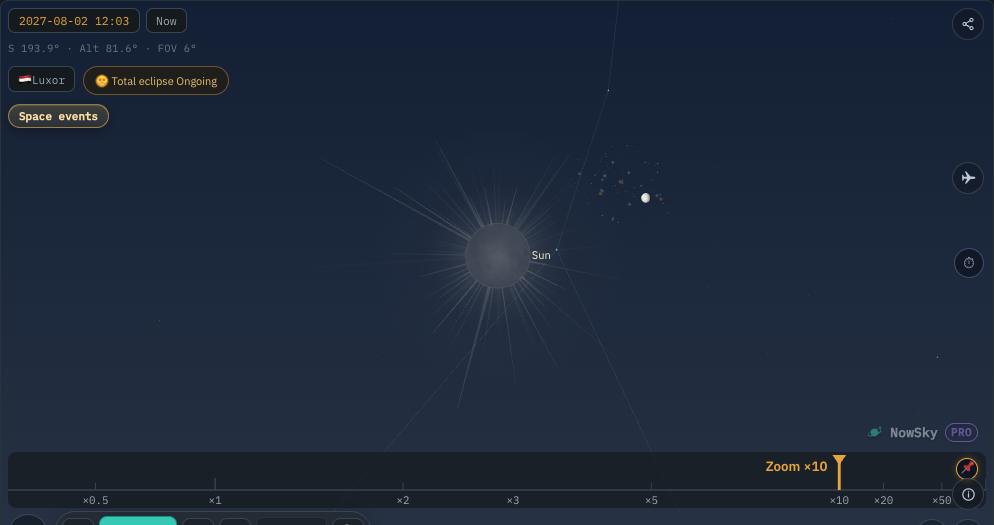
The 2 August 2027 eclipse crosses southern Spain, Morocco, Algeria, Libya, Egypt and Saudi Arabia, with totality lasting about 6 minutes 23 seconds near Luxor, Egypt. In the Southern Hemisphere, the total eclipse of 22 July 2028 crosses Australia and New Zealand, and that of 25 November 2030 crosses Botswana, South Africa and Australia. The total lunar eclipse of 31 December 2028 peaks at about 16:52 UTC and can be seen from Europe, Africa, Asia and Australia. Choosing the 2027 eclipse in the Sky view's event list shows the sky over Luxor at the moment of totality.
Try it in the simulator
- The 2027 total eclipse sky →Shows the sky over Luxor as the Moon covers the Sun on 2 August 2027.
- Tonight's Moon →Shows where tonight's Moon is, with its rise and set times.
- Watch from Earth's orbit →Follows Earth from above as it travels around the Sun.
FAQ
- Can I watch a solar eclipse through sunglasses?
- No. Ordinary sunglasses do not block nearly enough sunlight and can leave your eyes damaged. Use certified eclipse glasses or an indirect method such as a pinhole projector.
- How many solar eclipses happen in a year?
- Between two and five solar eclipses occur worldwide each year, at least one in every eclipse season. Many are partial or fall over oceans and polar regions, so any one place sees far fewer.
- Why do lunar eclipses happen only at full Moon?
- Earth's shadow points directly away from the Sun, and the Moon is in that direction only at full Moon. For the same reason, solar eclipses happen only at new Moon.
Related reading
- Sky news Great total eclipse — 6 minutes over Egypt
- Sky news Total lunar eclipse — New Year blood moon
- Sky news Total solar eclipse — across Sydney
- Object Moon
- Guide Why does the Moon change phase, and when is it best to observe?