Which constellations can you see each season, and why do they change?
The evening constellations change with the seasons because Earth's orbit around the Sun slowly turns our night side toward different parts of the sky. Each star rises about four minutes earlier every day, two hours earlier each month, and returns to the same place at the same clock time after a year. The seasonal names used here follow the Northern Hemisphere; south of the equator the same stars appear in the opposite season.
Earth's orbit turns the night sky
The stars we see at night are the ones on the far side of Earth from the Sun. Over a year Earth goes once around the Sun, and from our viewpoint the Sun drifts eastward through the constellations by a little under one degree per day. Whatever constellation lies behind the Sun is lost in daylight, while the opposite part of the sky rules the night.
The same motion shows up on the clock. One rotation of Earth measured against the stars, the sidereal day, lasts 23 hours 56 minutes 4 seconds, about four minutes shorter than a solar day. So each star rises about four minutes earlier every day, and about two hours earlier after a month. A pattern sitting in the south at 23:00 local time will be there at 21:00 a month later and at 19:00 a month after that. This is why a 'winter' constellation can already be seen before dawn in autumn.
Seasonal labels for the sky are therefore a shorthand for the evening sky, around 21:00 local time. They also depend on the hemisphere. In this guide the season names follow the Northern Hemisphere; observers in Sydney or Cape Town see the same groups in the opposite season, often turned upside down.
Spring: follow the arc to Arcturus
In the northern spring the Big Dipper climbs high in the evening sky. Follow the curve of its handle away from the bowl and you reach Arcturus in Boötes, a bright orange star; continue the same curve and you come to Spica in Virgo. The traditional rhyme is 'arc to Arcturus, then speed on to Spica'. Arcturus, at magnitude −0.05, is the fourth-brightest star in the night sky and lies about 37 light-years away.
Leo sits to the south. The lion's head is a backward question mark of stars, with the bright star Regulus at its base. Arcturus, Spica and Denebola, the star at Leo's tail, form the Spring Triangle. From the Southern Hemisphere these same stars appear in the autumn evening sky, in the north, with Leo standing on its head.
Summer: the Summer Triangle and the Milky Way
On northern summer nights three bright stars form a large triangle high overhead: Vega in Lyra, Altair in Aquila and Deneb in Cygnus. Vega is about 25 light-years away and Altair about 17, but Deneb is a supergiant some 2,600 light-years distant. Shining at a similar brightness from more than a hundred times farther away, it is vastly more luminous than the other two.
Under a dark sky the Milky Way runs through the triangle and down toward the southern horizon, where Scorpius and Sagittarius lie. Antares, the red heart of the scorpion, is easy to recognise by its colour, and Scorpius is best placed around 21:00 in July. Sagittarius marks the direction of the centre of our galaxy, where the Milky Way is broadest and brightest. From London these two constellations stay low in the south; from New York they ride a little higher.
For the Southern Hemisphere this region is the winter sky. From Sydney, Scorpius passes almost overhead on July evenings, and the Milky Way's central bulge is spectacular. The Summer Triangle is still visible there, low in the north.
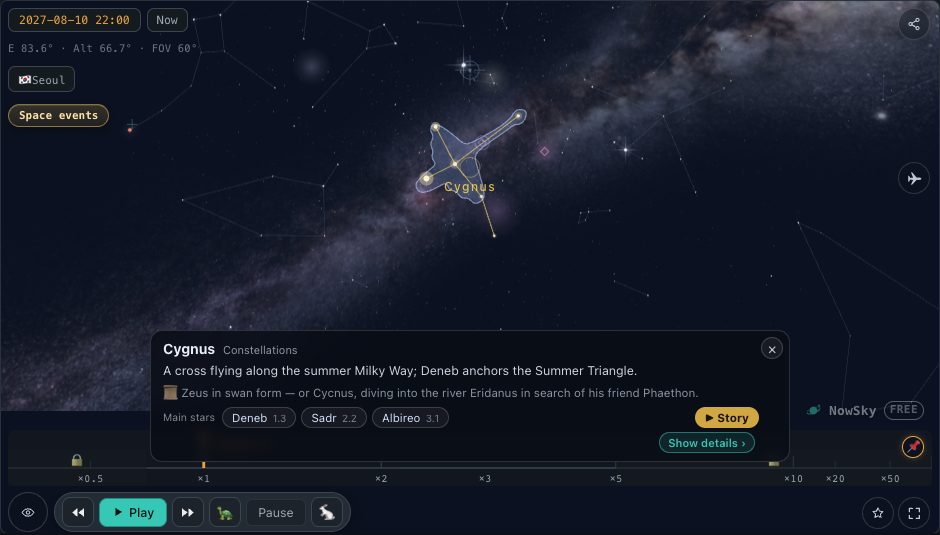 ▶ Open in the simulator
 Autumn: the Great Square and the Andromeda Galaxy
The autumn sky has few bright stars, but one large shape makes a reliable signpost: the Great Square of Pegasus, formed by three stars of Pegasus and Alpheratz in Andromeda. It is best seen around 21:00 in October. Few naked-eye stars lie inside it, so its outline stands out clearly.
From Alpheratz, follow the chain of Andromeda's stars to the northeast to find the Andromeda Galaxy, our large neighbour about 2.5 million light-years away. At magnitude 3.4 it shows to the naked eye on a moonless night as a faint, elongated smudge. Long-exposure photographs show it spreading about six times wider than the full Moon, though the eye picks up only the bright core. High in the north, the W of Cassiopeia is well placed at the same time. Southern observers see the Great Square low in the northern sky in their spring.
Winter: Orion and the Winter Hexagon
The northern winter sky holds more bright stars than any other season. Its centrepiece is Orion, easy to find from the three stars of its belt in a neat row. Betelgeuse at one shoulder is a red supergiant and Rigel at the opposite foot a blue supergiant, so their colours contrast clearly. Below the belt, in Orion's sword, the Orion Nebula shows to the naked eye as a small hazy patch.
Extend the line of the belt to the southeast and you reach Sirius, the brightest star in the night sky; extend it to the northwest and you reach Aldebaran in Taurus. Betelgeuse, Sirius and Procyon form the nearly equilateral Winter Triangle. A wider ring of Rigel, Aldebaran, Capella, Pollux, Procyon and Sirius makes the Winter Hexagon.
Orion straddles the celestial equator, so it is visible from almost everywhere on Earth. In the Southern Hemisphere it is a summer constellation and appears upside down, high in the north; in Australia and New Zealand the belt and sword are known as the Saucepan. There the hexagon is called the summer hexagon and is sometimes extended south to the bright star Canopus.
Year-round stars near the poles
Constellations close to a celestial pole never set; they circle the pole once a day and only their height and tilt change with the season. From the British Isles, Canada and the northern United States, the W of Cassiopeia never sets. The Big Dipper rides high on spring evenings and sinks toward the northern horizon on autumn evenings, just as Cassiopeia climbs high, so one of the two is always well placed for finding Polaris.
In the Southern Hemisphere the equivalent is Crux, the Southern Cross. South of about 34°S it never sets, and it is best placed around 21:00 in May. The two bright stars Alpha and Beta Centauri point to it. From the Northern Hemisphere Crux can be seen only from about 25°N or farther south, low on late spring evenings, so it stays out of view from Europe and most of the United States.
Try it in the simulator
- Find Orion →Select Orion to see on the card when it rises and sets tonight.
- Cygnus and the Summer Triangle →Vega and Altair appear around Cygnus.
- The Great Square →See Andromeda's chain of stars leading off the Square.
- See Leo →Step the date forward to watch its rising time move earlier.
FAQ
- How many constellations are there?
- The International Astronomical Union recognises 88 constellations. Which of them you can see depends on your latitude; some deep southern or northern groups never rise for observers at the other end of the globe.
- Is the Summer Triangle a constellation?
- No. It links bright stars from three different constellations, a kind of pattern called an asterism. The Big Dipper is also an asterism, part of the constellation Ursa Major.
- Why is my birth sign not visible on my birthday?
- A zodiac sign marks the constellation the Sun was passing through around that date, at least as the signs were fixed some 2,000 years ago; precession has since shifted the Sun about one constellation back. Being in the same direction as the Sun, it is hidden in daylight around your birthday and is best seen about six months later.
Related reading
- Object Cygnus
- Object Andromeda Galaxy
- Object Betelgeuse
- Guide How do you find Polaris and true north in the night sky?
- Guide How are sky positions given? Altitude, azimuth, RA and declination